Great Lakes Dunes
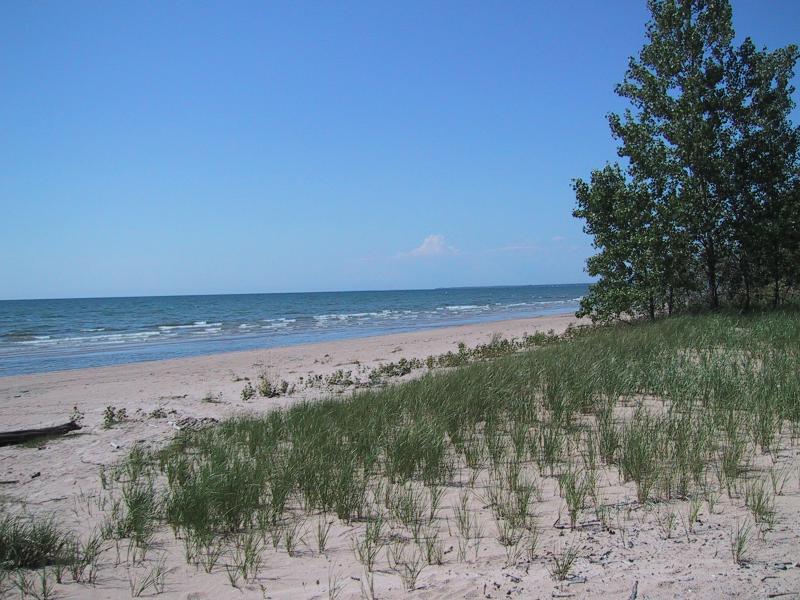
Great Lakes dunes
Adele M. Olivero
- System
- Terrestrial
- Subsystem
- Open Uplands
- State Protection
- Not Listed
Not listed or protected by New York State.
- Federal Protection
- Not Listed
- State Conservation Status Rank
- S1
Critically Imperiled in New York - Especially vulnerable to disappearing from New York due to extreme rarity or other factors; typically 5 or fewer populations or locations in New York, very few individuals, very restricted range, very few remaining acres (or miles of stream), and/or very steep declines.
- Global Conservation Status Rank
- G3G4
Vulnerable globally, or Apparently Secure - At moderate risk of extinction, with relatively few populations or locations in the world, few individuals, and/or restricted range; or uncommon but not rare globally; may be rare in some parts of its range; possibly some cause for long-term concern due to declines or other factors. More information is needed to assign either G3 or G4.
Summary
Did you know?
Most Great Lakes dunes were formed about 4000-6000 years ago, during very high water. They are found along all of the Great Lakes and are the largest freshwater dune ecosystem in the world. The dunes in New York are small examples of much larger ones found in Michigan on Lake Superior that can be seen from outer space. The plants that live on all Great Lakes dunes must be able to withstand large climate variations such as bitter cold winters, summers over 100°F (37°C), and abrasive winds.
State Ranking Justification
There are less than twenty occurrences statewide, and probably not many more historically given that its range is restricted to the eastern shore of Lake Ontario, Lake Erie, and Lake Champlain. Although several documented occurrences have good viability, there are no high quality examples known in the state (i.e., no A- to AB-ranked occurrences). Several dunes are protected on public land or private conservation land. The current trend of this community is declining slightly as a result of shoreline development, invasive species, and recreational overuse.
Short-term Trends
The number and acreage of Great Lakes dunes in New York have probably declined slightly in recent decades as a result of shoreline development and recreational overuse.
Long-term Trends
The number and acreage of Great Lakes dunes in New York have probably declined moderately from historical numbers as a result of shoreline development and artificial lake level management. Specific occurrences have reported substantial declines (e.g., 80% loss of area in one New York site).
Conservation and Management
Threats
Great Lakes dunes are threatened by development (e.g., residential, recreational, shoreline hardening), either directly within the community or in the surrounding landscape. Other threats include habitat alteration (e.g., beach grooming, vegetation removal), and recreational overuse (e.g., ATVs, beach access trails and boardwalks, trash dumping, campgrounds). This community is particurly threatened by activities that alter the natural movement and deposition of sand. ATVs and trampling by visitors kills vegetation, which leads to erosion, and in some cases results in dune "blow-outs." At a larger scale, the artificial management of lake levels may have altered past natural sand deposition patterns. A few Great Lakes dunes are threatened by invasive species, such as buckthorns (Rhamnus cathartica, Frangula alnus), shrubby honeysuckle (Lonicera tartarica), spotted knapweed (Centaurea maculosa), black locust (Robinia pseudo-acacia), purple loosestrife (Lythrum salicaria), and exotic grasses (e.g., Festuca obtusa, F. ovina).
Conservation Strategies and Management Practices
Minimize or avoid habitat alteration within the dunes and surrounding landscape. Prevent recreational overuse. Prevent the spread of invasive exotic species into the dunes through appropriate direct management and by minimizing potential dispersal corridors, such as beach access trails and roads.
Development and Mitigation Considerations
Any development effort that disrupts connectivity between one of the Great Lakes and and the dune system should be avoided (e.g., a road running parallel to the beach between the beach and dunes). This community is best protected as part of a beach, dune, backdune community complex. Development should avoid fragmentation of such systems to allow dynamic ecological processes (overwash, erosion, and migration) to continue. Connectivity to sand beach and backdune communities should be maintained. Connectivity between these habitats is important not only for nutrient flow and seed dispersal, but also for animals that move between them seasonally. Similarly, fragmentation of linear dune systems should be avoided. Bisecting trails, roads, and developments allow exotic species to invade, potentially disrupt physical dune processes.
Inventory Needs
Look for other occurrences along Lake Ontario and check the boundaries of El Dorado and Southwick dunes and confirm their extent.
Research Needs
Research is needed to determine the effect artificial lake level management has had on the natural movement and deposition of sand in this community. Research is needed into the relative proportion of Amophila breviligulata vs. A. champlainensis at these dunes and into their use in dune restoration.
Rare Species
- Ammophila breviligulata ssp. champlainensis (Champlain Beachgrass) (guide)
- Carex houghtoniana (Houghton's Sedge) (guide)
- Cicindela hirticollis (Hairy-necked Tiger Beetle) (guide)
- Cyperus schweinitzii (Schweinitz's Flat Sedge) (guide)
- Cypripedium arietinum (Ram's Head Lady's Slipper) (guide)
- Euxoa pleuritica (Fawn Brown Dart) (guide)
- Geum virginianum (Cream-colored Avens) (guide)
- Hydroprogne caspia (Caspian Tern) (guide)
- Polygonum buxiforme (American Knotweed) (guide)
- Prunus pumila var. pumila (Great Lakes Sand Cherry) (guide)
- Ptelea trifoliata ssp. trifoliata (Wafer-ash) (guide)
- Salix cordata (Sand Dune Willow) (guide)
- Sterna hirundo (Common Tern) (guide)
Range
New York State Distribution
Primarily restricted to the eastern shore of Lake Ontario, with a few small occurrences along the eastern shore of Lake Erie and northwestern Lake Champlain. There may be small sites extant along the south shore of Lake Ontario. The historical range may have extended to this area. New York is at the easternmost end of the range extending west across the Great Lakes shores to eastern Minnesota.
Global Distribution
This community is restricted to the shores of the five Great Lakes and Lake Champlain. This range is estimated to span north to southern Ontario, west to eastern Minnesota, south to Ohio, east to New York, and possibly Vermont.
Best Places to See
- Southwick Beach State Park (Jefferson County)
- Sandy Pond Beach State Unique Area (Oswego County)
- Black Pond Wildlife Management Area, El Dorado Beach Preserve (Jefferson County)
- Hamlin Beach State Park (Monroe County)
- Woodlawn Beach State Park
- Deer Creek Marsh Wildlife Management Area (Oswego County)
Identification Comments
General Description
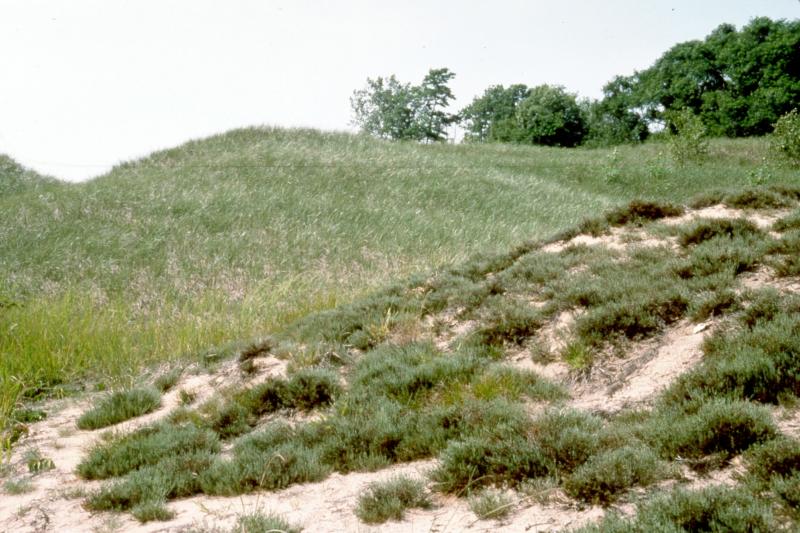
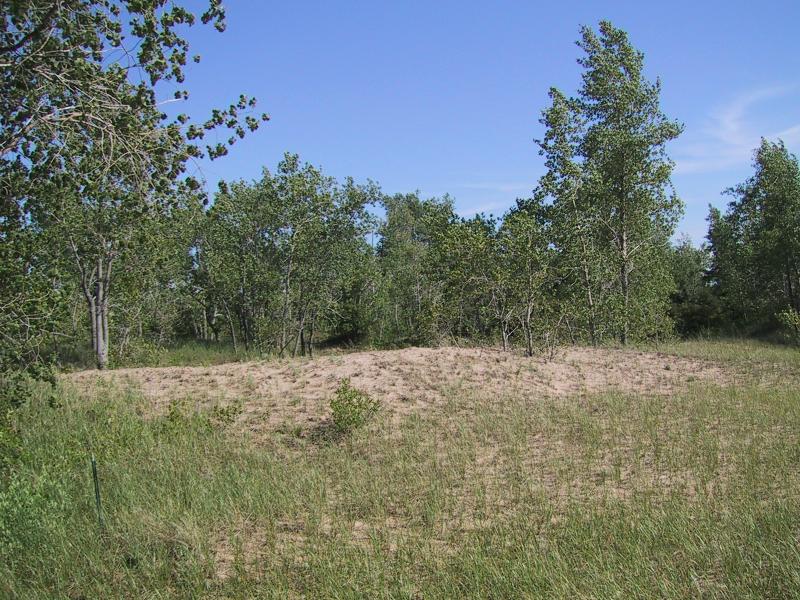
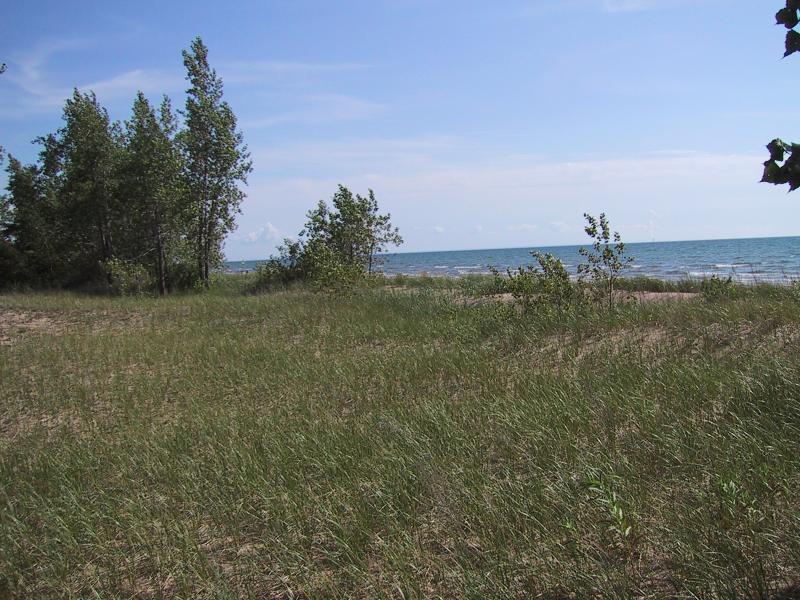
A community dominated by grasses and shrubs that occurs on active and stabilized sand dunes along the shores of the Great Lakes. The composition and structure of the community is variable depending on stability of the dunes, the amount of sand deposition and erosion, and distance from the lake. Unstable dunes are sparsely vegetated, whereas the vegetation of stable dunes is more dense, and can eventually become forested.
Characters Most Useful for Identification
Great Lakes dunes are a grass and shrub dominated community found on wind-deposited sand on the shores of Lake Erie and Lake Ontario. Unstable dunes that are actively being created are often covered with beach grass (Ammophila breviligulata) and open sand areas, or blowouts, are common.
Elevation Range
Known examples of this community have been found at elevations between 100 feet and 610 feet.
Best Time to See
The best time to visit Great Lakes dunes is in the summer, from mid-June to early September, when dune plants are reproductive and the water of the Great Lakes has warmed to a comfortable temperature for swimming.
Great Lakes Dunes Images
Adele M. Olivero
Stephen M. Young
Adele M. Olivero
Adele M. Olivero

Classification
International Vegetation Classification Associations
This New York natural community encompasses all or part of the concept of the following International Vegetation Classification (IVC) natural community associations. These are often described at finer resolution than New York's natural communities. The IVC is developed and maintained by NatureServe.
- American Beachgrass - Beach Pea Grassland (CEGL006274)
- American Beachgrass - (Little Bluestem) Grassland (CEGL005098)
- American Searocket Great Lakes Shore Sparse Vegetation (CEGL005162)
- Eastern Cottonwood - (Eastern Red-cedar) Dune Woodland (CEGL005119)
NatureServe Ecological Systems
This New York natural community falls into the following ecological system(s). Ecological systems are often described at a coarser resolution than New York's natural communities and tend to represent clusters of associations found in similar environments. The ecological systems project is developed and maintained by NatureServe.
- Great Lakes Dune (CES201.026)
Characteristic Species
-
Trees > 5m
- Acer rubrum var. rubrum (common red maple)
- Betula alleghaniensis (yellow birch)
- Fagus grandifolia (American beech)
- Populus deltoides ssp. deltoides (eastern cottonwood)
- Quercus rubra (northern red oak)
-
Shrubs 2 - 5m
- Cornus amomum ssp. amomum (silky dogwood)
- Cornus sericea (red-osier dogwood)
-
Shrubs < 2m
- Prunus pumila var. pumila (Great Lakes sand cherry)
- Salix cordata (sand-dune willow)
-
Vines
- Celastrus scandens (American bittersweet)
- Lathyrus japonicus var. maritimus (beach-pea)
- Toxicodendron radicans ssp. radicans (eastern poison-ivy)
- Vitis riparia (river grape, frost grape)
-
Herbs
- Ammophila breviligulata (beach grass)
- Artemisia campestris ssp. caudata (sand wormwood)
- Avenella flexuosa (common hair grass)
- Cakile edentula var. lacustris (lake sea rocket)
- Centaurea stoebe ssp. micranthos (spotted knapweed)
- Elymus canadensis var. canadensis (Canada wild-rye)
- Euphorbia polygonifolia (northern seaside spurge)
- Maianthemum stellatum (starry Solomon's-seal)
- Polygonum articulatum (northern jointweed)
- Pteridium aquilinum ssp. latiusculum (eastern bracken fern)
- Sporobolus cryptandrus (sand dropseed)
Similar Ecological Communities
- Maritime dunes
(guide)
Martime dunes and Great Lakes dunes share many plant species and experience similar disturbance regimes, but maritime dunes are located on the Atlantic Ocean and are typically much larger due to the strength and duration of ocean winds.
- Sand beach
The sand beach community is directly adjacent to the lake and experiences more frequent wave and ice scouring, whereas maritime dunes are further away from its associated lake and located at a higher elevation than the beach.
Vegetation
Percent cover
This figure helps visualize the structure and "look" or "feel" of a typical Great Lakes Dunes. Each bar represents the amount of "coverage" for all the species growing at that height. Because layers overlap (shrubs may grow under trees, for example), the shaded regions can add up to more than 100%.
Additional Resources
References
Bonanno, Sandra E., Donald J. Leopold, and Lisa R. St. Hiliaire. 1998. Vegetation of a freshwater dune barrier under high and low recreational uses. Journal of the Torrey Botanical Society. 125(1), 1998, pp. 40-50.
Edinger, G. J., D. J. Evans, S. Gebauer, T. G. Howard, D. M. Hunt, and A. M. Olivero (editors). 2014. Ecological Communities of New York State. Second Edition. A revised and expanded edition of Carol Reschke’s Ecological Communities of New York State. New York Natural Heritage Program, New York State Department of Environmental Conservation, Albany, NY. https://www.nynhp.org/ecological-communities/
Edinger, Gregory J., D.J. Evans, Shane Gebauer, Timothy G. Howard, David M. Hunt, and Adele M. Olivero (editors). 2002. Ecological Communities of New York State. Second Edition. A revised and expanded edition of Carol Reschke's Ecological Communities of New York State. (Draft for review). New York Natural Heritage Program, New York State Department of Environmental Conservation. Albany, NY. 136 pp.
New York Natural Heritage Program. 2024. New York Natural Heritage Program Databases. Albany, NY.
Reschke, Carol. 1990. Ecological communities of New York State. New York Natural Heritage Program, New York State Department of Environmental Conservation. Latham, NY. 96 pp. plus xi.
Links
About This Guide
This guide was authored by: Shereen Brock
Information for this guide was last updated on: February 5, 2024
Please cite this page as:
New York Natural Heritage Program. 2024.
Online Conservation Guide for
Great Lakes dunes.
Available from: https://guides.nynhp.org/great-lakes-dunes/.
Accessed April 23, 2024.