Peregrine Falcon
Falco peregrinus Tunstall, 1771
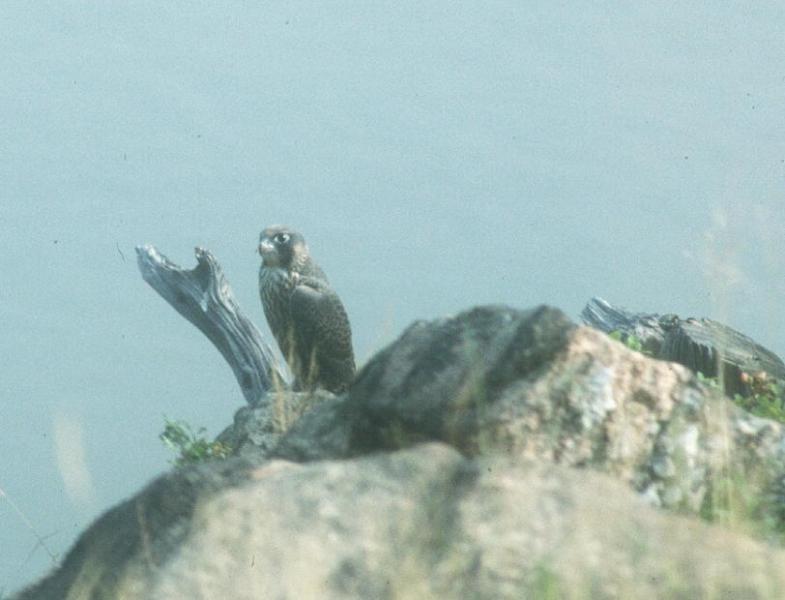
Peregrine Falcon
Jesse W. Jaycox
- Class
- Aves (Birds)
- Family
- Falconidae (Caracaras and Falcons)
- State Protection
- Endangered
Listed as Endangered by New York State: in imminent danger of extirpation in New York. For animals, taking, importation, transportation, or possession is prohibited, except under license or permit. For plants, removal or damage without the consent of the landowner is prohibited.
- Federal Protection
- Migratory Bird Treaty Act
The Migratory Bird Treaty Act implements various treaties and conventions between the U. S. and Canada, Japan, Mexico and the former Soviet Union for the protection of migratory birds. Under this Act, taking, killing, or possessing migratory birds, including nests or eggs, is unlawful unless specifically permitted by other regulations.
- State Conservation Status Rank
- S3B
Vulnerable in New York - Vulnerable to disappearing from New York due to rarity or other factors (but not currently imperiled); typically 21 to 80 populations or locations in New York, few individuals, restricted range, few remaining acres (or miles of stream), and/or recent and widespread declines. (A migratory animal which occurs in New York only during the breeding season.)
- Global Conservation Status Rank
- G4
Apparently Secure globally - Uncommon in the world but not rare; usually widespread, but may be rare in some parts of its range; possibly some cause for long-term concern due to declines or other factors.
Summary
Did you know?
The Peregrine Falcon is the fastest known flying bird. The highest flight speed recorded is 60 mph. They can dive from mid-air at speeds up to 200 mph to attack their prey.
State Ranking Justification
During the 2012 breeding season, 77 territorial pairs were reported in the state. The population has been steadily recovering from extirpation since the first breeding pair was documented in 1983. However, many of the existing pairs, especially in urban areas and on bridges, would fail if it wasn't for intensive management (Loucks 2005). It is too soon to determine if the population is stable. Threats to nesting pairs still exist.
Short-term Trends
After the United States banned DDT in 1972, an effort was made to reintroduce Peregrine Falcons into the northeast. The Peregrine Fund and New York State Department of Environmental Conservation released 168 young falcons in New York State between 1974 and 1988. Falcons were released at more than 12 sites in the state and 123 birds dispersed normally. By 1983, two breeding pairs returned to two sites. Two years later, two historical eyries were re-occupied by breeding pairs. An additional 12 young falcons were released in 1994 (Levine 1998). Peregrine Falcons have made a remarkable recovery in the state with the population growing steadily since 1983. By 1998 there were 38 breeding pairs. In 2003, 49 territorial pairs were known in the state (New York State Department of Environmental Conservation 2003). By 2006, there were 62 territorial pairs in the state (Loucks 2006), and by 2012 there were 77. Because of the recovery success, releases are no longer necessary (New York State Department of Environmental Conservation 2003). Breeding Bird Atlas data also shows an increase in the Peregrine Falcon population with confirmed breeding in four blocks (Andrle and Carroll 1988) compared to 68 confirmed breeding blocks during the second Atlas (McGowan and Corwin 2008). Trend data is not available from the Breeding Bird Survey (Sauer et al. 2007). The Peregrine Falcon range has expanded beyond its previously known range (McGowan and Corwin 2008). However, the future of the Peregrine Falcon in New York State is still uncertain and the population is not considered stable at this time (Levine 1998).
Long-term Trends
Prior to the 1950s, there were 40 known Peregrine Falcon nest sites documented in New York. However, it is not likely that all breeding areas were known. Several factors that contributed to the decline of the Peregrine Falcon population during the first half of the 20th century include habitat loss and human disturbances (Levine 1998). However, the breeding populations disappeared from New York mostly as a result of DDT (and its breakdown product DDE) and PCB poisoning (NatureServe 2003). These chemicals caused eggshell thinning which led to the eggs breaking before hatching. By 1957 there was no successful nesting reported in the state (Bull 1985). After DDT was banned, a recovery effort was launched throughout much of the northeast including New York. Currently, the number of known nests in the state is higher than the number of known nests prior to the 1950s. In addition, most of the historical range has been re-occupied by Peregrine Falcons with the exception of the Finger Lakes area. In fact, the range has expanded. While the recent recovery of the Peregrine Falcon is encouraging, it is still too soon to predict the long term trends.
Conservation and Management
Threats
Threats include habitat disturbance and loss, human activities, poachers robbing nests, shooting by hunters, and contamination effects (Loucks 2005). In some areas, predators such as raccoons and Great Horned Owls may decrease nest success. Human disturbances include building and bridge maintenance and recreational activities such as rock climbing, hiking, and camping near nest sites during the breeding season (NatureServe 2003). In urban areas, the mortality rate may be high due to collisions with skyscrapers and other tall office buildings.
Conservation Strategies and Management Practices
Building and bridge maintenance should be reduced or restricted in nesting areas during the breeding season. Place nest boxes on buildings and bridges where Peregrine Falcons are breeding. Recreational activities such as rock climbing at popular areas during the breeding season should be limited. Develop signs and displays to inform the public of the need to protect and limit disturbances to Peregrine Falcons (Loucks 2005).
Research Needs
Little is known about the mortality rate of Peregrine Falcons in urban areas. Research is needed to compare mortality rates of urban nesting birds to birds nesting in a more natural setting. Combine radio-telemetry studies with field observations to determine essential Peregrine Falcon habitat (Loucks 2005).
Habitat
Habitat
Peregrine Falcons often nest on ledges or holes on the faces of rocky cliffs. They will also nest on manmade structures such as bridges and tall buildings, especially near or in urban areas. Wintering birds frequent buildings, towers, and steeples in urban areas, and open areas with plentiful prey in more natural settings.
Associated Ecological Communities
- Calcareous cliff community
(guide)
A community that occurs on vertical exposures of resistant, calcareous bedrock (such as limestone or dolomite) or consolidated material; these cliffs often include ledges and small areas of talus.
- Cliff community
(guide)
A community that occurs on vertical exposures of resistant, non-calcareous bedrock (such as quartzite, sandstone, or schist) or consolidated material; these cliffs often include ledges and small areas of talus.
- Red cedar rocky summit
(guide)
A community that occurs on warm, dry, rocky ridgetops and summits where the bedrock is calcareous (such as limestone or dolomite, but also marble, amphibolite, and calcsilicate rock), and the soils are more or less calcareous. The vegetation may be sparse or patchy, with numerous lichen covered rock outcrops.
- Shale cliff and talus community
(guide)
A community that occurs on nearly vertical exposures of shale bedrock and includes ledges and small areas of talus. Talus areas are composed of small fragments that are unstable and steeply sloping; the unstable nature of the shale results in uneven slopes and many rock crevices.
- Urban structure exterior
The exterior surfaces of metal, wood, or concrete structures (such as commercial buildings, apartment buildings, houses, bridges) or any structural surface composed of inorganic materials (glass, plastics, etc.) in an urban or densely populated suburban area. These sites may be sparsely vegetated with lichens, mosses, and terrestrial algae; occasionally vascular plants may grow in cracks.
Range
New York State Distribution
The current Peregrine Falcon range includes the Adirondacks, the New York City area on buildings and bridges, the Hudson Valley on bridges and cliffs, and scattered urban sites such as Rochester, Buffalo, Binghamton, and Albany on buildings and bridges. The range has expanded in recent years (McGowan and Corwin 2008). The historical range was slightly different, but still included New York City buildings, the Hudson Valley, and the Adirondacks. Scattered cliff sites in the Finger Lakes Region are also included in the historical range.
Global Distribution
The Peregrine Falcon is a nearly cosmopolitan bird that breeds on every continent except Antarctica. They are absent from high mountains, desert regions of Africa, Asia, and Australia, and from most tropical forests although, occasionally, they reach Hawaii. In North America, much recovery of populations has occurred, but still the large area extending from the western Cascades of Oregon and Washington to the eastern slope of the Big Horn Mountains of Wyoming and Montana and north into the southern provinces of Canada was largely unoccupied as of the early 1990s (The Peregrine Fund 1992 cited in NatureServe 2003).
Best Places to See
- As the Peregrine Falcon is a sensitive species, no sites are listed. Contact local raptor centers to find out if they have any individuals for viewing.
Identification Comments
Identifying Characteristics
A strong face pattern distinguishes Peregrine Falcons from other falcons. Diagnostic field characteristics include a black hood, broad, dark brown wedge below the eye, and pale underparts with spots and dark bars. The nesting area used by Peregrine Falcons is known as an eyrie. Eyries are typically an unlined scrape on a cliff ledge or rocky outcrop. If in similar habitat, they may use abandoned raven or hawk nests. Peregrine Falcons will also choose man-made structures such as bridges and tall buildings. Eggs are cream or buff-colored and covered with red-brown markings. From the eyrie, a repeated "we'chew" can be heard. The alarm call is a harsh, rapid "kak, kak, kak".
Behavior
Peregrine Falcons hunt anytime during the day but they appear to hunt most frequently in the morning and to a lesser extent toward the evening. At the beginning of the breeding season courtship begins with aerial acrobatics, including circling, figure eights, and undulating flights, by both the male and female. Courtship feeding may occur. The average home range has a radius of approximately 5-7.5 miles (8-12 kilometers). The foraging range has a radius of approximately 17 miles (27 kilometers).
Diet
Peregrine Falcons feed primarily on birds ranging in size from medium-size song birds up to small waterfowl. Young birds may also eat insects.
Best Time to See
The best time to observe Peregrine Falcons is at the peak of their breeding season (March-June) when they are more likely to remain close to the nesting site. Fall migrants move along the coast in the greatest numbers in late September to late October.
- Active
- Reproducing
The time of year you would expect to find Peregrine Falcon active and reproducing in New York.
Similar Species
- Merlin (Falco columbarius)
Merlins are smaller than Peregrine Falcons. The black wedge (sideburns) below the eye is smaller.
- Gyrfalcon (Falco rusticolus)
Gyrfalcons are much larger and lack the broad, dark brown wedge (sideburns) below the eye.
- American Kestrel (Falco sparverius)
American Kestrels are much smaller and have a double wedge below the eye.
Peregrine Falcon Images
Jesse W. Jaycox
Taxonomy
Peregrine Falcon
Falco peregrinus Tunstall, 1771
- Kingdom Animalia
- Phylum Craniata
- Class Aves
(Birds)
- Order Falconiformes
(Raptors)
- Family Falconidae (Caracaras and Falcons)
- Order Falconiformes
(Raptors)
- Class Aves
(Birds)
- Phylum Craniata
Additional Resources
References
American Ornithologists' Union (AOU). 1983. Check-list of North American Birds, 6th edition. Allen Press, Inc., Lawrence, Kansas. 877 pp.
Andrle, Robert F. and Janet R. Carroll, editors. 1988. The atlas of breeding birds in New York State. Cornell University Press. 551 pp.
Baker, J.A. 1967. The peregine. 191 pp.
Beauvais, G., J. H. Enderson, and A. J. Magro. 1992. Home range, habitat use and behavior of Prairie Falcons wintering in east-central Colorado. J. Raptor Res. 26:13-18.
Berger, D.D., C.R. Sindelar, Jr. and K.E. Gamble. 1969. The Status Of Breeding Peregrines in the Eastern United States. pp.165-173. In J.J. Hickey (ed). Peregrine Falcon Populations, Their Biology and Decline. Univ Wisconsin Press, Madison. 596 pp.
Bollengier, R.M., JR. (Team Leader). 1979. Eastern Peregrine Falcon Recovery Plan. U.S. Fish and Wildlife Service. 147 pp
Britten, M. W., C. L. McIntyre, and M. Kralovec. Satellite radiotelemetry and bird studies in national parks and preserves. Park Science 15(2):20-24.
Brown, B. T., et al. 1992. Density of nesting peregrine falcons in Grand Canyon National Park, Arizona. Southwestern Naturalist 37:188-193.
Brown, L. and D. Amadon. 1968. Eagles, hawks, and falcons of the world, Vol. 2. Country Life Books. London. 945 pp.
Bull, John. 1974. Birds of New York State. Doubleday, Garden City, New York. 655 pp.
Bull, John. 1985. Birds of New York State. Cornell University Press, Ithaca, New York.
Byrd, M. A., and D. W. Johnston. 1991. Birds. Pages 477-537 in K. Terwilliger, coordinator. Virginia's endangered species: proceedings of a symposium. McDonald and Woodward Publ. Co., Blacksburg, Virginia.
Cade, T. J. 1987. The falcons of the world. Cornell Univ. Press. Ithaca, NY.
Cade, T.J. 1982. The Falcons of the World. Cornell University Press, Ithaca, New York. 192 pp.
Cade, T.J., J.H. Enderson, C.G. Thelander, and C.M. White. 1988. Peregrine Falcon Populations. Their Management and Recovery. The Peregrine Fund: Boise, Idaho. 949 pp., 67 pls.
California Department of Fish and Game (CDF&G). 1990. 1989 annual report on the status of California's state listed threatened and endangered plants and animals. 188 pp.
Campbell, R. W., N. K. Dawe, I. McTaggart-Cowan, J. M. Cooper, G. W. Kaiser, and M. C. McNall. 1990b. The birds of British Columbia. Volume 2. Nonpasserines: diurnal birds of prey through woodpeckers. University of British Columbia Press, Vancouver, B.C. 636 pp.
Chavez-Ramirez, F., G. P. Vose, and A. Tennant. 1994. Spring and fall migration of peregrine falcons from Padre Island, Texas. Wilson Bull. 106:138-145.
Ehrlich, P. R., D. S. Dobkin, and D. Wheye. 1992. Birds in Jeopardy: the Imperiled and Extinct Birds of the United States and Canada, Including Hawaii and Puerto Rico. Stanford University Press, Stanford, California. 259 pp.
Ellis, D. H., and R. L. Glinski. 1988. Population estimates for the peregrine falcon in Arizona: a habitat inventory approach. Pages 191-196 in Glinski et al., eds. Proc. Southwest raptor management symposium and workshop. Nat. Wildl. Fed. Sci. and Tech. Ser. No. 11.
Enderson, J. H. 1964. A study of the Prairie Falcon in the central Rocky Mountain region. Auk 81:332-352.
Evans, D. L. 1982. Status reports on twelve raptors. U.S. Department of the Interior, Fish and Wildlife Service, Special Scientific Report No. 238. 68 pp.
Evers, D. C. 1992. A guide to Michigan's endangered wildlife. Univ. Michigan Press, Ann Arbor. viii + 103 pp.
Fisher, A.K. 1893. The hawks and owls of the United States in their relation to agriculture. Washington U.S. Dept. of Agriculture Bull. no. 6. 210 pp.
Grebence, B. L., and C. M. White. 1989. Physiographic characteristics of peregrine falcon nesting habitat along the Colorado River system in Utah. Great Basin Naturalist 49:408-418.
Harris, J. 1979. The peregrine falcon in Greenland: observing an endangered species. Univ. Missouri Press. 255 pp.
Harrison, C. 1978. A Field Guide to the Nests, Eggs and Nestlings of North American Birds. Collins, Cleveland, Ohio.
Hickey, J.J. 1969. Peregrine falcon populations: their biology and decline. Univ. Wisconsin Press, Madison, WI. 596 pp.
Hickey, J.J. ND. Natural History of the Peregrine Falcon East of the Rockies. Unpublished Manuscript. 178 p.
Holroyd, G. L., and U. Banasch. 1990. The reintroduction of the peregrine falcon, Falco peregrinus anatum, into southern Canada. Canadian Field-Naturalist 104:203-208.
Holroyd, G. L., and U. Banasch. 1995. Trends in peregrine falcon populations in Canada from 1965 to 1990. Bird Trends (Canadian Wildlife Service) (4):11-14.
Hubbard, J. P., and C. G. Schmitt. 1988. Organochlorine residues in avian prey of peregrine falcons breeding in New Mexico. Pages 176-181 in Glinski et al., eds. Proc. Southwest raptor management symposium and workshop. Nat. Wildl. Fed. Sci. and Tech. Ser. No. 11.
Hunt, L. E. 1993. Diet and habitat use of nesting Prairie Falcons (FALCO MEXICANUS) in an agricultural landscape in southern Alberta. MS Thesis, University of Alberta, Edmonton, Alberta. 61 pp.
Johnsgard, P. A. 1990. Hawks, eagles, and falcons of North America. Smithsonian Inst. Press, Washington, D.C. xvi + 403 pp.
Johnson, S. R. and D. R. Herter. 1989. The Birds of the Beaufort Sea. BP Exploration (Alaska) Inc., Anchorage, Alaska. 372 pp.
Johnson, T. H. 1988. Responses of breeding peregrine falcons to human stimuli. Pages 301-305 in Glinski et al., eds. Proc. Southwest raptor management symposium and workshop. Nat. Wildl. Fed. Sci. and Tech. Ser. No. 11.
Johnson, T. H., R. W. Skaggs, and K. E. Skaggs. 1988. Natural breeding performance of the peregrine falcon in New Mexico, 1979-1985. Pages 165-168 in Glinski et al., eds. Proc. Southwest raptor management symposium and workshop. Nat. Wildl. Fed. Sci. and Tech. Ser. No. 11.
Kaufman, J., and H. Meng. 1992. Falcons return: restoring an endangered species. Revised second edition. Available from Peregrine Falcon Foundation, New Paltz, New York. 132 pp.
King, W. B., compiler. 1979. Endangered birds of the world. The International Council for Bird Preservation. Smithsonian Institution Press, Washington, D.C. [Reprinted in handbook form in 1981.]
Lefranc, M. N., Jr., and R. L. Glinski. 1988. Southwest raptor management issues and recommendations. Pages 375-392 in Glinski et al., eds. Proc. Southwest raptor management symposium and workshop. National Wildlife Federation Science and Tech. Ser. No. 11.
Levine, E. 1998. Bull's birds of New York State. Comstock Publishing Associates, Ithaca, NY.
Loucks, B. 1986. New York's peregrine falcon restoration program. Informational pamphlet. New York State Department of Environmental Conservation. Delmar, NY 2pp.
Loucks, B.A. and K. Kogut. 1985. The peregrine returns. Conservationist. 39(5):12-17.
Loucks, Barbara Allen. 2006. New York State Peregrine Falcons 2006.
Loucks, Barbara. 2005. Species group report for peregrine falcon. Pages 134-138 of Appendix A1, Species group reports for birds in: New York State comprehensive wildlife conservation strategy. New York Department of Environmental Conservation. Albany NY.
Martin, M. 1979. Status report on Peregrine Falcon (FALCO PEREGRINUS) in Canada. Report submitted to the Committee on the Status of Endangered Wildlife in Canada (COSEWIC). B.C. Fish and Wildlife Branch, Victoria, BC. 48pp.
Matthews, J.R. and C.J. Moseley (eds.). 1990. The Official World Wildlife Fund Guide to Endangered Species of North America. Volume 1. Plants, Mammals. xxiii + pp 1-560 + 33 pp. appendix + 6 pp. glossary + 16 pp. index. Volume 2. Birds, Reptiles, Amphibians, Fishes, Mussels, Crustaceans, Snails, Insects, and Arachnids. xiii + pp. 561-1180. Beacham Publications, Inc., Washington, D.C.
McGowan, K.J. and K. Corwin, eds. 2008. The Second Atlas of Breeding Birds in New York State: 2000-2005. Cornell University Press, Ithaca, NY. 688 pp.
McNutt, J. W. 1984. A peregrine falcon polymorph: observations of the reproductive behavior of FALCO KREYENBORGI. Condor 86:378-382.
Murphy, J. E. 1990. The 1985-1986 Canadian peregrine falcon, FALCO PEREGRINUS, survey. Canadian Field-Naturalist 104:182-192.
National Geographic Society (NGS). 1983. Field guide to the birds of North America. National Geographic Society, Washington, DC.
NatureServe. 2003. NatureServe Explorer: An online encyclopedia of life [web application]. Version 1.8. NatureServe, Arlington, Virginia. Available http://www.natureserve.org/explorer. (Accessed: January 26, 2004).
New York Natural Heritage Program, New York Department of Environmental Conservation. 2004. Biotics Database. Albany, NY.
New York Natural Heritage Program. 2024. New York Natural Heritage Program Databases. Albany, NY.
New York State Breeding Bird Atlas. 1984. Preliminary species distribution maps, 1980-1984. New York State Department of Environmental Conservation, Wildlife Resources Center. Delmar, NY.
New York State Breeding Bird Atlas. 1985. Final breeding bird distribution maps, 1980-1985. New York State Department of Environmental Conservation, Wildlife Resources Center. Delmar, NY.
New York State Department of Enviromental Conservation. 2003. Peregrine falcon fact sheet. Last updated March 18, 2003. Available at http://www/dec.state.ny.us/website/dfwmr/wildlife.endspec/pefafs/html. (Accessed on January 30, 2004).
New York State Department of Environmental Conservation. 2005. Comprehensive Wildlife Conservation Strategy Planning Database. New York State Department of Environmental Conservation. Albany, NY.
Olsen, P. D., R. C. Marshall, and A. Gaal. 1989. Relationships within the genus FALCO: a comparison of the electrophoretic patterns of feather proteins. Emu 89:193-203.
Pagel, J. E. 1989. Use of explosives to enhance a peregrine falcon eyrie. J. Raptor Res. 23:176-178.
Palmer, R. S., ed. 1988b. Handbook of North American birds. Vol. 5. Yale Univ. Press, New Haven. 465 pp.
Parker, R. C. 1972. Prairie Falcon management in Washington State. Proc. West. Assoc. State Game Fish Comm. 52:394-408.
Parrish, J. R., D. T. Rogers, Jr., and F. P. Ward. 1983. Identification of natal locales of peregrine falcons (FALCO PEREGRINUS) by trace-element analysis of feathers. Auk 100:560-567.
Peakall, D. B. 1990. Prospects for the peregrine falcon, FALCO PEREGRINUS, in the nineties. Canadian Field-Naturalist 104:168-173.
Pendleton, B. A. G., B. A. Millsap, K. W. Cline, and D. M. Bird. 1987. Raptor management techniques manual. National Wildlife Federation, Sci. and Tech. Ser. No. 10. 420 pp.
Porter, R. D. and C. M. White. 1973. Peregrine Falcon in Utah, emphasizing ecology and competition with the Prairie Falcon. Brigham Young University Science Bulletin, Biol. Series 18:1-74.
Porter, R. D., M. A. Jenkins, and A. L. Gaski. 1987. Working bibliography of the peregrine falcon. National Wildlife Federation, Science and Tech. Ser. No. 9. 185 pp.
Raffaele, H. A. 1983a. A guide to the birds of Puerto Rico and the Virgin Islands. Fondo Educativo Interamericano, San Juan, Puerto Rico. 255 pp.
Ratcliffe, D. 1980. The Peregrine Falcon. Buteo Books, Vermillion, South Dakota. 416 pp.
Ratcliffe, D. 1993. The peregrine falcon. Second edition. Academic Press, Inc., San Diego. 454 pp.
Runde, D. E. 1987. Population dynamics, habitat use and movement patterns of the Prairie Falcon (FALCO MEXICANUS). PhD Dissertation, Univ. Wyoming, Laramie. 166 pp.
Sauer, J.R., J.E. Hines, and J. Fallon. 2007. The North American breeding bird survey, results and analysis 1966-2006. Version 10.13.2007. US Geological Survey, Patuxent Wildlife Research Center, Laurel, MD.
Schmutz, J. K., R. W. Fyfe, U. Banasch and H. Armbruster. 1991. Routes and timing of migration of falcons banded in Canada. Wilson Bull. 103:44-58.
Sherrod, S. K. 1983. Behavior of fledgling peregrines. Pioneer Impressions, Fort Collins, Colorado (available from The Peregrine Fund, Inc., Ithaca, New York. xi + 202 pp.
Sherrod, S. K., et al. 1982. Hacking: a method for releasing peregrine falcons and other birds of prey. Secondedition. The Peregrine Fund, Cornell Univ., Ithaca, New York. vi + 61 pp.
Skaggs, R. W., et al. 1988. Peregrine falcon. Pages 127-136 in Glinski et al., eds. Proc. Southwest raptor management symposium and workshop. Natural Wildlife Fed. Science and Tech. Ser. No. 11.
Squires, J. R. 1986. Movements, food habits, and productivity for a small population of Prairie Falcon utilizing oil developed lands, Campbell County, Wyoming. MS Thesis, Univ. Wyoming, Laramie. 185 pp.
Steenhof, K. 1998. Prairie Falcon (Falco mexicanus). In A. Poole and F. Gill, editors, The Birds of North America, No. 346. The Birds of North America, Inc., Philadelphia, PA. 28 pp.
Steidl, R. J., et al. 1991c. Reproductive success and eggshell thinning of a reestablished peregrine falcon population. J. Wildlife Management 55:294-299.
Terres, J. K. 1980. The Audubon Society encyclopedia of North American birds. Alfred A. Knopf, New York.
The Peregrine Fund. 1992. Peregrine falcon recovery program: status and reommendations. Unpublished report.
Titus, K., and M. R. Fuller. 1990. Recent trends in counts of migrant hawks from northeastern North America. Journal of Wildlife Management 54:463-470.
U.S. Fish and Wildlife Service (USFWS). 1980. Selected vertebrate endangered species of the seacoast of the United States - American peregrine falcon. FWS/OBS-80/01.57, Slidell.
U.S. Fish and Wildlife Service (USFWS). 1980. Selected vertebrate endangered species of the seacoast of the United States - Arctic peregrine falcon. FWS/OBS-80/01.51, Slidell.
U.S. Fish and Wildlife Service (USFWS). 1990. Endangered and threatened species recovery program: report to Congress. 406 pp.
U.S. Fish and Wildlife Service (USFWS). 1991. Request for information on the Arctic and American peregrine falcons. Federal Register 56(113):26969-26971.
U.S. Fish and Wildlife Service (USFWS). 1994. Removal of arctic peregrine falcon from the list of endangered and threatened wildlife. Federal Register 59(192):50796-50805. 5 October 1994.
White, C. M. and D. G. Roseneau. 1970. Observations on food, nesting, and winter populations of large North American falcons. Condor 72:113-115.
White, C. M., R. W. Fyfe, and D. B. Lemon. 1990. The 1980 North American peregrine falcon, FALCO PEREGRINUS, survey. Canadian Field-Naturalist 104:174-181.
Links
About This Guide
Information for this guide was last updated on: June 29, 2019
Please cite this page as:
New York Natural Heritage Program. 2024.
Online Conservation Guide for
Falco peregrinus.
Available from: https://guides.nynhp.org/peregrine-falcon/.
Accessed April 25, 2024.