Clay-colored Sparrow
Spizella pallida (Swainson, 1832)
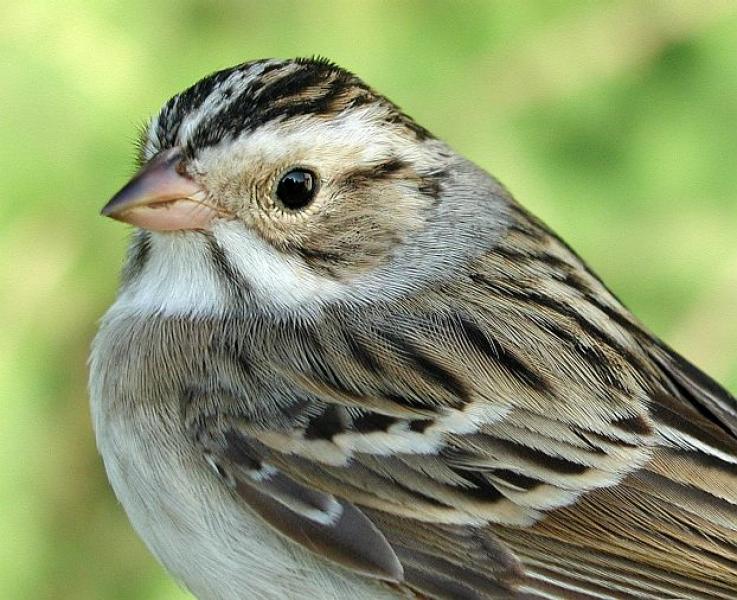
Clay-colored Sparrow
www.powdermill.org
- Class
- Aves (Birds)
- Family
- Passerellidae
- State Protection
- Protected Bird
Defined as a Protected Bird by New York State law, and the species may not be hunted or taken at any time in New York. Includes birds also defined as a game species, but for which no open seasons are set.
- Federal Protection
- Migratory Bird Treaty Act
The Migratory Bird Treaty Act implements various treaties and conventions between the U. S. and Canada, Japan, Mexico and the former Soviet Union for the protection of migratory birds. Under this Act, taking, killing, or possessing migratory birds, including nests or eggs, is unlawful unless specifically permitted by other regulations.
- State Conservation Status Rank
- S3S4B
Vulnerable in New York, or Apparently Secure – Vulnerable to disappearing from New York (but not currently imperiled), with relatively few populations or locations, few individuals, and/or restricted range; or uncommon but not rare in New York; may be rare in some parts of the state; possibly some cause for long-term concern due to declines or other factors. More information is needed to assign either S3 or S4. (A migratory animal which occurs in New York only during the breeding season.)
- Global Conservation Status Rank
- G5
Secure globally - Common in the world; widespread and abundant (but may be rare in some parts of its range).
Summary
Did you know?
Clay-colored Sparrows have been known to breed with Chipping Sparrows.
State Ranking Justification
Clay-colored Sparrows have been expanding their range from eastern Canadian provinces into New York State. Breeding Bird Atlas data reports that the number of probable and confirmed blocks has increased from 23 in the mid-1980s to 49 from 2000 to 2005 (Andrle and Carroll 1988, McGowan and Corwin 2008). While the Clay-colored Sparrow population in New York appears to be increasing, breeding is rarely established at one location and populations may not be stable as suitable habitat converts to woodlands.
Short-term Trends
During the first Breeding Bird Atlas, Clay-colored Sparrows were reported in 23 blocks from 1980 to 1985 with 12 blocks recorded as probable or confirmed breeding (Andrle and Carroll 1988). This species was reported in 67 blocks during the second Breeding Bird Atlas (2000-2005) with 49 blocks reported as probable or confirmed breeding (McGowan and Corwin 2008). When comparing probable and confirmed breeding blocks from both atlases, it appears that the breeding population may have quadrupled. In addition, the range has expanded from 14 counties to 30 counties in New York between the two atlases. The increase is most likely due to the increasing conversion of cropland to shrubland in the state. Breeding Bird Survey data are too sparse in New York to determine trends (Sauer et al. 2007).
Long-term Trends
The first breeding record for Clay-colored Sparrow is from 1970 at Ithaca in Tompkins County. Since then, the population has been increasing in New York. While breeding rarely occurs at the same location on a regular basis, they are likely established breeders in many counties. Breeding Bird Survey Data was not abundant enough to determine trends (Sauer et al. 2007).
Conservation and Management
Threats
The main threat to Clay-colored Sparrows in New York is loss of suitable habitat through succession. There are many areas in the state where farming has declined allowing for old farm fields to succeed to a shrub habitat. This has resulted in what is likely a temporary increase in suitable breeding habitat. However, without management, succession will continue and suitable shrubby areas will eventually decline. Brood parasitism by Brown-headed Cowbirds is another potential threat.
Conservation Strategies and Management Practices
Efforts should be made to maintain habitat so that shrubs persist in areas where Clay-colored Sparrows breed. Management may include mowing or burning in patches or light grazing. Allow grasslands to remain idle to promote shrubby vegetation growth. While Clay-colored Sparrows readily use cropland to forage, they do not for nesting. It is important to retain or promote brushy edges along cropland edges for nesting (NatureServe 2007).
Research Needs
Additional research is needed to determine the percentage of time Clay-colored Sparrows are breeding with Chipping Sparrows.
Habitat
Habitat
In New York, breeding Clay-colored Sparrows are typically found in abandoned agricultural land that has been invaded by shrubs and saplings, young conifer plantations, and regenerating clear-cuts (Carroll and Andrle 1988, McGowan and Corwin 2008). Areas with scattered shrubs or small trees interspersed with grassy or weedy openings seem to be preferred. In western parts of the state, young conifer tree plantations are used more often. To the north, sandy pine barrens habitat is more likely to be occupied by breeding birds. Idle or lightly grazed grasslands with low shrubs are used in other parts of the state.
Associated Ecological Communities
- Brushy cleared land
A former forest, woodland, or shrubland that has been clearcut or cleared by brush-hog. The cut stumps of trees and shrubs are evident and usually common. There may be a lot of woody debris such as branches and slashings from trees that were logged. Vegetation is patchy, with scattered herbs, shrubs, and tree saplings.
- Calcareous pavement woodland
(guide)
An open canopy woodland that occurs on very shallow soils over flat, striated outcrops of calcareous bedrock (limestone and dolomite).
- Conifer plantation
A stand of softwoods planted for the cultivation and harvest of timber products, or to provide wildlife habitat, soil erosion control, windbreaks, or landscaping. This is a broadly defined community that excludes stands in which pine, spruce, or fir are dominant. Softwoods that are typically planted in these plantations include European larch, Japanese larch, and northern white cedar.
- Pastureland
Agricultural land permanently maintained (or recently abandoned) as a pasture area for livestock.
- Pine plantation
A stand of pines planted for the cultivation and harvest of timber products, or to provide wildlife habitat, soil erosion control, windbreaks, or landscaping. Pines that are typically planted in New York include white pine, red pine, Scotch pine, pitch pine, and jack pine.
- Successional old field
A meadow dominated by forbs and grasses that occurs on sites that have been cleared and plowed (for farming or development), and then abandoned or only occasionally mowed.
- Successional shrubland
A shrubland that occurs on sites that have been cleared (for farming, logging, development, etc.) or otherwise disturbed. This community has at least 50% cover of shrubs.
Associated Species
- Chipping Sparrow (Spizella passerina)
Range
New York State Distribution
Breeding Clay-colored Sparrows are found in patchy locations throughout New York State excluding Long Island and high elevations of the Catskills and Adirondacks. Migrants have been reported on Long Island in addition to breeding locations.
Global Distribution
Breeding Clay-Colored Sparrows are found from southern MacKenzie and eastern British Columbia east to central Ontario south to eastern Washington, central Montana, southeastern Wyoming, eastern Colorado, western Kansas, southern Nebraska, northern Iowa, southern Wisconsin, central, southeastern Michigan (AOU 1983, Knapton 1994) and New York, excluding Long Island. Non-breeding Clay-colored Sparrows are found southern Baja California, northern mainland of Mexico, and central Texas south to Veracruz, Oaxaca, and Chiapas, in highlands. Casual to western Guatemala (AOU 1983, Knapton 1994).
Best Places to See
- Lyme (Jefferson County)
Identification Comments
Identifying Characteristics
The Clay-colored Sparrow is a small sparrow with a notched tail. Underparts are buff to gray with a brown rump. Wings are streaked with 2 white wing bars. There is a gray band across the nape of the neck splitting the streaked head and neck. Sexes are similar. During the breeding season, plumage differs in that there is a white eye stripe, a dark cheek line that includes a distinctive moustache, and a white throat patch with dark bars dividing the patch into three segments in males. Nests are fairly compact and cup-shaped. Typically, nests are woven grasses that are lined with finer grasses, rootlets, and animal hair that are usually in a low shrub or tree. Vocalizations are a series of two to eight low, flat buzzes that can be easily mistaken for an insect.
Best Time to See
The best time to observe Clay-colored Sparrows is during the breeding season when the males are maintaining territories from late May to early July. They may be observed migrating until the end of November.
- Active
- Reproducing
The time of year you would expect to find Clay-colored Sparrow active and reproducing in New York.
Similar Species
- Chipping Sparrow (Spizella passerina)
Chipping Sparrows have a darker face pattern and no moustache. Clay-colored Sparrows have a brown rump.Typically, Clay-colored Sparrows are smaller and have smaller bills than Chipping Sparrows.
Clay-colored Sparrow Images
www.powdermill.org
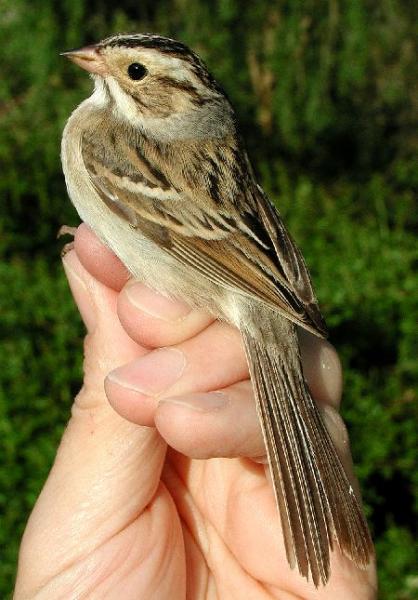
www.powdermill.org
Taxonomy
Clay-colored Sparrow
Spizella pallida (Swainson, 1832)
- Kingdom Animalia
- Phylum Craniata
- Class Aves
(Birds)
- Order Passeriformes
(Perching Birds)
- Family Passerellidae
- Order Passeriformes
(Perching Birds)
- Class Aves
(Birds)
- Phylum Craniata
Additional Resources
References
American Ornithologists' Union (AOU). 1983. Check-list of North American Birds, 6th edition. Allen Press, Inc., Lawrence, Kansas. 877 pp.
Andrle, Robert F. and Janet R. Carroll, editors. 1988. The atlas of breeding birds in New York State. Cornell University Press. 551 pp.
Bull, John. 1974. Birds of New York State. Doubleday, Garden City, New York. 655 pp.
Carter, M., C. Hunter, D. Pashley, and D. Petit. 1998. The Watch List. Bird Conservation, Summer 1998:10.
Carter, M., G. Fenwick, C. Hunter, D. Pashley, D. Petit, J. Price, and J. Trapp. 1996. Watchlist 1996: For the future. Field Notes 50(3):238-240.
Dodge, A. G., A. J. Fry, R. C. Blackwell, and R. M. Zink. 1995. Comparison of phylogenies derived from two molecular data sets in the avian genera PIPILO and SPIZELLA. Wilson Bulletin 107:641-654.
Harrison, C. 1978. A Field Guide to the Nests, Eggs and Nestlings of North American Birds. Collins, Cleveland, Ohio.
Johnson, R.G., and S.A. Temple. 1990. Nest predation and brood parasitism of tallgrass prairie birds. Journal of Wildlife Management 54:106-111.
Knapton, R.W. 1994. Clay-colored Sparrow (SPIZELLA PALLIDA). In A. Poole and F. Gill, editors, The Birds of North America, No. 120. Academy of Natural Sciences, Philadelphia, and American Ornithologists' Union, Washington, DC. 16 pp.
McGowan, K.J. and K. Corwin, eds. 2008. The Second Atlas of Breeding Birds in New York State: 2000-2005. Cornell University Press, Ithaca, NY. 688 pp.
Munson, E. S. 1992. Influence of nest cover on habitat selection in clay-colored sparrows. Wilson Bull. 104:525-529.
New York Natural Heritage Program. 2024. New York Natural Heritage Program Databases. Albany, NY.
New York State Department of Environmental Conservation. Checklist of the amphibians, reptiles, birds, and mammals of New York State, including their protective status. Nongame Unit, Wildlife Resources Center, Delmar, NY.
Pylypec, B. 1991. Impacts of fire on bird populations in a fescue prairie. Can. Field-Nat. 105:346-349.
Terres, J. K. 1980. The Audubon Society encyclopedia of North American birds. Alfred A. Knopf, New York.
Zink, R. M., and D. L. Dittmann. 1993b. Population structure and gene flow in the chipping sparrow and a hypothesis for evolution in the genus SPIZELLA. Wilson Bull. 105:399-413.
Links
About This Guide
Information for this guide was last updated on: December 31, 2007
Please cite this page as:
New York Natural Heritage Program. 2024.
Online Conservation Guide for
Spizella pallida.
Available from: https://guides.nynhp.org/clay-colored-sparrow/.
Accessed April 25, 2024.