Henslow's Sparrow
Ammodramus henslowii (Audubon, 1829)
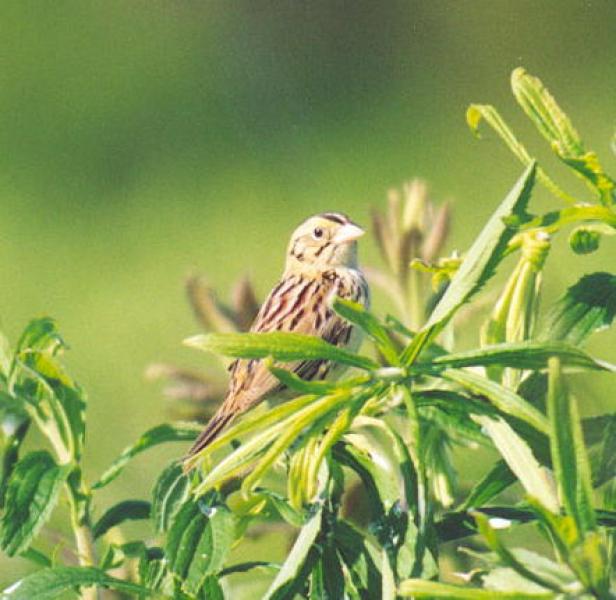
Henslow's Sparrow
Patricia L. Nelson
- Class
- Aves (Birds)
- Family
- Passerellidae
- State Protection
- Threatened
Listed as Threatened by New York State: likely to become Endangered in the foreseeable future. For animals, taking, importation, transportation, or possession is prohibited, except under license or permit. For plants, removal or damage without the consent of the landowner is prohibited.
- Federal Protection
- Migratory Bird Treaty Act
The Migratory Bird Treaty Act implements various treaties and conventions between the U. S. and Canada, Japan, Mexico and the former Soviet Union for the protection of migratory birds. Under this Act, taking, killing, or possessing migratory birds, including nests or eggs, is unlawful unless specifically permitted by other regulations.
- State Conservation Status Rank
- S3B
Vulnerable in New York - Vulnerable to disappearing from New York due to rarity or other factors (but not currently imperiled); typically 21 to 80 populations or locations in New York, few individuals, restricted range, few remaining acres (or miles of stream), and/or recent and widespread declines. (A migratory animal which occurs in New York only during the breeding season.)
- Global Conservation Status Rank
- G4
Apparently Secure globally - Uncommon in the world but not rare; usually widespread, but may be rare in some parts of its range; possibly some cause for long-term concern due to declines or other factors.
Summary
Did you know?
John James Audubon named the Henslow's Sparrow in honor of his good friend John Stevens Henslow, a professor of botany at Cambridge and teacher of Charles Darwin.
State Ranking Justification
There is evidence of a significant decline across the species' range and there has been a loss of grassland habitats in New York State in recent years. Breeding Bird Survey data show a possible decline of 18.7% per year between 1980 and 2006 in New York (Sauer et al. 2007). When comparing data from the first and second breeding bird atlases, an 80% decrease is noted with Henslow's sparrows reported in 348 blocks (Andrle and Carroll 1988) and 70 blocks (McGowan and Corwin 2008), respectively. McGowan and Corwin (2008) describe this decline as "the largest proportional decline in any formerly common species in the Atlas."
Short-term Trends
As with most grassland birds in the last few decades, Henslow's Sparrow populations have been significantly declining. Analyzed Breeding Bird Survey data from New York showed that the population may have declined by as much as 18.7% per year between 1980 and 2006 (Sauer et al. 2007). During the first Breeding Bird Atlas (1980-1985), Henslow's Sparrows were found in 348 blocks. Two-hundred thirteen of those blocks were reported with probable or confirmed breeding (Andrle and Carroll 1988). The second Breeding Bird Atlas reported 70 blocks with Henslow's Sparrows. Probable or confirmed breeding was reported in 57 of those blocks (McGowan and Corwin 2008). Areas in New York where Henslow's Sparrows are persisting rely on human disturbances to maintain the grassland habitat. For example, farming practices and military practices at the Fort Drum Military Reservation have maintained the grassland habitat in Jefferson County. However, there are areas where Henslow's Sparrows are no longer found, indicating possible habitat changes range wide (McGowan and Corwin 2008). Even with the recent declines, it is possible that Henslow's Sparrows are more abundant and widespread in New York now than they were in the early 1900s (Levine 1998).
Long-term Trends
Henslow's Sparrows were first documented in New York in 1844 on Long Island. It is not known if Henslow's Sparrows were found in New York prior to European settlement but, there were probably areas with suitable habitat such as wet meadows (Levine 1998). After European settlement, the landscape of New York began to change with forests being logged and cleared for farming. In the early 1900s, they were considered a local breeder that was uncommon or rare in the state. Between the 1920s and 1940s Henslow's Sparrow populations appeared to be increasing as they were reported from many new locations. Then, as early as the 1950s, reports became less frequent and they were no longer found on the south shore of Long Island (Andrle and Carroll 1988). Analysis of Breeding Bird Survey data from 1966-2006 for New York show that Henslow's Sparrow populations appear to be decreasing at a rate of approximately 12.1% per year (Sauer et al. 2007).
Conservation and Management
Threats
The most significant threat to Henslow's Sparrows is the loss of suitable grassland habitat. Economic factors have affected the viability of farms in New York. Many farmers have intensified their farming practices, converted hayfields to row crops, or abandoned farming altogether (Andrle and Carroll 1988, Post 2004, McGowan and Corwin 2008). Remaining hayfields are often mowed earlier and more frequently to increase production. As a result, the mortality rate of young in those fields is high and sometimes adults are killed during mowing. As farms are abandoned they are lost to development or the land reverts to shrublands and forests. Grasslands are becoming more scattered and isolated, reducing connectivity (Post 2004). Wetland loss is also a threat because this species often nests in nearby damp or wet meadows. As wetlands are drained for development any associated wet meadows are also lost (Andrle and Carroll 1988).
Conservation Strategies and Management Practices
Management practices and restoration may be necessary to preserve remaining grassland habitat for this species in New York. Several strategies could be used to preserve and protect grassland habitat for this species. Identify public lands with Henslow's Sparrow populations where management may be more easily implemented. Develop education and outreach programs in areas where Henslow's Sparrows persist that are aimed at grassland management and preservation. Implementing a program in New York similar to the Conservation Reserve Program, would likely be beneficial to Henslow's Sparrow populations and many other grassland birds.
This species prefers large fields that have grasses that are at least 30 cm high (NatureServe 2019). Management strategies include mowing, burning, and grazing grasslands that ideally would be greater than 30 contiguous hectares (NatureServe 2019). If that is not an option, then a complex of smaller grasslands that are near each other should allow for birds to move between sites (Herkert 1998). Mowing and burning should be done in the spring, before birds arrive, or in the fall after migration has started. A rotational schedule is recommended because the habitat will not be suitable again for one or two growing seasons after treatment (Herkert 1998). Woody vegetation should be removed when it reaches the height of the herbaceous vegetation (Herkert 1998). Some research in New York has suggested that Henslow’s Sparrows do not have the same habitat requirements in the east as other regions. Smith and Smith (1990) found that birds preferred areas with high productivity, high annual growth, and tolerate grazing with the removal of up to 60% of the annual productivity of herbaceous biomass.
Research Needs
The effects of certain farming practices on breeding populations should be evaluated. For instance, it would be beneficial to determine how different mowing frequencies and how different intensities of grazing affect Henslow's Sparrow populations. Some studies have suggested that populations in the east may have different habitat requirements than other locations (NatureServe 2019). It would also be beneficial to know how mowing versus prescribed burning affects populations.
Habitat
Habitat
The Henslow's Sparrow is a grassland species, preferring tall, dense, grassy fields without woody vegetation. Wet grasslands are also used. Peterson (1983) found them in large, ungrazed fields with a variety of moisture regimes and without woody invasion. They were also found on hilltops. Bull (1974) described their habitat preference in New York as "grassy fields and meadows with scattered bushes and herbaceous plants, both in wet and dry situations." They can tolerate lightly to moderately grazed pastures (NatureServe 2005).
Associated Ecological Communities
- Cropland/field crops
An agricultural field planted in field crops such as alfalfa, wheat, timothy, and oats. This community includes hayfields that are rotated to pasture.
- Hempstead Plains grassland*
(guide)
A tall grassland community that occurs on rolling outwash plains in west-central Long Island. This community occurs inland, beyond the influence of offshore winds and salt spray.
- Maritime grassland*
(guide)
A grassland community that occurs on rolling outwash plains of the glaciated portion of the Atlantic coastal plain, near the ocean and within the influence of offshore winds and salt spray.
- Pastureland
Agricultural land permanently maintained (or recently abandoned) as a pasture area for livestock.
- Sedge meadow*
(guide)
A wet meadow community that has organic soils (muck or fibrous peat). Soils are permanently saturated and seasonally flooded. The dominant herbs must be members of the sedge family, typically of the genus Carex.
- Successional old field
A meadow dominated by forbs and grasses that occurs on sites that have been cleared and plowed (for farming or development), and then abandoned or only occasionally mowed.
* probable association but not confirmed.
Range
New York State Distribution
In New York State, Henslow's Sparrow populations occur in central and western New York and in a few locations in the Hudson River Valley. Currently, the largest populations are found in Jefferson County. During the first Breeding Bird Atlas (1980-1985), Henslow's sparrows were reported as probable or confirmed breeders in 213 blocks. The Breeding Bird Atlas 2000 reported probable and confirmed breeding in 57 blocks (McGowan and Corwin 2008), indicating a sharp decline in breeding birds. According to Breeding Bird Atlas 2000 data and the New York Natural Heritage Database, Henslow's sparrows are no longer found in the following counties: Broome, Cortland, Delaware, Fulton, Herkimer, Madison, Oneida, Onondaga, Otsego, Saratoga, Schenectady, Schoharie, St. Lawrence, Tioga, and Wayne (McGowan and Corwin 2008, New York Natural Heritage Program 2005).
Global Distribution
Breeding: Henslow's Sparrows breed locally from southeastern South Dakota (at least formerly), across the Great Lakes region of the eastern U.S. (southeastern Minnesota, north-central Wisconsin, northern Michigan) and southern Canada (southern Ontario, formerly southern Quebec) to New England and New York, south to central Kansas, northeastern Oklahoma, southwestern and central Missouri, southern Illinois, northern Kentucky, central West Virginia, eastern Virginia, northern Tennessee, and central and eastern North Carolina. Formerly the breeding range included eastern Texas. Non-breeding: Outside of the breeding season Henslow's Sparrows are found in coastal states from South Carolina south to Florida, west to Texas, casually north to Illinois, Indiana, New England, and Nova Scotia (Smith 1992 cited in NatureServe 2005, AOU 1998 cited in NatureServe 2005).
Best Places to See
- Dog Hill Road near Perch River Wildlife Management Area (Jefferson County)
Identification Comments
Identifying Characteristics
Henslow's Sparrows can be identified by the large, flat head, large gray bill, and short tail. Wings are reddish. The head, nape, and most of the central crown are olive-colored. Sexes are similar, but can be determined in hand during the breeding season by the cloacal protuberance in males and brood patch in females. Henslow's Sparrows fly low and jerkily with a twisting motion of the tail. Juveniles are clay-colored above and their head and back are streaked with black. They are a faint yellow below with traces of buff on the throat and chin. Typically, the sides of the throat are unstreaked, but streaking can be found on some individuals. Nests are found on or near the ground and can be either open or dome-shaped. When nests are built off the ground, they are attached to grasses or forbs. Nests are loosely woven with dead grass and lined with finer grasses and hair. Vocalizations are described as a short, quiet "see-lick" or a hiccupping "tsi-lick." Calls can sometimes be heard on quiet summer nights. Henslow's sparrows are shy and secretive. Typically, they are heard rather than seen. Therefore, it is important to be able to identify this species by its song, especially for census and survey work.
Characters Most Useful for Identification
Henslow's Sparrow has a large, flat head; large, gray bill; and a short tail. Vocalizations are a quiet "see-likc" or hiccupping "tsi-lick."
Best Life Stage for Proper Identification
Observations of adults or vocalizations are the best way to identify Henslow's Sparrow.
Behavior
This bird perches on the tops of weed stalks to sing. When flushed, it flies low, short distances before dropping into the weeds.
Diet
Henslow's Sparrows eat insects, mostly grasshoppers and beetles. Seeds are consumed during the winter months.
Best Time to See
Henslow's Sparrows are most often observed or heard during the peak of their breeding season between mid-June and mid-July. They are more likely to be heard rather than seen. Sometimes they are heard calling on quiet summer nights.
- Active
- Reproducing
The time of year you would expect to find Henslow's Sparrow active and reproducing in New York.
Similar Species
- Grasshopper Sparrow (Ammodramus savannarum)
(guide)
Young Henslow's Sparrows practically lack breast streaks thus the similar appearance to adult Grasshopper Sparrows.
Henslow's Sparrow Images
Patricia L. Nelson
Taxonomy
Henslow's Sparrow
Ammodramus henslowii (Audubon, 1829)
- Kingdom Animalia
- Phylum Craniata
- Class Aves
(Birds)
- Order Passeriformes
(Perching Birds)
- Family Passerellidae
- Order Passeriformes
(Perching Birds)
- Class Aves
(Birds)
- Phylum Craniata
Additional Resources
References
American Ornithologists' Union (AOU). 1983. Check-list of North American Birds, 6th edition. Allen Press, Inc., Lawrence, Kansas. 877 pp.
American Ornithologists' Union (AOU). 1998. Check-list of North American birds. Seventh edition. American Ornithologists' Union, Washington, D.C. [as modified by subsequent supplements and corrections published in The Auk]. Also available online: http://www.aou.org/.
Andrle, Robert F. and Janet R. Carroll, editors. 1988. The atlas of breeding birds in New York State. Cornell University Press. 551 pp.
Bajema, R. A., T. L. DeVault, P. E. Scott, and S. L. Lima. 2001. Reclaimed coal mine grasslands and their significance for Henslow's Sparrows in the American Midwest. Auk 118:422-431.
Bent, A.C., et al. 1968. Life histories of North American cardinals, grosbeaks, buntings, towhees, finches, sparrows, and allies. Part Two. U.S. National Museum Bulletin 237. (reprinted by Dover Publications, Inc., New York, NY).
Bull, John. 1974. Birds of New York State. Doubleday, Garden City, New York. 655 pp.
Byrd, M. A., and D. W. Johnston. 1991. Birds. Pages 477-537 in K. Terwilliger, coordinator. Virginia's endangered species: proceedings of a symposium. McDonald and Woodward Publ. Co., Blacksburg, Virginia.
Carter, M., C. Hunter, D. Pashley, and D. Petit. 1998. The Watch List. Bird Conservation, Summer 1998:10.
Carter, M., G. Fenwick, C. Hunter, D. Pashley, D. Petit, J. Price, and J. Trapp. 1996. Watchlist 1996: For the future. Field Notes 50(3):238-240.
Ehrlich, P. R., D. S. Dobkin, and D. Wheye. 1992. Birds in Jeopardy: the Imperiled and Extinct Birds of the United States and Canada, Including Hawaii and Puerto Rico. Stanford University Press, Stanford, California. 259 pp.
Figg, D. E. 1991. Missouri Department of Conservation Annual Nongame and Endangered Species Report July 1990 - June 1991. ii + 35 pp.
Flanigan, A. B. 1975. Banding of nestling Henslow's sparrows. Inland Bird-Banding News 47:136-9.
Graber, J. W. 1968. PASSERBERBULUS HENSLOWII HENSLOWII. Pages 779-88 in Bent, A. C. Life Histories of North American Cardinals, Grosbeaks, Buntings, Towhees, Finches, Sparrows, and Allies. Part 2. U.S. National Museum Bulletin 237:603-1248.
Hands, H. M., R. D. Drobney, and M. R. Ryan. 1989. Status of the Henslow's sparrow in the northcentral United States. Missouri Coop. Fish Wildl. Res. Unit Rep. 12 pp.
Harrison, C. 1978. A Field Guide to the Nests, Eggs and Nestlings of North American Birds. Collins, Cleveland, Ohio.
Harrison, H. H. 1979. A field guide to western birds' nests. Houghton Mifflin Company, Boston. 279 pp.
Herkert, J. R. 1994c. Status and habitat selection of the Henslow's sparrow in Illinois. Wilson Bull. 106:35-45.
Herkert, J. R., editor. 1992. Endangered and threatened species of Illinois: status and distribution. Vol. 2: Animals. Illinois Endangered Species Protection Board. iv + 142 pp.
Herkert, J.R. 1998. Effects of management practices on grassland birds: Henslow's Sparrow. Northern Prairie Wildlife Research Center, Jamestown, ND. 14 pp.
Hyde, A. S. 1939. The life history of Henslow's sparrow, Passerherbulus henslowii (Audubon). University of Michigan Museum of Zoology. Misc. Pub. No. 41. 72. pp.
Levine, E. 1998. Bull's birds of New York State. Comstock Publishing Associates, Ithaca, NY.
McGowan, K.J. and K. Corwin, eds. 2008. The Second Atlas of Breeding Birds in New York State: 2000-2005. Cornell University Press, Ithaca, NY. 688 pp.
National Geographic Society (NGS). 1987. Field guide to the birds of North America. Second edition. National Geographic Society, Washington, D.C.
NatureServe. 2005. NatureServe Explorer: An online encyclopedia of life [web application]. Version 4.2. NatureServe, Arlington, Virginia. Available http://www.natureserve.org/explorer. (Accessed: January 19, 2005).
NatureServe. 2019. NatureServe Explorer: An online encyclopedia of life [web application]. Version 7.1. NatureServe, Arlington, Virginia. http://www.natureserve.org/explorer.
New York Natural Heritage Program, New York State Department of Environmental Conservation. 2005. Element Occurrence Database subset. Albany, NY.
New York Natural Heritage Program. 2024. New York Natural Heritage Program Databases. Albany, NY.
New York State Department of Environmental Conservation. 2005. New York State Breeding Bird Atlas Database. Division of Fish and Wildlife, Albany, NY.
New York State Department of Environmental Conservation. Checklist of the amphibians, reptiles, birds, and mammals of New York State, including their protective status. Nongame Unit, Wildlife Resources Center, Delmar, NY.
Peterson, Allen. 1983. Observations of habitat selection by Henslow's sparrow in Broome County, New York. Kingbird 33:155-164.
Peterson, R. T. 1980a. A Field Guide to the Birds East of the Rockies. Houghton Mifflin Company. 383 pp.
Post, Tim. 2004. State wildlife comprehensive plan- draft species group report for grassland birds. In: New York State Department of Environmental Coservation. Comprehensive wildlife conservation strategy species reports for: Birds. 114 pgs. September 24, 2004.
Pyle, P.S., N.G. Howell, R.P. Yunick, and D.F. DeSante. 1987. Identification guide to North American passerines. Slate Creek Press, Bolinas, California. 273 pp.
Robbins, C. S., D. Bystrak, and P. H. Geissler. 1986. The Breeding Bird Survey: its first fifteen years. U.S. Fish and Wildlife Serv. Resource Publ. 157. iii + 196 pp.
Roberts, T.S. 1949. Manual for the identification of the birds of Minnesota and neighboring states. University of Minnesota Press, Minneapolis. 738 pp.
Robins, J. D. 1971a. A study of Henslow's sparrow in Michigan. The Wilson Bulletin 83:39-48.
Root, T. 1988. Atlas of wintering North American birds: An analysis of Christmas Bird Count data. University of Chicago Press. 336 pp.
Skinner, R.M. 1975. Grassland use patterns and prairie bird populations in Missouri. Pages 171-180 in M.K. Wali, editor. Prairie: a multiple view. University of North Dakota Press, Grand Forks, ND. 433 pp.
Smith, C.R. 1992. Henslow's sparrow, Ammodramus henslowii. pgs. 315-330 in K.J. Schneider and D.M. Pence, Eds. Migratory nongame birds of management concern in the northeast. United States Department of the Interior, Fish and Wildlife Service, Newton Corner, MA. 400pp.
Smith, D. J., and C. R. Smith. 1992. Henslow's sparrow and grasshopper sparrow: a comparison of habitat use in Finger Lakes National Forest, New York. Bird Observer 20(4):187-194.
Smith, W. P. 1968g. Eastern Henslow's sparrow. Pages 776-778 in O. L. Austin, Jr. Life histories of North American cardinals, grosbeaks, bunting, towhees, finches, sparrows, and allies. Part Two. U.S. National Museum Bulletin No. 237.
Terres, J. K. 1980. The Audubon Society encyclopedia of North American birds. Alfred A. Knopf, New York.
U.S. Fish and Wildlife Service (USFWS). 1987. Migratory nongame birds of management concern in the United States: the 1987 list. U.S. Fish and Wildlife Service, Office of Migratory Bird Management, Washington, D.C. 63 pp.
Wiens, J.A. 1969. An approach to the study of ecological relationships among grassland birds. Ornithological Monographs No. 8:1-93.
Zimmerman, J.L. 1988. Breeding season habitat selection by the Henslow's Sparrow (AMMODRAMUS HENSLOWII) in Kansas. Wilson Bulletin 100(1):17-24.
Zink, R. M., and J. C. Avise. 1990. Patterns of mitochondrial DNA and allozyme evolution in the avian genus AMMODRAMUS. Syst. Zool. 39:148-161.
Links
About This Guide
This guide was authored by: Shaw, Hollie Y.
Information for this guide was last updated on: June 28, 2019
Please cite this page as:
New York Natural Heritage Program. 2024.
Online Conservation Guide for
Ammodramus henslowii.
Available from: https://guides.nynhp.org/henslows-sparrow/.
Accessed April 18, 2024.