New England Cottontail
Sylvilagus transitionalis (Bangs, 1895)
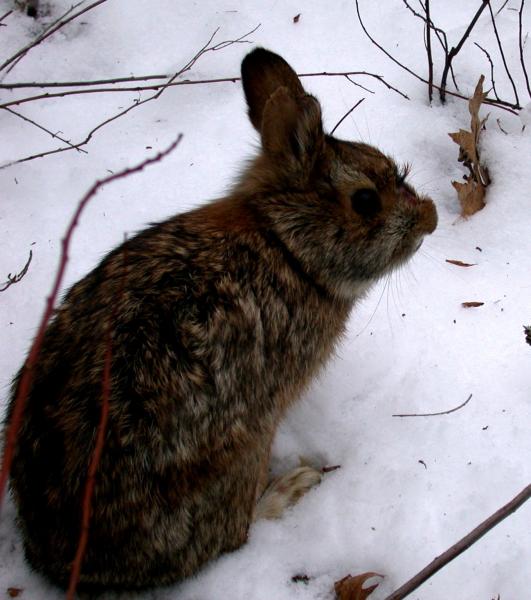
New England cottontail
Michael N. Marchand
- Class
- Mammalia (Mammals)
- Family
- Leporidae (Rabbits and Hares)
- State Protection
- Special Concern
Listed as Special Concern by New York State: at risk of becoming Threatened; not listed as Endangered or Threatened, but concern exists for its continued welfare in New York; NYS DEC may promulgate regulations as to the taking, importation, transportation, or possession as it deems necessary.
- Federal Protection
- Not Listed
- State Conservation Status Rank
- S1S2
Critically Imperiled or Imperiled in New York - Especially or very vulnerable to disappearing from New York due to rarity or other factors; typically 20 or fewer populations or locations in New York, very few individuals, very restricted range, few remaining acres (or miles of stream), and/or steep declines. More information is needed to assign either S1 or S2.
- Global Conservation Status Rank
- G3
Vulnerable globally - At moderate risk of extinction due to rarity or other factors; typically 80 or fewer populations or locations in the world, few individuals, restricted range, few remaining acres (or miles of stream), and/or recent and widespread declines.
Summary
Did you know?
The New England Cottontail is difficult to tell apart from the more common Eastern Cottontail, unless the rabbit is captured. Scientists typically perform genetic testing on rabbit scat (droppings) to determine which species are present.
State Ranking Justification
The New England cottontail has disappeared from many historical locations including Warren County, the Catskills, and Long Island. It was last documented in Rensselaer County in the 1960s (Benton and Atkinsin 1964). Its decline throughout its range resulted from forest maturation, habitat loss, habitat fragmentation, and competition with eastern cottontails (Litvaitis et al. 2006). In New York, it is now limited to a few fragmented populations in Columbia, Dutchess, Putnam, and Westchester counties.
Short-term Trends
The species was last found in Rennselaer County in the 1960s, and has declined elsehwere. It is now limited to a few fragmented populations in Columbia, Dutchess, Putnam, and Westchester counties (Litvaitis et al. 2006). Pellet surveys conducted since 2009 have turned up new locations for New England cottontails but have not substantially increased the size of the known range in NY.
Long-term Trends
The historical record includes specimens from Warren County to the north, west of the Hudson River in the Catskills, and south to Long Island, but recent records from these locations are lacking. The current distribution is thought to be restricted to the east side of the Hudson River and includes fragmented populations in Columbia, Dutchess, Putnam, and Westchester counties.
Conservation and Management
Threats
Changing habitat, fragmentation of forest lands, and competition with the eastern cottontail (Sylvilagus floridanus) have likely contributed to the decline of this species and remain as threats (Litvaitis 1993, Tash and Litvaitis 2007).
Conservation Strategies and Management Practices
Identify potential habitat within the historic range of the species, modify this habitat to increase its suitability, and reintroduce New England cottontails to these locations (Litvaitis and Villafuerte 1996, Tash and Litvaitis 2007).
Research Needs
Comparisons of habitat within extant and historical sites are necessary to see if there are significant differences between the two that may have led to the decline of the New England cottontail (Tash and Litvaitis 2007).
Habitat
Habitat
The New England cottontail is an early-successional species, preferring open woods, disturbed areas, shrubby areas, thickets, and marshes (Hamilton and Whitaker 1979). Specimens collected in Rensselaer County in the 1960s were from second-growth hardwoods with hemlocks at elevations greater than 1000 feet, and scattered swampy areas with stands of spruce and conifer plantations (Benton and Atkinson 1964). Current populations in southeastern New York can be found in isolated habitat patches that have undergone some form of disturbance such as agricultural fields and edges, and occasionally, brushy edges of transportation corridors (Tash and Litvaitis 2007).
Associated Ecological Communities
- Beech-maple mesic forest
(guide)
A hardwood forest with sugar maple and American beech codominant. This is a broadly defined community type with several variants. These forests occur on moist, well-drained, usually acid soils. Common associates are yellow birch, white ash, hop hornbeam, and red maple.
- Hemlock-northern hardwood forest
(guide)
A mixed forest that typically occurs on middle to lower slopes of ravines, on cool, mid-elevation slopes, and on moist, well-drained sites at the margins of swamps. Eastern hemlock is present and is often the most abundant tree in the forest.
- Red maple-hardwood swamp*
(guide)
A hardwood swamp that occurs in poorly drained depressions, usually on inorganic soils. Red maple is usually the most abundant canopy tree, but it can also be codominant with white, green, or black ash; white or slippery elm; yellow birch; and swamp white oak.
- Sedge meadow
(guide)
A wet meadow community that has organic soils (muck or fibrous peat). Soils are permanently saturated and seasonally flooded. The dominant herbs must be members of the sedge family, typically of the genus Carex.
- Shallow emergent marsh*
(guide)
A marsh meadow community that occurs on soils that are permanently saturated and seasonally flooded. This marsh is better drained than a deep emergent marsh; water depths may range from 6 in to 3.3 ft (15 cm to 1 m) during flood stages, but the water level usually drops by mid to late summer and the soil is exposed during an average year.
- Shrub swamp*
(guide)
An inland wetland dominated by tall shrubs that occurs along the shore of a lake or river, in a wet depression or valley not associated with lakes, or as a transition zone between a marsh, fen, or bog and a swamp or upland community. Shrub swamps are very common and quite variable.
- Spruce-fir swamp*
(guide)
A conifer swamp that typically occurs in a drainage basin but also can occur at the edge of a lake or pond or along gentle slopes of islands. These swamps are usually dense, with a fairly closed canopy (80 to 90% cover). The dominant tree is usually red spruce. Codominant trees include balsam fir and red maple. In the Catskills, balsam fir may be absent, and in the Adirondacks, black spruce or white spruce may replace red spruce as a dominant tree.
- Spruce flats*
(guide)
A mixed forest that occurs on moist sites along the borders of swamps and in low flats along lakes and streams in the Adirondacks. Soils are strongly podzolized, loamy to sandy, and seasonally moist, but not saturated and not peaty. Typically, the dominant trees are red spruce and red maple.
- Successional old field
A meadow dominated by forbs and grasses that occurs on sites that have been cleared and plowed (for farming or development), and then abandoned or only occasionally mowed.
- Successional shrubland
A shrubland that occurs on sites that have been cleared (for farming, logging, development, etc.) or otherwise disturbed. This community has at least 50% cover of shrubs.
* probable association but not confirmed.
Associated Species
- Eastern Cottontail (Sylvilagus floridanus)
Range
New York State Distribution
Various range maps show the former distribution including the southern tier counties, Catskills, and most of the eastern New York counties. Most records are old and actual specimens are known only from Suffolk, Warren, Nassau, Westchester, Rensselaer, and Schoharie counties. Recently, the New York State Department of Environmental Conservation Endangered Species Unit has conducted survey efforts (skull collection, live-trapping, fecal analysis) from potential counties of occurrence and has discovered extant populations in Columbia, Dutchess, Putnam, and Westchester counties (Litvaitis et al. 2006).
Global Distribution
The New England cottontail previously was widely distributed in New England, extending north to Rutland, Vermont, southern New Hampshire, southwestern Maine, and southwest through eastern New York. The range has been reduced and fragmented. Currently the species is restricted to boreal/montane regions in southwestern Maine, central and southern New Hampshire, perhaps extreme southern Vermont (Litvaitis 1993), Massachusetts (except southeastern part), northern Rhode Island, Connecticut, and New York east of the Hudson River (Chapman et al. 1992). Remnant populations are apparently restricted to five regions: 1) seacoast region of southern Maine and New Hampshire, 2) Merrimack River Valley of New Hampshire, 3) a portion of Cape Cod, Massachusetts, 4) eastern Connecticut and Rhode Island, and 5) portions of western Connecticut, eastern New York, and southwestern Massachusetts (Litvaitis et al. 2006).
Best Places to See
- Southern Columbia County and northern Dutchess County
Identification Comments
Identifying Characteristics
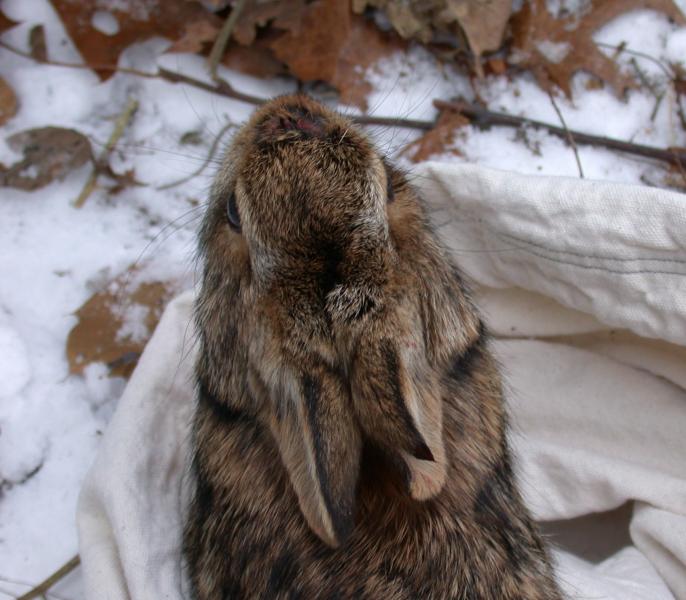
The New England cottontail closely resembles the eastern cottontail (Sylvilagus floridanus), but it tends to be a little smaller and darker. The ears are shorter and rounder, with the outer edge possessing a broad, black stripe which does not blend gradually into the browner color of the ear as in the eastern cottontail. There is usually a black spot between the ears, as compared to the white spot found on the forehead of the eastern cottontail. (Chapman 1975, Godin 1977, Litvaitis et al. 1991)
Characters Most Useful for Identification
True identification can only be made thrugh DNA analysis or skull characteristics (Hamilton and Whitaker 1979, Ruedas et al. 1989).
Behavior
Breeding season is January to September, peaking from March to July. The gestation period is 28 days. Litter size is genrally 3-5 or occasionally up to 8, with up to several litters per year. Litters are smaller but more numerous than in the eastern cottontail, resulting in about the same productivity. Most individuals first breed in their second season, but 18% of pregnancies are in juveniles (Dalke 1942, Hamilton and Whitaker 1979).
Diet
In the spring and summer, New England cottontails feed on grasses and herbs including goldenrods, crabgrass, and chickweed. In the fall and winter, their diet consists of seedlings, bark, twigs of gray birch, red maple, and aspen, and shrubs including blackberry, dewberry, and willow (Dalke and Sime 1941).
Best Time to See
New England Cottontails are most active at dawn and dusk. The breeding season is typically from March to September.
- Active
- Reproducing
The time of year you would expect to find New England Cottontail active and reproducing in New York.
Similar Species
- Eastern Cottontail (Sylvilagus floridanus)
The eastern cottontail is lighter in color and typically has a white spot between the ears, whereas the New England cottontail is darker and typically has a dark spot between the ears.
New England Cottontail Images
Michael N. Marchand
Michael N. Marchand
Taxonomy
New England Cottontail
Sylvilagus transitionalis (Bangs, 1895)
- Kingdom Animalia
- Phylum Craniata
- Class Mammalia
(Mammals)
- Order Lagomorpha
(Pikas, Rabbits, and Hares)
- Family Leporidae (Rabbits and Hares)
- Order Lagomorpha
(Pikas, Rabbits, and Hares)
- Class Mammalia
(Mammals)
- Phylum Craniata
Additional Resources
Best Identification Reference
Cheeseman, A. E., S. J. Ryan, C. M. Whipps, and J. B. Cohen. 2018. Competition alters seasonal resource selection and promotes use of invasive shrubs by an imperiled native cottontail. Ecology and Evolution 8:11122-11133.
Buffum, B., T. J. McGreevy Jr., A. E. Gottfriend, M. E. Sullivan, and T. P. Husband. 2015. An Analysis of Overstory Tree Canopy Cover in Sites Occupied by Native and Introduced Cottontails in the Northeastern United States with Recommendations for Habitat Management for New England Cottontail. PLOS ONE 10(8): e0135067.
Other References
Benton, A.H. and T. Atkinson. 1964. Notes on the New England cottontail in eastern New York. N.Y. Fish and Game J. 11(2):154-156.
Chapman, J. A., et al. 1992. Systematics and biogeography of the New England cottontail, SYLVILAGUS TRANSITIONALIS (Bangs, 1895), with the description of a new species from the Appalachian Mountains. Proc. Biol. Soc. Washington 105(4):841-866.
Chapman, Joseph A. 1975. SYLVILAGUS TRANSITIONALIS, New England Cottontail. Mammalian Species 55:1-4.
Connor, P.F. 1971. The mammals of Long Island, New York. NYS Museum and Science Service Bull. 416. 78 pp.
Dalke, P.D. 1942. The cottontail rabbits in Connecticut. Bull Conn. Geol. Nat. Hist. Surv. 65. 97 pp.
Dalke, P.D., and P.R. Sime. 1941. Food habits of the eastern and New England cottontails. J. Wildl. Mgmt. 5:216-228.
Godin, A. J. 1977. Wild mammals of New England. Johns Hopkins University Press, Baltimore. 304 pp.
Hall, E. R. 1981a. The Mammals of North America, second edition. Vols. I & II. John Wiley & Sons, New York, New York. 1181 pp.
Hamilton, W. J., Jr., and J. O. Whitaker, Jr. 1979. Mammals of the eastern United States. Cornell Univ. Press, Ithaca, New York. 346 pp.
Litvaitis, J. A., D. L. Verbyla, and M. K. Litvaitis. 1991. A field method to differentiate New England and eastern cottontails. Trans. Northeast Sec. Wildl. Soc. 48:11-14.
Litvaitis, J. A., J. P. Tash, M. K. Litvaitis, M. N. Marchand, A. I. Kovach, and R. Innis. 2006. A range-wide survey to determine the current distribution of New England cottontails. Wildlife Society Bulletin 34: 1190-1197.
Litvaitis, J.A. 1993. Response of early successional vertebrates to historic change in land use. Conservation Biology. 7(4):866-873.
Litvaitis, J.A. and R. Villafuerte. 1996. Factors affecting the persistence of New England cottontail metapopulations: the role of habitat management. Wildlife Society Bulletin. 24(4):686-693.
Litvaitis, M. K., J. A. Litvaitis, W.-J. Lee, and T. D. Kocher. 1997. Variation in the mitochondrial DNA of the SYLVILAGUS complex occupying the northeastern United States. Canadian Journal of Zoology 75:595-605.
New York Natural Heritage Program. 2024. New York Natural Heritage Program Databases. Albany, NY.
New York State Department of Environmental Conservation. Checklist of the amphibians, reptiles, birds, and mammals of New York State, including their protective status. Nongame Unit, Wildlife Resources Center, Delmar, NY.
Ruedas, L. A., R. C. Dowler, and E. Aita. 1989. Chromosomal variation in the New England cottontail, SYLVILAGUS TRANSITIONALIS. J. Mamm. 70:860-864.
Tash, J.P. and J.A. Litvaitis. 2007. Characteristics of occupied habitats and identification of sites for restoration and translocation of New England cottontail populations. Biological Conservation. 137(4):584-598.
US Fish and Wildlife Service. 2004. Endangered and threatened wildlife and plants; a 90-day finding on a petition to list the New England cottontail as threatened or endangered. Federal Register. 69(125):39395-39400.
Links
About This Guide
Information for this guide was last updated on: June 28, 2019
Please cite this page as:
New York Natural Heritage Program. 2024.
Online Conservation Guide for
Sylvilagus transitionalis.
Available from: https://guides.nynhp.org/new-england-cottontail/.
Accessed April 19, 2024.