Rapids Clubtail
Phanogomphus quadricolor (Walsh, 1863)
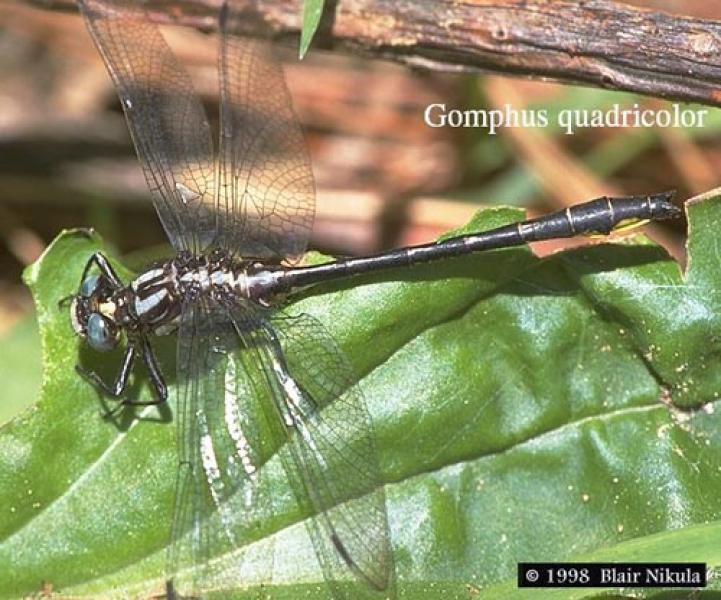
Gomphus quadricolor
Blair Nikula
- Class
- Insecta (Insects)
- Family
- Gomphidae (Clubtails)
- State Protection
- Not Listed
Not listed or protected by New York State.
- Federal Protection
- Not Listed
- State Conservation Status Rank
- S3
Vulnerable in New York - Vulnerable to disappearing from New York due to rarity or other factors (but not currently imperiled); typically 21 to 80 populations or locations in New York, few individuals, restricted range, few remaining acres (or miles of stream), and/or recent and widespread declines.
- Global Conservation Status Rank
- G3G4
Vulnerable globally, or Apparently Secure - At moderate risk of extinction, with relatively few populations or locations in the world, few individuals, and/or restricted range; or uncommon but not rare globally; may be rare in some parts of its range; possibly some cause for long-term concern due to declines or other factors. More information is needed to assign either G3 or G4.
Summary
Did you know?
All adult dragonflies are aerial predators that hunt and capture other insects on the wing for food. Gomphus females have larger spines on their hind legs, allowing them to capture larger prey than their male counterparts (Dunkle 2000).
State Ranking Justification
There are five extant and two historical locations where this species is known to occur in New York State, with no population estimates determined. There are two locations in the state where exuviae have been found, but no adult sightings were confirmed. If these records are confirmed, this may change the rank to an "S2".
Short-term Trends
There has been no estimate of population size for this species based on statewide occurrences. These occurrences have been reported from the late 1990's to present, and information prior to this time frame is limited. Therefore, any new location information on the Rapids Clubtail in New York may be reflective of heightened interest in surveying for this species rather than a population increase or a range expansion (Holst 2005).
Long-term Trends
There are two known historical occurrences of Gomphus quadricolor in New York State, in Broome and Tompkins counties. Five extant occurrences have been located in Warren, Saratoga, Orange, Ulster, St. Lawrence, Sullivan, and Broome counties. There is no existing information regarding the current existence of populations at these locations; therefore long-term trends are unclear.
Conservation and Management
Threats
Any activity which might lead to water contamination or the alteration of natural hydrology could impact Rapids Clubtail populations (Holst 2005). Such threats might include agricultural run-off, heavy siltation, flow manipulation of streams and rivers, residential development, and recreational boating (Holst 2005, Cuthrell 2000).
Conservation Strategies and Management Practices
Any efforts to reduce agricultural run-off, habitat alteration (including development and clearcutting) and contamination of streams and rivers should be considered when managing for this species (Cuthrell 2000).
Research Needs
Further research is needed to define the distribution and population size of the Rapids Clubtail. In addition, research is required to understand the habitat requirements and threats to this species, and to create appropriate management guidelines for its persistence in known locations (Holst 2005).
Habitat
Habitat
The Rapids Clubtail inhabits rapid flowing streams with projecting rocks and a substrate consisting of boulder, rock, gravel, and sand (Walker 1958, Cuthrell 2000). It may also be found in or near slow-flowing, small streams and swiftly-flowing large rivers (Nikula et al. 2003, New York Natural Heritage Program, 2007).
Associated Ecological Communities
- Cobble shore
(guide)
A community that occurs on the well-drained cobble shores of lakes and streams. These shores are usually associated with high-energy waters (such as high-gradient streams), and they are likely to be scoured by floods or winter ice floes.
- Confined river
(guide)
The aquatic community of relatively large, fast flowing sections of streams with a moderate to gentle gradient.
Associated Species
- Spine-crowned Clubtail (Hylogomphus abbreviatus) (guide)
Range
New York State Distribution
The Rapids Clubtail has been confirmed in locations from 10 counties. While no population estimates have been made, they are known to occur in large, shallow, swift-flowing rivers throughout the state including the Upper Delaware River and the Upper Hudson River. More inventories are needed to determine the full extent of its statewide range (Holst 2005).
Global Distribution
The Rapids Clubtail is known to range from Ontario and southwestern Maine to its western limit in eastern Minnesota, south to Alabama. (Walker 1958, Needham and Westfall 1955). This species may be at risk in Ontario as it is extirpated from one of the four known sites.
Best Places to See
- Shawangunk Kill (Ulster County)
- Upper Delaware River (Orange, Sullivan Counties)
Identification Comments
Identifying Characteristics
As their name suggests, Clubtails have an enlarged tip on the end of their abdomens, giving them a club-like appearance. Not only is this species uncommon in New York State, but it is difficult to see due to its camouflaged coloration. The Rapids Clubtail is greenish yellow in color with blackish brown stripes and a blackish abdomen with yellow dorsal (top) and lateral (side) stripes (Needham et al. 2000, Nikula et al. 2003). They are 42-45 mm (1.7-1.8 inches) in length with a 31-34 mm abdomen. They have blue-green eyes and, as with all Gomphids, their eyes are separated dorsally. They have a slender abdomen with a widened "club" at the end and abdominal segments 8-10 are dark dorsally, with yellow, linear spots present on the top of the other abdominal segments. Yellow to gray-green stripes occur laterally on all abdominal segments. The male anterior hamule (the top pair of terminal appendages, consisting of hardened cuticle, which borders the genital pocket) is sickle-shaped and female sub-genital plate is thick and 1/7 as long as abdominal segment 9 and has a V-notch nearly to the base. They may be distinguished from other similar species by the following characteristics: Adults have a more prominent club and less yellow on the abdomen and completely black legs. Also, females have more yellow spotting on their abdomen.
Behavior
Gomphid larvae spend much of their time burrowing into the substrate of streams and rivers where they are found. Adults are found perching on the ground, on emergent rocks in streams and rivers, or on leaf surfaces (Nikula et al. 2003). Adult females oviposit by tapping their abdomens onto the surface of swift-flowing water while simultaneously releasing eggs (Nikula et al. 2003, Mead 2003).
Diet
Rapids Clubtail larvae feed on smaller aquatic invertebrates and adults feed on insects which they capture in flight.
Best Time to See
Adults are active from late May through mid-July. Larvae may be found in appropriate aquatic habitats year-round. Exuviae (cast skin of dragonfly larvae) are best found in June (Cuthrell 2000).
- Present
- Reproducing
The time of year you would expect to find Rapids Clubtail present and reproducing in New York.
Similar Species
- Beaverpond Clubtail (Phanogomphus borealis)
The Beaverpond Clubtail is noticably larger and more drab than the Rapids Clubtail. The Beaverpond Clubtail has a narrower brown midfrontal stripe. Females have a pale lateral stripe on abdominal segment 7 where the Rapids Clubtail female has a pale basal spot (Dunkle 2000).
- Harpoon Clubtail (Phanogomphus descriptus)
The Harpoon Clubtail is noticably larger and more drab than the Rapids Clubtail. Females have a pale lateral stripe on abdominal segment 7 where the Rapids Clubtail female has a pale basal spot. Females also usually have pale hind thighs and a pale dorsal stripe on abdominal segment 10 (Dunkle 2000).
- Lancet Clubtail (Phanogomphus exilis)
The Lancet Clubtail has brown legs, whereas the Rapids Clubtail has black legs. This species usually has pale dorsal markings on each abdominal segment.
- Ashy Clubtail (Phanogomphus lividus)
The Ashy Clubtail has a less developed club and their legs are a lighter brown color basally than the Rapids Clubtail.
- Dusky Clubtail (Phanogomphus spicatus)
The Dusky Clubtail is noticably larger and more drab than the Rapids Clubtail. Females have a pale lateral stripe on abdominal segment 7 where the Rapids Clubtail female has a pale basal spot. Females also usually have pale hind thighs and a pale dorsal stripe on abdominal segment 10. Both sexes of the Dusky Clubtails have pale shins and a dorsal yellow spot on abdominal segments 8 and 10.
Rapids Clubtail Images
Blair Nikula
Taxonomy
Rapids Clubtail
Phanogomphus quadricolor (Walsh, 1863)
- Kingdom Animalia
- Phylum Arthropoda
(Mandibulates)
- Class Insecta
(Insects)
- Order Odonata
(Dragonflies and Damselflies)
- Family Gomphidae (Clubtails)
- Order Odonata
(Dragonflies and Damselflies)
- Class Insecta
(Insects)
- Phylum Arthropoda
(Mandibulates)
Synonyms
- Gomphus quadricolor Walsh, 1863
Additional Resources
References
Cuthrell, D.L. 2000. Special animal abstract for Gomphus quadricolor (rapids clubtail). Michigan Natural Features Inventory, Lansing, MI. 2pp. Available http://web4.msue.msu.edu/mnfi/abstracts/zoology/Gomphus_quadricolor.pdf(Accessed: January 11, 2007).
Donnelly, T. W. 1992. The odonata of New York State. Bulletin of American Odonatology. 1(1):1-27.
Dunkle, S.W. 2000. Dragonflies Through Binoculars. A Field Guide to Dragonflies of North America. Oxford University Press: New York, New York. 266 pp.
Louton, J. 1982. Lotic dragonfly (Anisoptera: Odonata) nymphs of the southeastern United States: Identification, distribution and historical. Ph.D. dissertation. University of Tennessee, Knoxville. 357pp.
Mead, K. 2003. Dragonflies of the North Woods. Kollath-Stensaas Publishing, Duluth, MN. 2003 pp.
NatureServe. 2007. NatureServe Explorer: An online encyclopedia of life [web application]. Version 6.1. NatureServe, Arlington, Virginia. Available http://www.natureserve.org/explorer. (Accessed: January 11, 2007).
Needham, J.G. and M.J. Westfall Jr. 1955. A manual of dragonflies of North America (Anisoptera) Including the Greater Antilles and the Provinces of the Mexican Border. University of California Press, Los Angeles.
Needham, J.G., M.J. Westfall, Jr., and M.L. May. 2000. Dragonflies of North America. Revised edition. Scientific Publishers, Gainesville, Florida. 939 pp.
New York Natural Heritage Program. 2007. Biotics Database. Albany, NY.
New York Natural Heritage Program. 2024. New York Natural Heritage Program Databases. Albany, NY.
New York State Department of Environmental Conservation. 2005. Comprehensive Wildlife Conservation Strategy Planning Database. New York State Department of Environmental Conservation. Albany, NY.
Nikula, B., J.L. Loose, and M.R. Burne. 2003. A field guide to the dragonflies and damselflies of Massachusetts. Division of Fisheries and Wildlife, Natural Heritage and Endangered Species Program, Westborough, MA. 197 pp.
Walker, E.M. 1958. The Odonata of Canada and Alaska. Vol 2. The Anisoptera-four families. Univ. Toronto Press 318 pp.
Ware, J.L., E. Pilgrim, M.L. May, T.W. Donnelly, and K. Tennessen. 2016. Phylogenetic relationships of North American Gomphidae and their close relatives. Systematic Entomology 2016:1-10.
Links
About This Guide
Information for this guide was last updated on: February 28, 2007
Please cite this page as:
New York Natural Heritage Program. 2024.
Online Conservation Guide for
Phanogomphus quadricolor.
Available from: https://guides.nynhp.org/rapids-clubtail/.
Accessed April 26, 2024.