Virginia Snakeroot
Endodeca serpentaria (L.) Raf.
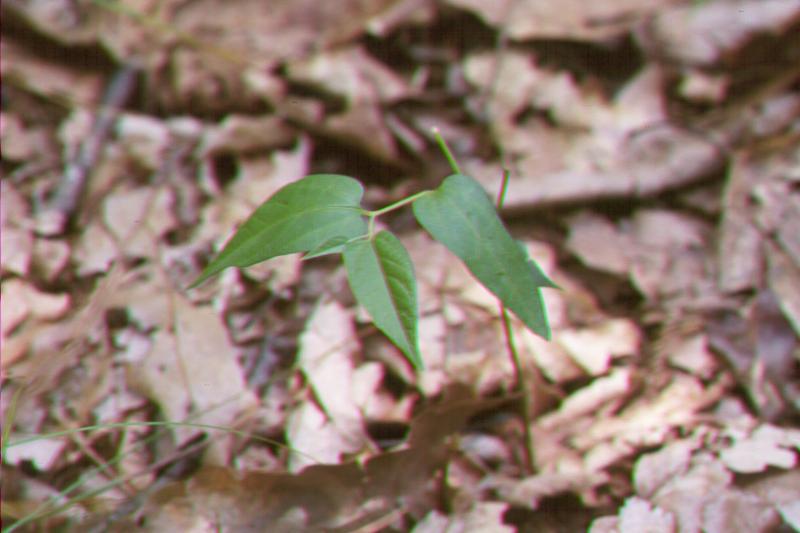
Aristolochia serpentaria
Troy Weldy
- Class
- Dicotyledoneae (Dicots)
- Family
- Aristolochiaceae (Birthwort Family)
- State Protection
- Threatened
Listed as Threatened by New York State: likely to become Endangered in the foreseeable future. For animals, taking, importation, transportation, or possession is prohibited, except under license or permit. For plants, removal or damage without the consent of the landowner is prohibited.
- Federal Protection
- Not Listed
- State Conservation Status Rank
- S2
Imperiled in New York - Very vulnerable to disappearing from New York due to rarity or other factors; typically 6 to 20 populations or locations in New York, very few individuals, very restricted range, few remaining acres (or miles of stream), and/or steep declines.
- Global Conservation Status Rank
- G4
Apparently Secure globally - Uncommon in the world but not rare; usually widespread, but may be rare in some parts of its range; possibly some cause for long-term concern due to declines or other factors.
Summary
Did you know?
Virginia snakeroot's species and common name comes from its use by Native Americans and pioneers to cure rattlesnake bites. It was also used to treat fevers, toothaches, coughs, and disorders of the stomach and lung. The genus name is Greek for best (aristos) delivery (lochia) for its ancient use in child delivery.
State Ranking Justification
With the exception of a few casual reports, this plant was absent from the New York flora for nearly 100 years. Numerous surveys tried to relocate this plant, but the focus was in areas that resemble its southern habitats. Not until 1994, when this plant was finally rediscoverd in New York, did we begin to understand its New York habitat. Since then, more surveys have been conducted in appropriate habitat and we know of at least six populations. As surveys continue, we expect to find more populations of this plant in the Hudson Highlands and the mid-Hudson Valley.
Short-term Trends
Since this plant was just rediscovered in New York in 1994, the short-term trends are difficult to assess. Now that the habitat requirements in New York are better understood, more populations are being discovered. These may have been present all along or this plant may be spreading northward. Populations that have been surveyed more than once appear stable.
Long-term Trends
After going nearly a century without any reports of this plant (absent between 1895-1994), this plant was rediscovered in the Hudson Highlands. Since this rediscovery, a number of new populations have been found. Whether these populations were here all along or if the plants are increasing in this region is unclear. Stanley Smith commented in the 1960s that he thought he saw this plant at a site in Ulster County, New York, but no voucher specimen was collected. All of the historical populations in the New York City and Long Island area are presumed extirpated.
Conservation and Management
Threats
Besides a few plants being nipped by deer, no threats are known within New York.
Conservation Strategies and Management Practices
While this plant has a specific habitat requirement, it requires no active management. Although active forestry is not practiced in areas where this plant is currently known, it should be noted that clear-cutting may be incompatiable with the protection of this plant. Likewise, any development proposed upslope from Aristolochia populations should study potential impacts.
Research Needs
Now that habitat requirements are better understood, habitat modeling could assist with finding new occurrences in the Hudson Highlands.
Habitat
Habitat
An often difficult to see plant of well-drained wooded slopes, rocky slopes of oak woods, open woods, moist woods, rich woods, and only rarely in clearings. It particularly seems to favor drainage patterns on southwest to southeast facing slopes in oak-hickory forests or chestnut oak forest. Search areas on the slope where leaves collect as water drains down the slope. These areas may have lots of Carex pennsylvanica surrounding the water sink, but little to no Carex pennsylvanica directly within the drainage where the Aristolochia may be concentrated (New York Natural Heritage Program 2004). Mesic forest (FNA 1997). Moist or dry upland woods (Gleason & Cronquist 1991). Rich, often calcareous soils, woodlands and floodplains (Mitchell and Beal 1979). Rich, often calcareous woods (Fernald 1970).
Associated Ecological Communities
- Appalachian oak-hickory forest
(guide)
A hardwood forest that occurs on well-drained sites, usually on ridgetops, upper slopes, or south- and west-facing slopes. The soils are usually loams or sandy loams. This is a broadly defined forest community with several regional and edaphic variants. The dominant trees include red oak, white oak, and/or black oak. Mixed with the oaks, usually at lower densities, are pignut, shagbark, and/or sweet pignut hickory.
- Chestnut oak forest
(guide)
A hardwood forest that occurs on well-drained sites in glaciated portions of the Appalachians, and on the coastal plain. This forest is similar to the Allegheny oak forest; it is distinguished by fewer canopy dominants and a less diverse shrublayer and groundlayer flora. Dominant trees are typically chestnut oak and red oak.
- Limestone woodland*
(guide)
A woodland that occurs on shallow soils over limestone bedrock in non-alvar settings, and usually includes numerous rock outcrops. There are usually several codominant trees, although one species may become dominant in any one stand.
- Oak-tulip tree forest*
(guide)
A hardwood forest that occurs on moist, well-drained sites in southeastern New York. The dominant trees include a mixture of five or more of the following: red oak, tulip tree, American beech, black birch, red maple, scarlet oak, black oak, and white oak.
- Rich mesophytic forest*
(guide)
A hardwood or mixed forest that resembles the mixed mesophytic forests of the Allegheny Plateau south of New York but is less diverse. It occurs on rich, fine-textured, well-drained soils that are favorable for the dominance of a wide variety of tree species. A canopy with a relatively large number of codominant trees characterizes this forest. Canopy codominants include five or more of the following species: red oak, red maple, white ash, American beech, sugar maple, black cherry, cucumber tree, and black birch.
- Successional old field*
A meadow dominated by forbs and grasses that occurs on sites that have been cleared and plowed (for farming or development), and then abandoned or only occasionally mowed.
* probable association but not confirmed.
Associated Species
- Acer saccharum (sugar maple)
- Alliaria petiolata (garlic mustard)
- Arabidopsis lyrata
- Asclepias quadrifolia (four-leaved milkweed)
- Aster divaricatus
- Carex albicans var. albicans
- Carex digitalis
- Carex pensylvanica (Pennsylvania sedge)
- Carya glabra (pignut hickory)
- Corydalis flavula (yellow corydalis)
- Corydalis sempervirens
- Cunila origanoides (American dittany)
- Galium circaezans (forest wild-licorice)
- Ostrya virginiana (hop hornbeam, ironwood)
- Panicum boscii
- Quercus alba (white oak)
- Quercus montana (chestnut oak)
- Quercus rubra (northern red oak)
- Quercus velutina (black oak)
- Ranunculus micranthus (small-flowered butter-cup, small-flowered crow-foot)
- Solidago caesia
Range
New York State Distribution
This plant is currently only known from a few locations on the west side of the Hudson River in the Hudson Highlands where is appears on well-drained rocky wooded slopes dominated by various deciduous hardwood species and Carex pensylvanica. Southeastern New York is at this species' northern range limit.
Global Distribution
This plants is found throughout much of the eastern United States ranging from Connecticut, southern New York, southern Michigan, and Iowa, south to Texas and Florida.
Identification Comments
General Description
This plant has lance to arrow-shaped leaves 6-12 cm long that are arranged alternately on a stem that can grow to 60 cm long. The stem may be erect if short or lying on the ground if long. The flowers will usually be hidden under the leaf litter, one at the end of each branch. They are inch-long, purple, S-shaped flower tubes that flare-out at the tip.
Identifying Characteristics
The stems of this plant are slender and erect to decumbent. The leaves highly variable but generally ovate to oblong, acuminate, and truncate to cordate at the base. The flowers appear solitary on slender, scaly peduncles from the lowest nodes. These are often buried below the leaf litter. The calyx is deep purple to chocolate in color and strongly curved.
Best Life Stage for Proper Identification
Fortunately, one can easily identify this plant based on leaves alone. Since the flower is often hidden under the leaf litter, it is infrequently observed.
Similar Species
A very unique plant, even vegetatively, that is not easily confused with any plant in our region.
Best Time to See
The plant flowers from mid-May to late July and the fruits persist until late October. Since this plant will often appear in areas surrounded by Carex pennsylvanica, surveys may be most effective after the Carex begins to senesce. The ideal survey time is from July to September.
- Vegetative
- Flowering
- Fruiting
The time of year you would expect to find Virginia Snakeroot vegetative, flowering, and fruiting in New York.
Virginia Snakeroot Images
Troy Weldy
Taxonomy
Virginia Snakeroot
Endodeca serpentaria (L.) Raf.
- Kingdom Plantae
- Phylum Anthophyta
- Class Dicotyledoneae
(Dicots)
- Order Aristolochiales
- Family Aristolochiaceae (Birthwort Family)
- Order Aristolochiales
- Class Dicotyledoneae
(Dicots)
- Phylum Anthophyta
Additional Common Names
- Narrow-leaved Snakeroot
- Pelican-flower
- Sangree-root
- Serpentaria
- Serpentary
- Snagrel
- Snakeweed
- Virginia Serpentaria
Synonyms
- Aristolochia serpentaria L.
- Aristolochia serpentaria var. hastata (Nutt.) Duchartre
Comments on the Classification
Together the segregate genera Endodeca and Isotrema form a very well supported clade that is morphologically, molecularly, and cytologically distinct from the rest of Aristolochia sensu lato (Kelly and González 2003, Neinhuis et al. 2005, Ohi-Toma et al. 2006, Wanke et al. 2006). These authors work strongly supports Hubers (1993) taxonomic alignment which recognizes Endodeca and Isotrema as distinct genera. Ohi-Toma et al. (2006), while supporting the recognition of segregate genera within Aristolochia s.l., chose to lump Endodeca under Isotrema because the two share the same chromosome number but their work also strongly supports the recognition of the two as distinct at the generic level with the choice somewhat subjective. We currently recognize Endodeca (E. serpentaria) and Isotrema (I. macrophyllum, I tomentosum) as distinct from Aristolochia (A. clematitis) following (Huber 1993, Kelly and González 2003, Neinhuis et al. 2005). A few taxa (all occurring south of New York) have been described within Endodeca serpentaria (e.g. Aristolochia hastata, A. convolvulacea) sometimes at the infraspecific level. We follow recent authors (Gleason and Cronquist 1991, Berringer 1997) in recognizing only one variable taxon.
Additional Resources
Best Identification Reference
Gleason, Henry A. and A. Cronquist. 1991. Manual of Vascular Plants of Northeastern United States and Adjacent Canada. The New York Botanical Garden, Bronx, New York. 910 pp.
Other References
Fernald, M.L. 1950. Gray's manual of botany. 8th edition. D. Van Nostrand, New York. 1632 pp.
Flora of North America Editorial Committee. 1997. Flora of North America, North of Mexico. Volume 3. Magnoliophyta: Magnoliidae and Hamamelidae.
Holmgren, Noel. 1998. The Illustrated Companion to Gleason and Cronquist's Manual. Illustrations of the Vascular Plants of Northeastern United States and Adjacent Canada. The New York Botanical Garden, Bronx, New York.
Huber, H. 1993. Aristolochiaceae. Pages 129-137 in K. Kubitzki, J. Rohwer, and V. Bittrich (editors), The Families and Genera of Vascular Plants. Volume II. Springer, Berlin, Germany.
Mitchell, Richard S. and Ernest O. Beal. 1979. Magnoliaceae to Ceratophyllaceae of New York State. New York State Museum Bulletin 435, 62 pp.
Mitchell, Richard S. and Gordon C. Tucker. 1997. Revised Checklist of New York State Plants. Contributions to a Flora of New York State. Checklist IV. Bulletin No. 490. New York State Museum. Albany, NY. 400 pp.
Mitchell, Richard. 1994. Virginia snakeroot (Aristolochia serpentaria) rediscovered in New York. NY Flora Association Newsletter 5(4): 1-2.
New York Natural Heritage Program, New York State Department of Enviromental Conservation. March 1998. Element Occurrence Record Database. Latham, NY.
New York Natural Heritage Program. 2024. New York Natural Heritage Program Databases. Albany, NY.
Reschke, Carol. 1990. Ecological communities of New York State. New York Natural Heritage Program, New York State Department of Environmental Conservation. Latham, NY. 96 pp. plus xi.
Weldy, T. and D. Werier. 2010. New York flora atlas. [S.M. Landry, K.N. Campbell, and L.D. Mabe (original application development), Florida Center for Community Design and Research http://www.fccdr.usf.edu/. University of South Florida http://www.usf.edu/]. New York Flora Association http://newyork.plantatlas.usf.edu/, Albany, New York
Links
About This Guide
Information for this guide was last updated on: September 7, 2004
Please cite this page as:
New York Natural Heritage Program. 2024.
Online Conservation Guide for
Endodeca serpentaria.
Available from: https://guides.nynhp.org/virginia-snakeroot/.
Accessed April 25, 2024.