Green Milkweed
Asclepias viridiflora Raf.
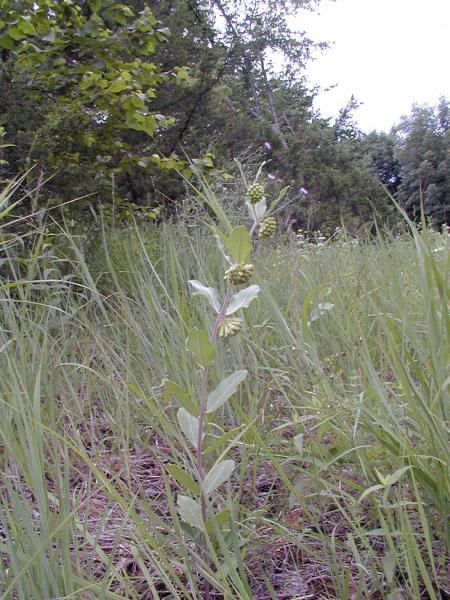
Asclepias viridiflora
Troy Weldy
- Class
- Dicotyledoneae (Dicots)
- Family
- Apocynaceae (Dogbane Family)
- State Protection
- Threatened
Listed as Threatened by New York State: likely to become Endangered in the foreseeable future. For animals, taking, importation, transportation, or possession is prohibited, except under license or permit. For plants, removal or damage without the consent of the landowner is prohibited.
- Federal Protection
- Not Listed
- State Conservation Status Rank
- S2
Imperiled in New York - Very vulnerable to disappearing from New York due to rarity or other factors; typically 6 to 20 populations or locations in New York, very few individuals, very restricted range, few remaining acres (or miles of stream), and/or steep declines.
- Global Conservation Status Rank
- G5
Secure globally - Common in the world; widespread and abundant (but may be rare in some parts of its range).
Summary
Did you know?
The green milkweed plants on Long Island are the easternmost populations in the United States. This is the only milkweed in New York with drooping pincushions of many green flowers.
State Ranking Justification
This milkweed is limited to serpentine and calcareous rocks in southeastern New York where it reaches its northern limit. Many of the populations are threatened by development, the spread of various invasive plants, and uncontrolled natural succession typically due to fire suppression. There are 14 known populations with half of these containing ten or fewer plants. With no additional populations expected and the threats mentioned above, we fear that the number of known populations will decrease over time.
Short-term Trends
This milkweed has always been rare in New York. Most of the known populations seem stable, but there are some locations with low numbers of plants that need to be resurveyed.
Long-term Trends
The number of known populations of this plant in New York has been relatively constant over time with a few historical sites disappearing and a few new sites discovered.
Conservation and Management
Threats
The most serious threat to this plant is the lack of continuous disturbance to keep the habitat open and prevent succession. Many of the sites do not have active management plans to help this plant persist. Another threat is the lack of adequate buffers around the natural areas to prevent overdevelopment.
Conservation Strategies and Management Practices
Succession and invasion by exotic plants should be managed with fire and other tools. Considering that a large percentage of the known populations are found on the geographically-limited serpentine bedrock formations, all effort should be made to protect these small sites.
Research Needs
There are no research needs at this time.
Habitat
Habitat
A milkweed of open areas on serpentine, calcareous, sandstone, or diabase bedrock, or sometimes in open sandy soil. These areas include recently burned slopes on serpentine rock, serpentine grasslands, mowed golf course rough atop serpentine bedrock, open maritime grassland habitats on sandy soil, open limestone slopes within cedar glades, open rocky summit grasslands on diabase rock formations, open calcareous rocky summits, alkaline sandstone ridges within open cedar glades, old pastures with alkaline soils, open cedar glades with exposed sandstone, and dry shaley slopes (New York Natural Heritage Program 2004). Dry fields and dry rocky slopes, including serpentine and limestone (Rhoads and Block 2000). Dunes and other dry sandy sites including prairies, borders of oak woods, road cuts, and railroads (Voss 1996). Dry upland woods, prairies, and barrens, especially in sandy soil (Gleason and Cronquist 1991). Dry woods and openings (Fernald 1970).
Associated Ecological Communities
- Calcareous red cedar barrens
(guide)
A small-patch calcareous rocky summit community occurring on dry, south-facing to southwest-facing slopes and low summits. These sites are characterized by stunted, sparse woodlands with small grassland openings.
- Hempstead Plains grassland*
(guide)
A tall grassland community that occurs on rolling outwash plains in west-central Long Island. This community occurs inland, beyond the influence of offshore winds and salt spray.
- Maritime grassland*
(guide)
A grassland community that occurs on rolling outwash plains of the glaciated portion of the Atlantic coastal plain, near the ocean and within the influence of offshore winds and salt spray.
- Red cedar rocky summit*
(guide)
A community that occurs on warm, dry, rocky ridgetops and summits where the bedrock is calcareous (such as limestone or dolomite, but also marble, amphibolite, and calcsilicate rock), and the soils are more or less calcareous. The vegetation may be sparse or patchy, with numerous lichen covered rock outcrops.
- Rocky summit grassland
(guide)
A grassland community that occurs on rocky summits and exposed rocky slopes of hills. Woody plants are sparse and may be scattered near the margin of the community. Small trees and shrubs may be present at low percent cover.
- Serpentine barrens
(guide)
A grass-savanna community that occurs on shallow soils over outcrops of serpentine bedrock. In New York this community is known only from Staten Island, where the remnants are relatively disturbed.
- Successional old field*
A meadow dominated by forbs and grasses that occurs on sites that have been cleared and plowed (for farming or development), and then abandoned or only occasionally mowed.
* probable association but not confirmed.
Associated Species
- Andropogon virginicus
- Anthoxanthum odoratum (sweet vernal grass)
- Aristida purpurascens
- Asclepias tuberosa (butterfly-weed)
- Bouteloua curtipendula
- Carex brevior (short-beaked sedge)
- Carex mühlenbergii var. enervis
- Draba reptans
- Juniperus virginiana
- Liatris borealis
- Linum sulcatum (grooved yellow flax)
- Panicum oligosanthes
- Panicum virgatum (switch grass)
- Prunus serotina
- Rhus copallinum
- Schizachyrium scoparium
- Solidago nemoralis
- Sorghastrum nutans (Indian grass)
- Toxicodendron radicans
Range
New York State Distribution
This milkweed is known from scattered locations within the Harlem Valley, Staten Island, and west-central Long Island. It is most abundant on the serpentine outcrops of Staten Island.
Global Distribution
A milkweed known from Connecticut and southern New York, west to Michigan and Manitoba, and south to Georgia, Arizona and northern Mexico. It is more common in the western portions of the range.
Identification Comments
General Description
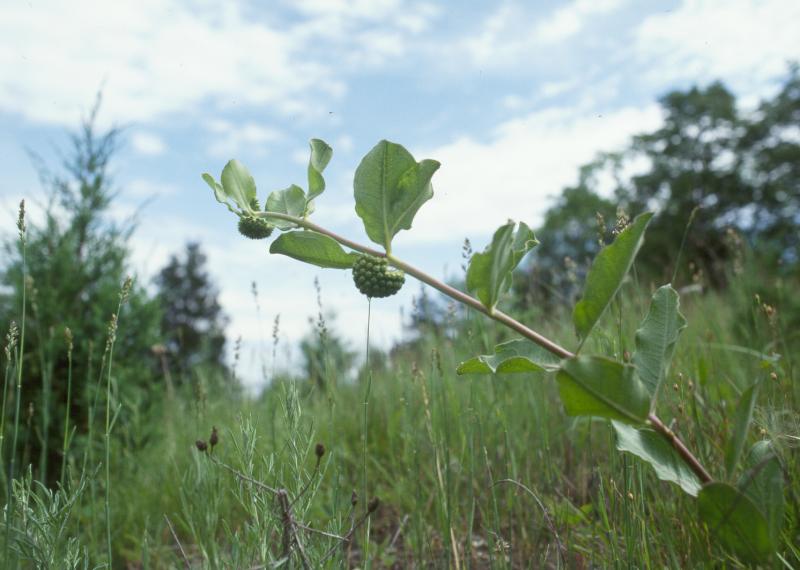
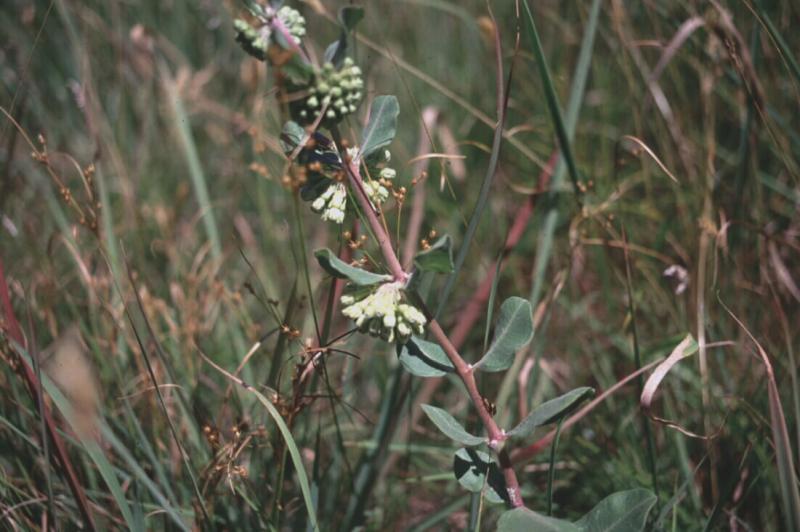
This is an erect milkweed up to 80 cm tall. Along the stem, opposite each other, there are 8-24 stiff, egg-shaped leaves that are slightly hairy on the top and almost hairless on the bottom. The pale green, tubular flowers are arranged in tight, drooping clusters along the top part of the stem.
Identifying Characteristics
A milkweed with stiff leaves and erect stem up to 80 cm tall. The leaves are thinly hairy to glabrate beneath. Usually there are 8-24 leaves, many or all opposite. These leaves are lanceolate to linear to broadly oblong. The flowering umbels are subsessile, axillary, and very compact with numerous flowers. Each flower is 9-13 mm long and pale green in color. The crown is sessile, about equaling the anthers. The hood is absent, an unusual character for milkweeds.
Best Life Stage for Proper Identification
The unique features of this milkweed allow one to easily identify it in a flowering, fruiting, or even vegetative state. Identification is easiest when flowers are present.
Similar Species
This milkweed is rather unique among Asclepias. It is often placed in its own genus (Acerates) with a few other milkweeds (none within New York's flora) that lack the horn on the corona hood.
Best Time to See
This milkweed flowers from early July though August with fruits persisting into October. The ideal survey time is July through September.
- Vegetative
- Flowering
- Fruiting
The time of year you would expect to find Green Milkweed vegetative, flowering, and fruiting in New York.
Green Milkweed Images
Troy Weldy
Kathy Kelly
Troy Weldy
Taxonomy
Green Milkweed
Asclepias viridiflora Raf.
- Kingdom Plantae
- Phylum Anthophyta
- Class Dicotyledoneae
(Dicots)
- Order Gentianales
- Family Apocynaceae (Dogbane Family)
- Order Gentianales
- Class Dicotyledoneae
(Dicots)
- Phylum Anthophyta
Additional Common Names
- Green Comet Milkweed
- Short Green Milkweed
- Wand Milkweed
Synonyms
- Acerates viridiflora (Raf.) Eaton
Additional Resources
Best Identification Reference
Gleason, Henry A. and A. Cronquist. 1991. Manual of Vascular Plants of Northeastern United States and Adjacent Canada. The New York Botanical Garden, Bronx, New York. 910 pp.
Other References
Fernald, M.L. 1950. Gray's manual of botany. 8th edition. D. Van Nostrand, New York. 1632 pp.
Holmgren, Noel. 1998. The Illustrated Companion to Gleason and Cronquist's Manual. Illustrations of the Vascular Plants of Northeastern United States and Adjacent Canada. The New York Botanical Garden, Bronx, New York.
Mitchell, Richard S. and Gordon C. Tucker. 1997. Revised Checklist of New York State Plants. Contributions to a Flora of New York State. Checklist IV. Bulletin No. 490. New York State Museum. Albany, NY. 400 pp.
New York Natural Heritage Program. 2010. Biotics database. New York Natural Heritage Program. New York State Department of Environmental Conservation. Albany, NY.
New York Natural Heritage Program. 2024. New York Natural Heritage Program Databases. Albany, NY.
Reschke, Carol. 1990. Ecological communities of New York State. New York Natural Heritage Program, New York State Department of Environmental Conservation. Latham, NY. 96 pp. plus xi.
Rhoads, Ann F. and Timothy A. Block. 2000. The Plants of Pennsylvania, an Illustrated Manual. University of Pennsylvania Press, Philadelphia, PA.
Voss, Edward G. 1996. Michigan Flora Part III. Dicots Concluded (Pyrolaceae - Compositae). Cranbrook Institute of Science Bulletin 61 and University of Michigan Herbarium. 622 pp.
Weldy, T. and D. Werier. 2010. New York flora atlas. [S.M. Landry, K.N. Campbell, and L.D. Mabe (original application development), Florida Center for Community Design and Research http://www.fccdr.usf.edu/. University of South Florida http://www.usf.edu/]. New York Flora Association http://newyork.plantatlas.usf.edu/, Albany, New York
Links
About This Guide
Information for this guide was last updated on: May 31, 2006
Please cite this page as:
New York Natural Heritage Program. 2024.
Online Conservation Guide for
Asclepias viridiflora.
Available from: https://guides.nynhp.org/green-milkweed/.
Accessed April 20, 2024.