Swamp Birch
Betula pumila L.
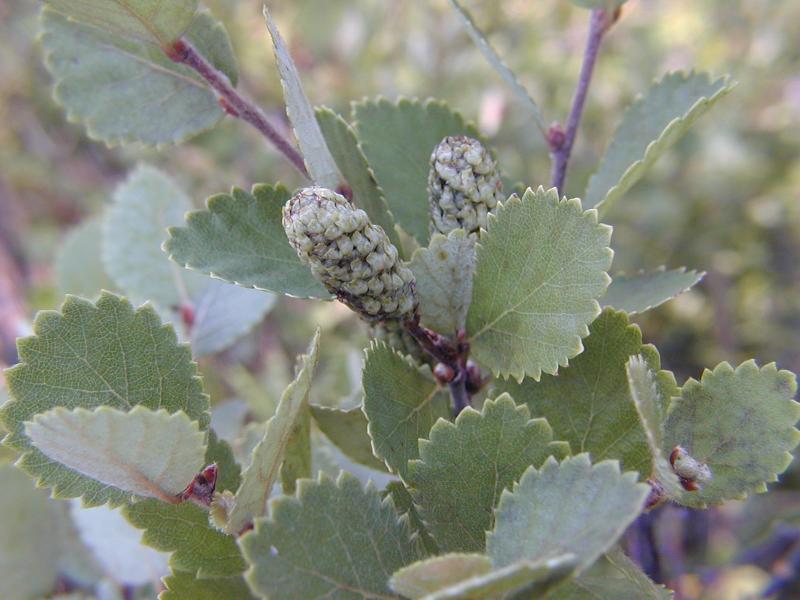
Betula pumila, Rich shrub fen
Troy Weldy
- Class
- Dicotyledoneae (Dicots)
- Family
- Betulaceae (Birch Family)
- State Protection
- Threatened
Listed as Threatened by New York State: likely to become Endangered in the foreseeable future. For animals, taking, importation, transportation, or possession is prohibited, except under license or permit. For plants, removal or damage without the consent of the landowner is prohibited.
- Federal Protection
- Not Listed
- State Conservation Status Rank
- S2
Imperiled in New York - Very vulnerable to disappearing from New York due to rarity or other factors; typically 6 to 20 populations or locations in New York, very few individuals, very restricted range, few remaining acres (or miles of stream), and/or steep declines.
- Global Conservation Status Rank
- G5
Secure globally - Common in the world; widespread and abundant (but may be rare in some parts of its range).
Summary
Did you know?
Swamp birch is the only shrubby birch in New York, hence its species name meaning small or dwarf. Its bark does not shred or peel. Native Americans would inhale the smoke from burning catkins to improve respiration.
State Ranking Justification
As of 2004, there are at least nine known populations, including six excellent quality populations with hundreds of plants in high-quality to pristine habitat settings. This shrub is near its southern limit in New York, but in the appropriate habitat (bogs and shrub fens) it can do quite well. These sites are often well-protected, both ecologically and legally.
Short-term Trends
While overall habitat for this plant is limited, where found the populations have been stable for a number of years. There is no reason to suspect any changes in populations in the next 10-20 years.
Long-term Trends
This shrub has always had relative few populations in New York. These populations often have many stems that are long-lived. The long-term trend has remained stable and should continue to remain stable long into the future.
Conservation and Management
Threats
Most of these populations are in isolated wetlands with few or no threats. Hypothetically, hydrological regime changes that result in changes to a peatland would undoubtedly impact this rare shrub. These wetlands are typically protected under various wetland regulations, so the threat to the immediate populations is low. Phragmites may threaten recruitment at one site, but overall the threats to this plant statewide are very low.
Conservation Strategies and Management Practices
There are no management requirements necessary for this plant.
Research Needs
In wetlands where Phragmites is present, a monitoring and research program should be established to determine the rate of spread, resulting hydrology changes, and bog birch seedling recruitment.
Habitat
Habitat
A shrub often present in high numbers in rich shrub fens, calcareous seepage swamps, birch/tamarack fens, rich shrub swamps, upper reaches of patterned peatleads, northern white cedar wetlands, dense shrub thickets of wet meadows on peaty soil, shrubby areas within peatlands (New York Natural Heritage Program 2004). Bogs, calcareous fens, wooded swamps, muskegs, lake shores (Flora of North America 1997). In bogs, often forming large colonies (Gleason and Cronquist 1991). Bogs and fens, conifer swamps, shrubby peatlands, stream borders, generally as a calciphile (Voss 1985). Bogs and wooded swamps, often calcareous (Fernald 1970).
Associated Ecological Communities
- Black spruce-tamarack bog*
(guide)
A conifer forest that occurs on acidic peatlands in cool, poorly drained depressions. The characteristic trees are black spruce and tamarack; in any one stand, either tree may be dominant, or they may be codominant. Canopy cover is quite variable, ranging from open canopy woodlands with as little as 20% cover of evenly spaced canopy trees to closed canopy forests with 80 to 90% cover.
- Dwarf shrub bog*
(guide)
A wetland usually fed by rainwater or mineral-poor groundwater and dominated by short, evergreen shrubs and peat mosses. The surface of the peatland is usually hummocky, with shrubs more common on the hummocks and peat moss throughout. The water in the bog is usually nutrient-poor and acidic.
- Inland poor fen*
(guide)
A wetland fed by acidic water from springs and seeps. Plant remains in these fens do not decompose rapidly and thus the plants in these fens usually grow on older, undecomposed plant parts of mostly sphagnum mosses.
- Northern white cedar swamp*
(guide)
A swamp that occurs on organic soils in cool, poorly drained depressions in central and northern New York, and along lakes and streams in the northern half of the state. These swamps are often spring-fed with continually saturated soils. Soils are often rich in calcium. The characteristic tree is northern white cedar, which makes up more than 30% of the canopy cover.
- Patterned peatland
(guide)
A large peatland whose surface forms a gentle slope with a mosaic of high and low areas (relative to water levels). These high and low areas occur as narrow or broad bands of vegetation and pools that extend perpendicular to the direction of water flow across the slope of the peatland. Peat moss (Sphagnum) is the most abundant plant.
- Red maple-tamarack peat swamp*
(guide)
A swamp that occurs on organic soils (peat or muck) in poorly drained depressions. These swamps are often spring fed or enriched by seepage of mineral-rich groundwater resulting in a stable water table and continually saturated soil. The dominant trees are red maple and tamarack. These species usually form an open canopy (50 to 70% cover) with numerous small openings dominated by shrubs or sedges.
- Rich shrub fen
(guide)
A wetland with many shrubs that is usually fed by water from springs and seeps. These waters have high concentrations of minerals and high pH values, generally from 6.0 to 7.8. Plant remains in these fens do not decompose rapidly and thus the plants in these fens usually grow on older, undecomposed woody plant parts.
- Shrub swamp
(guide)
An inland wetland dominated by tall shrubs that occurs along the shore of a lake or river, in a wet depression or valley not associated with lakes, or as a transition zone between a marsh, fen, or bog and a swamp or upland community. Shrub swamps are very common and quite variable.
* probable association but not confirmed.
Associated Species
- Acer rubrum var. rubrum (common red maple)
- Carex lacustris (lake-bank sedge)
- Carex pellita (woolly sedge)
- Cornus sericea (red-osier dogwood)
- Dulichium arundinaceum
- Ilex verticillata (common winterberry)
- Larix laricina (tamarack)
- Lindera benzoin (spicebush)
- Lonicera oblongifolia (swamp fly honeysuckle)
- Menyanthes trifoliata (buck-bean)
- Myrica gale (sweet gale)
- Potentilla fruticosa
- Rhamnus frangula
- Salix pedicellaris (bog willow)
- Salix serissima (autumn willow)
- Scheuchzeria palustris (pod-grass)
- Spiraea alba
- Toxicodendron vernix (poison-sumac)
Range
New York State Distribution
A northern species that has scattered populations within the St. Lawrence River Valley, northern Adirondacks, and the eastern Hudson Valley.
Global Distribution
Swamp birch (Betula pumila) is found from Newfoundland and Quebec, west to southern Ontario and Michigan, and south to New Jersey, Maryland, central Ohio and northern Indiana.
Identification Comments
General Description
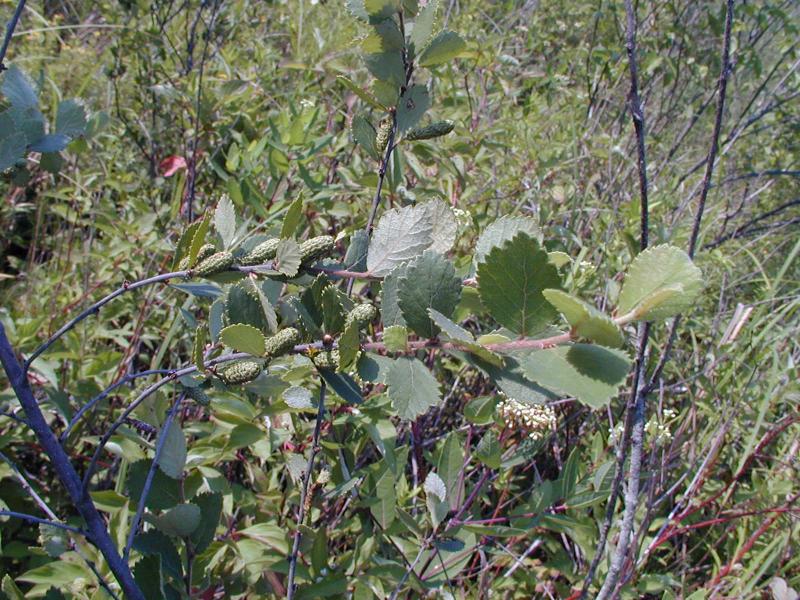
This is an erect woody shrub up to 2-3 meters tall, usually growing in colonies. The small rounded leaves are pale green to whitish underneath with large teeth on the edges. There are male and female birch catkins along the upper half of the branches.
Identifying Characteristics
A shrub to 2 meters tall (rarely as high as 3.5 meters). The young branchlets, with varying degrees of pubescence, are usually glandless but occasionally with scattered glandular dots. The leaves are submembranaceous, pale green to whitish beneath. The pistillate scales are 3-lobed, the middle lobe narrow and much longer than the lateral lobes. The wings of the fruit are barely as wide as the nutlet. In New York, this is a plant of calcareous wetlands and not alpine areas.
Best Life Stage for Proper Identification
Ideally, one would identify this from a plant with leaves and fruits. At a minimum, you need to have leaves and young branchlets, along with a good habitat and location description, to allow for proper identification.
Similar Species
Betula nana (=B. glandulosa) is an alpine birch that has resin glands copiously scattered on the young stems and leaves. Betula pumila var. glandulifera is morphologically very similar to Betula nana, but differs on ecological and cytological grounds. Any species keying to Betula nana based on the presence of glands but collected from a non-alpine area should presumably be Betula pumila var. glandulifera.
Best Time to See
Flowers first appear by late May to early June and new fruits may begin forming shortly after. This fruits usually persist through winter, but many remnant fruits may even persist for a few years. Surveys for this plant should occur between mid-April to mid-October.
- Vegetative
- Flowering
- Fruiting
The time of year you would expect to find Swamp Birch vegetative, flowering, and fruiting in New York.
Swamp Birch Images
Troy Weldy
Troy Weldy
Taxonomy
Swamp Birch
Betula pumila L.
- Kingdom Plantae
- Phylum Anthophyta
- Class Dicotyledoneae
(Dicots)
- Order Fagales
- Family Betulaceae (Birch Family)
- Order Fagales
- Class Dicotyledoneae
(Dicots)
- Phylum Anthophyta
Additional Common Names
- Bog Birch
- Dwarf Birch
- Low Birch
Synonyms
- Betula glandulosa var. glandulifera (Regel) Gleason
- Betula pumila var. glandulifera Regel
- Betula pumila var. pumila
Comments on the Classification
The classification of the dwarf birches has not yet been satisfactorily completed. The group is highly variable with two or three variants often growing together. The more alpine plants (Betula nana) are diploid (2n=28) while the less alpine plants (Betula pumila) are tetraploid (2n=56). The NY Natural Heritage Program is following the nomenclature of Mitchell and Tucker (1997) until such time when a clearer taxonomic understanding is complete.
Additional Resources
Best Identification Reference
Gleason, Henry A. and A. Cronquist. 1991. Manual of Vascular Plants of Northeastern United States and Adjacent Canada. The New York Botanical Garden, Bronx, New York. 910 pp.
Other References
Fernald, M.L. 1950. Gray's manual of botany. 8th edition. D. Van Nostrand, New York. 1632 pp.
Flora of North America Editorial Committee. 1997. Flora of North America, North of Mexico. Volume 3. Magnoliophyta: Magnoliidae and Hamamelidae.
Holmgren, Noel. 1998. The Illustrated Companion to Gleason and Cronquist's Manual. Illustrations of the Vascular Plants of Northeastern United States and Adjacent Canada. The New York Botanical Garden, Bronx, New York.
Mitchell, Richard S. and Gordon C. Tucker. 1997. Revised Checklist of New York State Plants. Contributions to a Flora of New York State. Checklist IV. Bulletin No. 490. New York State Museum. Albany, NY. 400 pp.
New York Natural Heritage Program. 2010. Biotics database. New York Natural Heritage Program. New York State Department of Environmental Conservation. Albany, NY.
New York Natural Heritage Program. 2024. New York Natural Heritage Program Databases. Albany, NY.
Reschke, Carol. 1990. Ecological communities of New York State. New York Natural Heritage Program, New York State Department of Environmental Conservation. Latham, NY. 96 pp. plus xi.
Soper, James H. and Margaret L. Heimburger. 1982. Shrubs of Ontario. The Royal Ontario Museum, Toronto, Canada, 495P.
Voss, E.G. 1985. Michigan Flora. Part II. Dicots (Saururaceae - Cornaceae). Cranbrook Institute of Science and University of Michigan Herbarium. Ann Arbor, Michigan. 724 pp.
Weldy, T. and D. Werier. 2010. New York flora atlas. [S.M. Landry, K.N. Campbell, and L.D. Mabe (original application development), Florida Center for Community Design and Research http://www.fccdr.usf.edu/. University of South Florida http://www.usf.edu/]. New York Flora Association http://newyork.plantatlas.usf.edu/, Albany, New York
Links
About This Guide
Information for this guide was last updated on: December 22, 2004
Please cite this page as:
New York Natural Heritage Program. 2024.
Online Conservation Guide for
Betula pumila.
Available from: https://guides.nynhp.org/swamp-birch/.
Accessed April 19, 2024.