Toothcup
Rotala ramosior (L.) Koehne
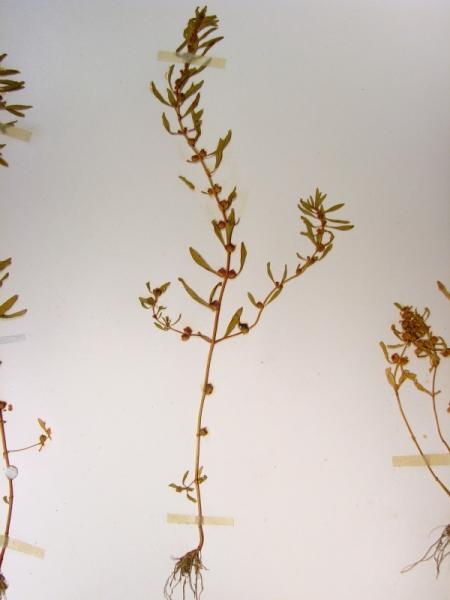
Rotala ramosior plant
Stephen M. Young
- Class
- Dicotyledoneae (Dicots)
- Family
- Lythraceae (Loosestrife Family)
- State Protection
- Threatened
Listed as Threatened by New York State: likely to become Endangered in the foreseeable future. For animals, taking, importation, transportation, or possession is prohibited, except under license or permit. For plants, removal or damage without the consent of the landowner is prohibited.
- Federal Protection
- Not Listed
- State Conservation Status Rank
- S2
Imperiled in New York - Very vulnerable to disappearing from New York due to rarity or other factors; typically 6 to 20 populations or locations in New York, very few individuals, very restricted range, few remaining acres (or miles of stream), and/or steep declines.
- Global Conservation Status Rank
- G5
Secure globally - Common in the world; widespread and abundant (but may be rare in some parts of its range).
Summary
Did you know?
This is by far our smallest plant in the loosestrife family in New York. The genus name means wheel and comes from the whorled leaves of some of the species that look like the spokes of a wheel. The species name means many-branched and refers to its habit (Fernald, 1970). This is the only species of the genus in the Western Hemisphere but some other old world species are popular aquarium plants.
State Ranking Justification
There are 10 existing populations but only four of these have more than 100 plants. There is one large population of over 2000 plants. The other populations are somewhat small and subject to human disturbance. Most of the 10 or so historical records are from developed areas of western Long Island and Staten Island and are considered extirpated. A few more populations may be found on eastern Long Island.
Short-term Trends
Short-term trends seem stable although more survey work would result in a better understanding of trends in a habitat where plants do not appear every year.
Long-term Trends
This species was always rare in New York. The 10 or so historical records from Western Long Island and Staten Island have been extirpated while populations on Eastern Long Island have mostly remained protected from development.
Conservation and Management
Threats
Threats include any damage or improper management of pond shores including trampling, ATV use, or mowing of the pond shore vegetation. The crowding out of pond shore vegetation by Phragmites is also a threat.
Conservation Strategies and Management Practices
The shoreline habitat where this species occurs should be protected from direct human disturbance during the growing season and from the invasion of exotic plant species.
Research Needs
It should be determined if this species is able to use artificial drainage basins, or sumps, in any significant numbers.
Habitat
Habitat
In New York tooth-cup has been found most often along the shorelines and edges of ponds and lakes, as well as those of artificial wetlands including reservoirs and roadside catchment basins. It also will occupy seasonally-wet sites such as wet meadows or agricultural fields, especially where paths or other disturbance provides bare soil substrate. It has been found growing in organic muck as well as in sandy soil (New York Natural Heritage Program 2007). Sandy shores and damp depressions (Fernald 1970). In mud or wet soil (Gleason 1952).
Associated Ecological Communities
- Artificial beach*
A sand beach constructed on a lake or river shore by depositing sand from outside the site onto the natural substrate; a sandy beach neither created nor maintained by natural lake shore or river processes.
- Artificial pool*
The aquatic community of a small pool that is constructed for recreational activities (e.g. swimming) or as a decorative element in a landscape design. The water is typically chlorinated, and flushed on a regular basis to reduce or eliminate the growth of algae, and bacteria; there is minimal development of any aquatic biota.
- Coastal plain pond shore
(guide)
The gently sloping shore of a coastal plain pond with seasonally and annually fluctuating water levels. Plants growing on the pond shore vary with water levels. In dry years when water levels are low there is often a dense growth of annual sedges, grasses, and herbs. Submerged and floating-leaved aquatic plants, such as fragrant waterlily and pondweeds, may become "stranded" on the exposed shore. In wet years when the water level is high only a few emergents and floating-leaved aquatics may be noticeable. T
- Cobble shore wet meadow*
(guide)
A community that occurs on the cobble shores of lakes and streams where the substrate is moist from seepage or intermittent flooding. These communities are likely to be scoured by floods or winter ice floes, but there is apparently no significant accumulation of pack ice.
- Marsh headwater stream*
(guide)
The aquatic community of a small, marshy perennial brook with a very low gradient, slow flow rate, and cool to warm water that flows through a marsh, fen, or swamp where a stream system originates. These streams usually have clearly distinguished meanders (i.e., high sinuosity) and are in unconfined landscapes.
- Reservoir/artificial impoundment
The aquatic community of an artificial lake created by the impoundment of a river with a dam. Reservoirs are constructed to collect water for municipal and/or agricultural water use, to provide hydroelectric power, and to improve opportunities for recreational activities (e.g., boating, swimming), and development.
- Unpaved road/path
A sparsely vegetated road or pathway of gravel, bare soil, or bedrock outcrop. These roads or pathways are maintained by regular trampling or scraping of the land surface. The substrate consists of the soil or parent material at the site which may be modified by the addition of local organic material (woodchips, logs, etc.) or sand and gravel. Abandoned railroad beds where tracks have been removed are included here. One characteristic plant is path rush.
* probable association but not confirmed.
Associated Species
- Bidens cernua (nodding beggar-ticks)
- Bidens frondosa (devil's beggar-ticks)
- Coreopsis rosea (pink coreopsis, pink tickseed)
- Cyperus strigosus (false yellow nut sedge)
- Eleocharis flavescens
- Eleocharis melanocarpa (black-fruited spike-rush)
- Eleocharis obtusa
- Eleocharis tricostata (three-ribbed spike-rush)
- Eriocaulon aquaticum (northern pipewort, northern hat-pins)
- Gratiola aurea (golden hedge-hyssop)
- Hypericum canadense (lesser Canadian St. John's-wort)
- Juncus effusus
- Juncus pelocarpus (brown-fruited rush)
- Lindernia dubia
- Ludwigia palustris (water-purslane)
- Lythrum salicaria (purple loosestrife)
- Mollugo verticillata (carpetweed)
- Persicaria lapathifolia (dock-leaved smartweed)
- Sagittaria teres (quill-leaved arrowhead)
Range
New York State Distribution
Today this species is known in the state from Long Island and the Lower Hudson Valley, as far north as Orange and Putnam Counties. There are historical records as far north as Ulster and Albany Counties.
Global Distribution
Tooth-cup is found in all U.S. states east of the Mississippi, except Maine and Vermont, and in just two Canadian Provinces: Ontario and British Columbia. It occurs in most of the western U.S. as well, and its range extends to South America.
Identification Comments
General Description
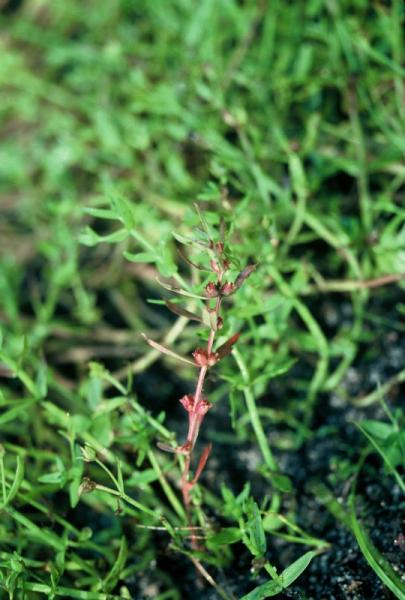
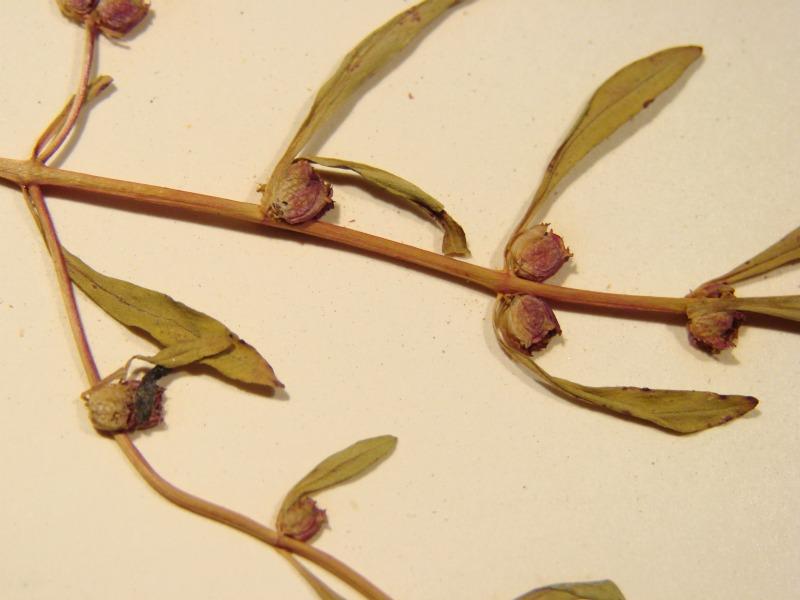
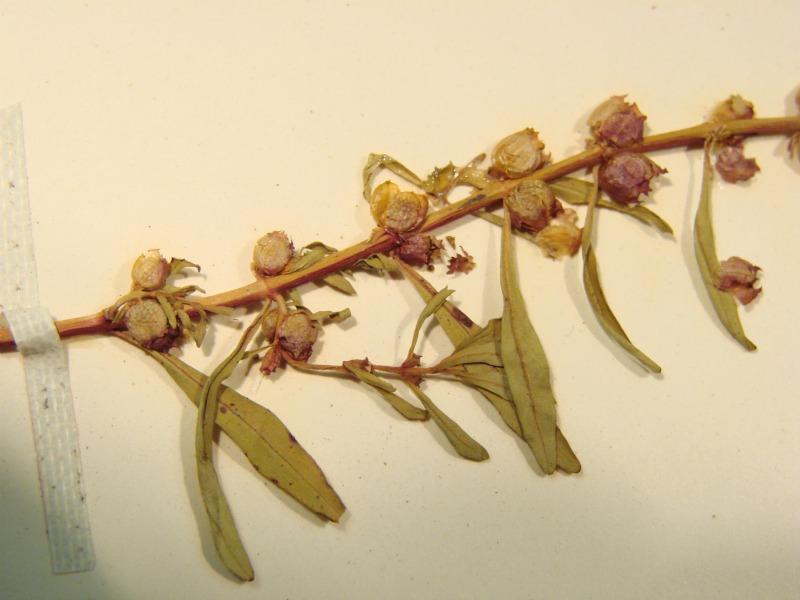
Tooth-cup is a small (up to 10 cm high), annual species with often spreading or prostrate, branching stems. The leaves are opposite, short and narrow (1.5 to 3 cm long), and the stem, and sometimes the leaves as well, may be flushed with red (Voss 1985). The tiny, solitary flowers are sessile in the axils of the upper leaves. The calyx is cup-shaped and 1-4 mm long, and the petals white and only 1 mm long.
Best Life Stage for Proper Identification
Flowering of fruiting specimens are best for identification, though it may be possible to identify this plant from only vegetative parts.
Similar Species
Tooth-cup is the only species of Rotala in New York (or for that matter, in North America.) Marsh seedbox (Ludwigia palustris), a common species which grows in similar habitats, has a similar overall appearance, but with much broader leaves and longer calyx lobes than tooth-cup. Rotala ramosior also confused with Ammania coccinea, a related species not yet known from New York but found in New Jersey and Pennsylvania, which differs from Tooth-cup by its cordate, clasping leaf bases.
Best Time to See
Tooth-cup flowers from July through September, the fruits persisting through October.
- Flowering
- Fruiting
The time of year you would expect to find Toothcup flowering and fruiting in New York.
Toothcup Images
Stephen M. Young
Stephen M. Young
Stephen M. Young
Stephen M. Young
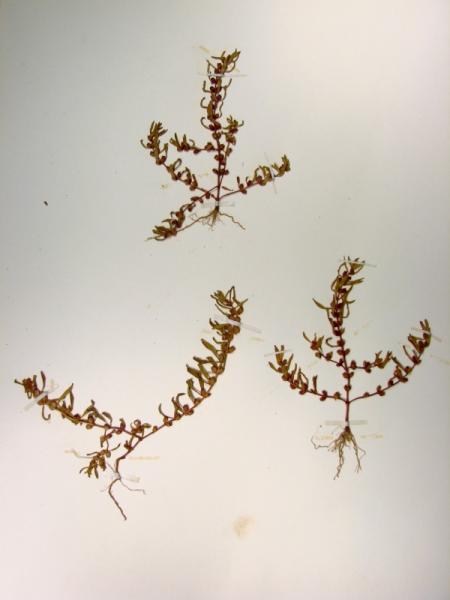
Stephen M. Young
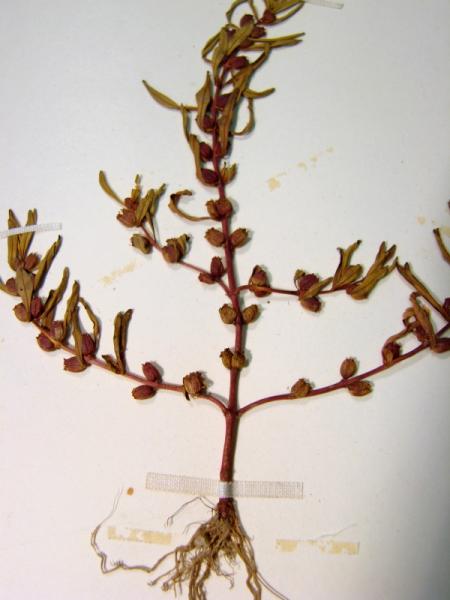
Stephen M. Young
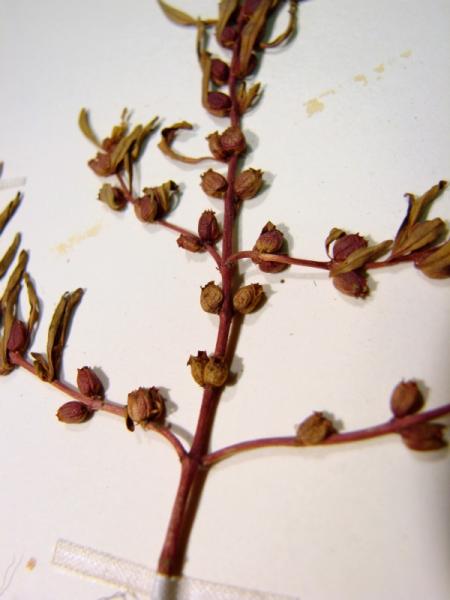
Stephen M. Young
Taxonomy
Toothcup
Rotala ramosior (L.) Koehne
- Kingdom Plantae
- Phylum Anthophyta
- Class Dicotyledoneae
(Dicots)
- Order Myrtales
- Family Lythraceae (Loosestrife Family)
- Order Myrtales
- Class Dicotyledoneae
(Dicots)
- Phylum Anthophyta
Additional Common Names
- Tooth Cup
Synonyms
- Ammania ramosior L.
- Rotala ramosior var. interior Fernald & Griscom
Additional Resources
Best Identification Reference
Gleason, Henry A. and A. Cronquist. 1991. Manual of Vascular Plants of Northeastern United States and Adjacent Canada. The New York Botanical Garden, Bronx, New York. 910 pp.
Other References
Fernald, M.L. 1950. Gray's manual of botany. 8th edition. D. Van Nostrand, New York. 1632 pp.
Holmgren, Noel. 1998. The Illustrated Companion to Gleason and Cronquist's Manual. Illustrations of the Vascular Plants of Northeastern United States and Adjacent Canada. The New York Botanical Garden, Bronx, New York.
New York Natural Heritage Program. 2010. Biotics database. New York Natural Heritage Program. New York State Department of Environmental Conservation. Albany, NY.
New York Natural Heritage Program. 2024. New York Natural Heritage Program Databases. Albany, NY.
Rhoads, Ann F. and Timothy A. Block. 2000. The Plants of Pennsylvania, an Illustrated Manual. University of Pennsylvania Press, Philadelphia, PA.
Weldy, T. and D. Werier. 2010. New York flora atlas. [S.M. Landry, K.N. Campbell, and L.D. Mabe (original application development), Florida Center for Community Design and Research http://www.fccdr.usf.edu/. University of South Florida http://www.usf.edu/]. New York Flora Association http://newyork.plantatlas.usf.edu/, Albany, New York
Weldy, Troy W. and David Werier. 2005. New York Flora Atlas. [S.M. Landry, K.N. Campbell, and L.D. Mabe (original application development), Florida Center for Community Design and Research. University of South Florida]. New York Flora Association, Albany, NY. Available on the web at (http://newyork.plantatlas.usf.edu/).
Links
About This Guide
Information for this guide was last updated on: December 29, 2008
Please cite this page as:
New York Natural Heritage Program. 2024.
Online Conservation Guide for
Rotala ramosior.
Available from: https://guides.nynhp.org/tooth-cup/.
Accessed April 25, 2024.