Heart-leaved Plantain
Plantago cordata Lam.
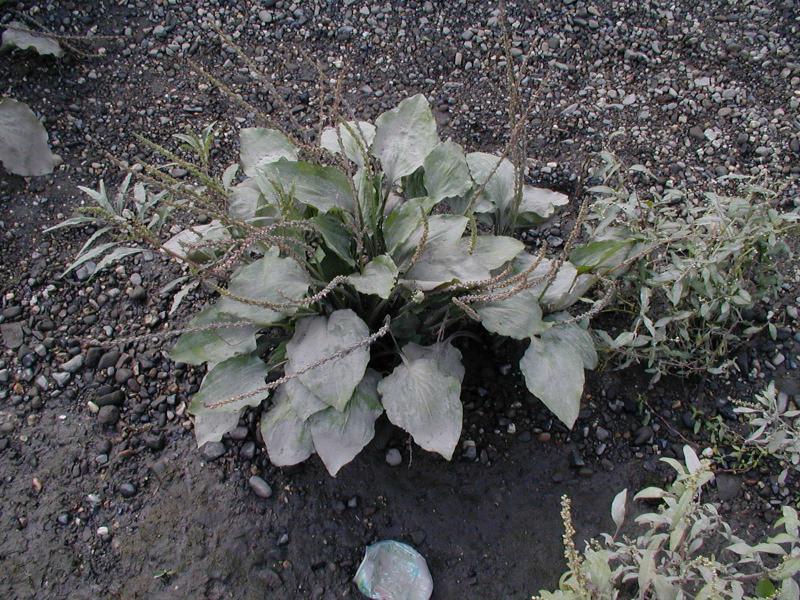
Plantago cordata
Troy Weldy
- Class
- Dicotyledoneae (Dicots)
- Family
- Plantaginaceae (Plantain Family)
- State Protection
- Rare
A plant listed as Rare by New York State. Removal or damage without the consent of the landowner is prohibited.
- Federal Protection
- Not Listed
- State Conservation Status Rank
- S3
Vulnerable in New York - Vulnerable to disappearing from New York due to rarity or other factors (but not currently imperiled); typically 21 to 80 populations or locations in New York, few individuals, restricted range, few remaining acres (or miles of stream), and/or recent and widespread declines.
- Global Conservation Status Rank
- G4
Apparently Secure globally - Uncommon in the world but not rare; usually widespread, but may be rare in some parts of its range; possibly some cause for long-term concern due to declines or other factors.
Summary
Did you know?
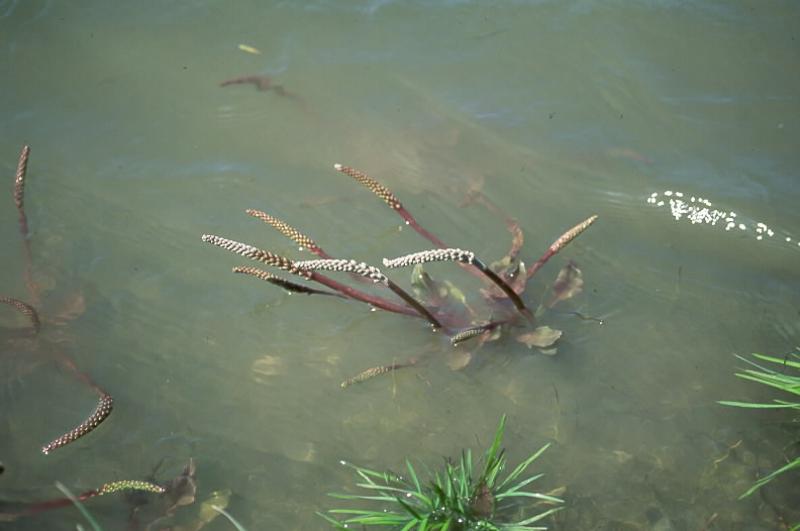
New York has more populations of this plant than any other state. It was only known from the tidal marshes along the Hudson River until the 1990s when a population was found along a stream in western New York. During river flooding and high tides, these plants may be submerged completely for long periods of time. The specific name refers to its heart-shaped leaves.
State Ranking Justification
There are nearly 30 known populations and sub-populations scattered along the freshwater tidal areas of the Hudson River, with a few disjunct populations in western New York. Many of these populations have fewer than 40 individuals, but at least three have more than 1,000 plants. There are some threats associated with this plant, but none are expected to have immediate or severe impacts. New York and Missouri share the greatest responsibility in ensuring the long-term protection of this unique Plantago.
Short-term Trends
Populations seem stable at this time.
Long-term Trends
Based on limited evidence, this plant at least appears to have a similar distribution and population abundance as it did in early colonial days. There is even some suggestion that it has increased in abundance due to the protection of various areas along the Hudson River.
Conservation and Management
Threats
Some of the smaller populations may be threatened with changes in the shoreline from floods or wake erosion.
Conservation Strategies and Management Practices
There are no management needs at this time but marina and boat dock development and river traffic should be assessed periodically.
Research Needs
There are no research needs at this time.
Habitat
Habitat
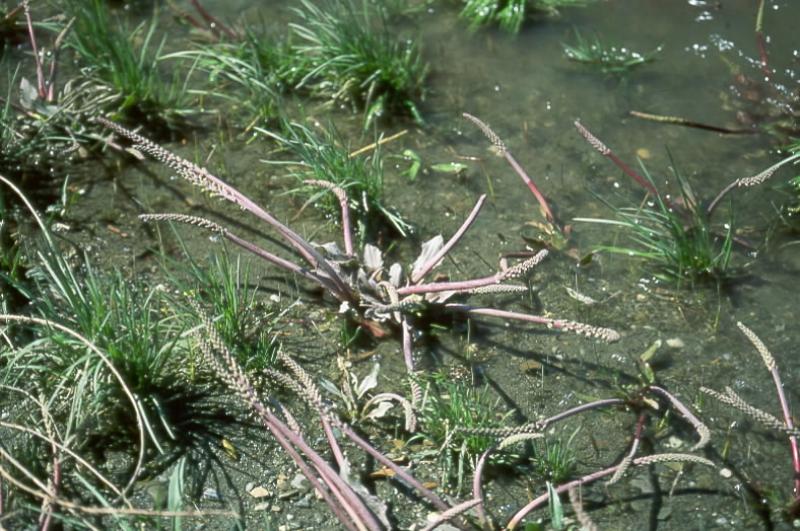
A plant of two different areas and habitats in New York. In the Hudson Valley, it is restricted to the edges of freshwater intertidal mudflats, sandy or rocky shorelines of tidal creeks and other waterways, edges of freshwater tidal marshes, and gravel shores along the freshwater tidal portions of the Hudson River. In western New York, it is found along gravelly streams through red maple-hardwood swamps of the Tonawanda Oak Orchard Swamp drainage (New York Natural Heritage Program 2004). Semi-aquatic, in marshes and along streams, especially on calcareous substrate (Gleason & Cronquist 1991). In and along streams and swampy woods (Fernald 1970).
Associated Ecological Communities
- Freshwater intertidal mudflats
(guide)
A sparsely vegetated community characterized by low rosette-leaved aquatics. This community occurs on exposed intertidal mudflats where the water is fresh (salinity less than 0.5 ppt). This community is best developed where mudflats are nearly level so that broad expanses are exposed at low tide. The plants are completely submerged in 0.9 to 1.2 m (3 to 4 ft) of water at high tide and they are usually coated with mud.
- Freshwater intertidal shore
(guide)
A community of the intertidal gravelly or rocky shores of freshwater tidal rivers and creeks, sometimes occurring at the base of cliffs. The vegetation may be very sparse.
- Freshwater tidal creek
(guide)
The aquatic community of a shallow, tidally flooded freshwater creek with submerged areas averaging less than 2 m (6 ft) deep at low tide.
- Freshwater tidal marsh
(guide)
A marsh community that occurs in shallow bays, shoals, and at the mouth of tributaries of large tidal river systems, where the water is usually fresh (salinity less than 0.5 ppt), and less than 2 m (6 ft) deep at high tide. Typically there are two zones in a freshwater tidal marsh: a low-elevation area dominated by short, broadleaf emergents bordering mudflats or open water, and a slightly higher-elevation area dominated by tall grass-like plants.
- Marsh headwater stream
(guide)
The aquatic community of a small, marshy perennial brook with a very low gradient, slow flow rate, and cool to warm water that flows through a marsh, fen, or swamp where a stream system originates. These streams usually have clearly distinguished meanders (i.e., high sinuosity) and are in unconfined landscapes.
- Red maple-hardwood swamp*
(guide)
A hardwood swamp that occurs in poorly drained depressions, usually on inorganic soils. Red maple is usually the most abundant canopy tree, but it can also be codominant with white, green, or black ash; white or slippery elm; yellow birch; and swamp white oak.
* probable association but not confirmed.
Associated Species
- Acer rubrum var. rubrum (common red maple)
- Acer saccharinum (silver maple)
- Alisma subcordatum (southern water-plantain)
- Amaranthus cannabinus (salt marsh water-hemp)
- Amorpha fruticosa (false indigo-bush)
- Amphicarpaea bracteata (hog peanut)
- Bidens bidentoides (estuary beggar-ticks)
- Bidens cernua (nodding beggar-ticks)
- Elodea canadensis (Canada waterweed)
- Helenium autumnale (common sneezeweed)
- Lindernia dubia
- Lobelia cardinalis (cardinal flower)
- Ludwigia palustris (water-purslane)
- Lysimachia ciliata (fringed-loosestrife)
- Orontium aquaticum (golden-club)
- Peltandra virginica (green arrow-arum, tuckahoe)
- Pilea fontana (black-fruited clearweed)
- Pilea pumila
- Pontederia cordata (pickerelweed)
- Rudbeckia hirta (common black-eyed Susan)
- Sagittaria graminea
- Sagittaria latifolia (common arrowhead)
- Trapa natans (water-chestnut)
- Vitis riparia (river grape, frost grape)
- Zizania aquatica
Range
New York State Distribution
With the exception of a few populations in the Tonawanda Creek drainage of western New York, all known and historical populations are located along the Hudson River. There are historical records from New York City to the Castleton Bridge. Today, extant populations along the Hudson River are only known within freshwater tidal areas from the Rondout Creek mouth northward towards Troy.
Global Distribution
Heartleaf plantain is characterized by a widespread geographical range within which it is highly localized. A high proportion of the populations are located along the Hudson River, but populations range from New York, south to Virginia, North Carolina, Georgia, and Alabama. It is disjunct inland to Ohio, southern Ontario, Wisconsin, and south through the Mississippi Valley.
Identification Comments
General Description
This is a short plant, under 30 cm, with compact clumps of many large, shiny-green, strongly-veined, heart-shaped leaves up to 25 cm long and 20 cm wide. The leaves arch out on long stalks from the center of the clump and are often covered with a fine layer of mud from being submerged during high tide. The thick pink flower stalks arise from the center of the clump in early spring and are topped by a spike covered with many tiny greenish flowers with stamens that stick out. These mature into small, green, egg-shaped fruits.
Identifying Characteristics
A plant of wet soils with several long, fleshy roots that are 0.5-1.3 cm thick. One of these roots will often become horizontal. The leaves are large and heart-shaped when mature. The main lateral veins tend to arise from the midrib within the blade The lower 2-4 lateral ribs are scattered, but confluent with the midrib. The inflorescence axis is exposed between the flowers.
Best Life Stage for Proper Identification
A plant with flowers or fruits and expanded leaves is best for proper identification. At a minimum, one needs fully expanded leaves along with a habitat description.
Similar Species
Common plantain (Plantago major) has slender fibrous roots, solid stems, and lower lateral leaf ribs approximate to the midrib but not confluent with it.
Best Time to See
This plantain flowers from April (starting before the leaves come out) through July with mature fruits present in August and September. The ideal survey period is mid-May to early October.
- Vegetative
- Flowering
- Fruiting
The time of year you would expect to find Heart-leaved Plantain vegetative, flowering, and fruiting in New York.
Heart-leaved Plantain Images
Troy Weldy
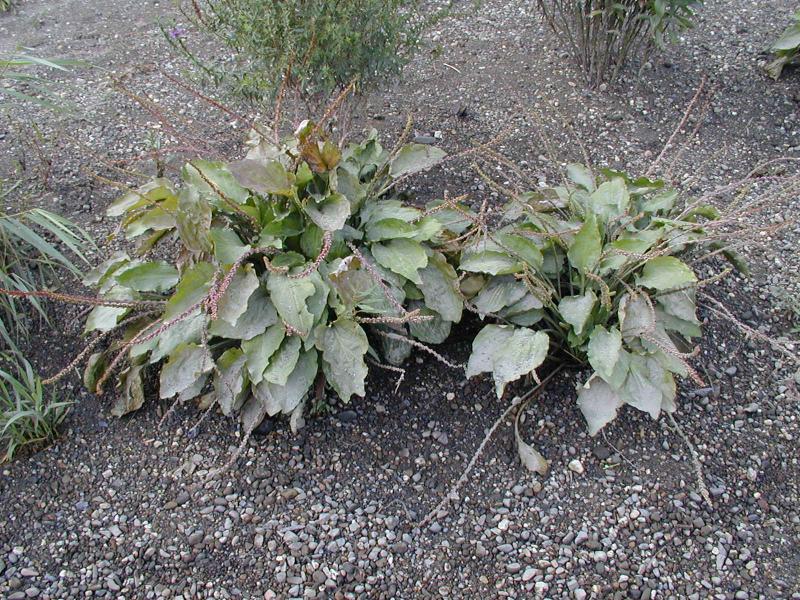
Troy Weldy
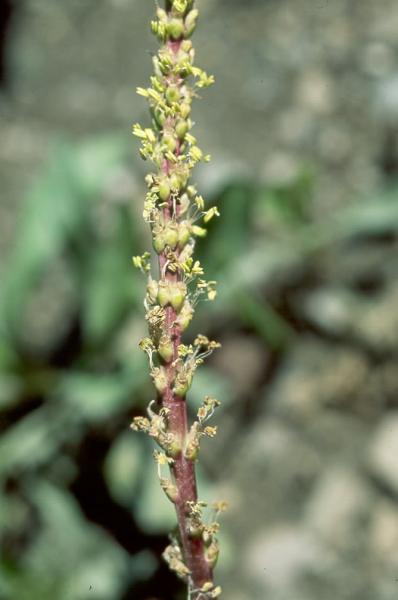
Stephen M. Young
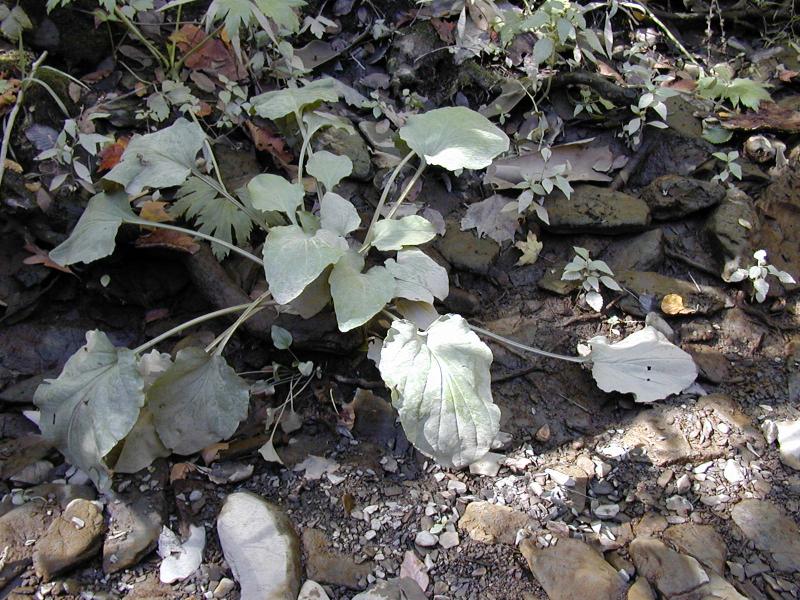
Troy Weldy
Stephen M. Young
Stephen M. Young
Taxonomy
Heart-leaved Plantain
Plantago cordata Lam.
- Kingdom Plantae
- Phylum Anthophyta
- Class Dicotyledoneae
(Dicots)
- Order Plantaginales
- Family Plantaginaceae (Plantain Family)
- Order Plantaginales
- Class Dicotyledoneae
(Dicots)
- Phylum Anthophyta
Synonyms
- Plantago kentukensis Michx.
Additional Resources
Best Identification Reference
Gleason, Henry A. and A. Cronquist. 1991. Manual of Vascular Plants of Northeastern United States and Adjacent Canada. The New York Botanical Garden, Bronx, New York. 910 pp.
Other References
Fernald, M.L. 1950. Gray's manual of botany. 8th edition. D. Van Nostrand, New York. 1632 pp.
Holmgren, Noel. 1998. The Illustrated Companion to Gleason and Cronquist's Manual. Illustrations of the Vascular Plants of Northeastern United States and Adjacent Canada. The New York Botanical Garden, Bronx, New York.
Meagher, T.R., J. Antonovics, and R. Primack 1978. Experimental Ecological Genetics in Plantago, III. Genetic Variation and Demography in Relation to Survival of Plantago cordata, a Rare Species. Biol. Conserv. 14:243-257.
Mitchell, Richard S. and Gordon C. Tucker. 1997. Revised Checklist of New York State Plants. Contributions to a Flora of New York State. Checklist IV. Bulletin No. 490. New York State Museum. Albany, NY. 400 pp.
New York Natural Heritage Program, New York State Department of Enviromental Conservation. March 1998. Element Occurrence Record Database. Latham, NY.
New York Natural Heritage Program. 2024. New York Natural Heritage Program Databases. Albany, NY.
Reschke, Carol. 1990. Ecological communities of New York State. New York Natural Heritage Program, New York State Department of Environmental Conservation. Latham, NY. 96 pp. plus xi.
Tessene, M.F. 1969. Systematic and Ecological Studies on Plantago cordata. Mich. Bot. 8:72-103.
Weldy, T. and D. Werier. 2010. New York flora atlas. [S.M. Landry, K.N. Campbell, and L.D. Mabe (original application development), Florida Center for Community Design and Research http://www.fccdr.usf.edu/. University of South Florida http://www.usf.edu/]. New York Flora Association http://newyork.plantatlas.usf.edu/, Albany, New York
Links
About This Guide
Information for this guide was last updated on: January 15, 2009
Please cite this page as:
New York Natural Heritage Program. 2024.
Online Conservation Guide for
Plantago cordata.
Available from: https://guides.nynhp.org/heart-leaved-plantain/.
Accessed April 25, 2024.