Northern Monkshood
Aconitum noveboracense Gray ex Coville
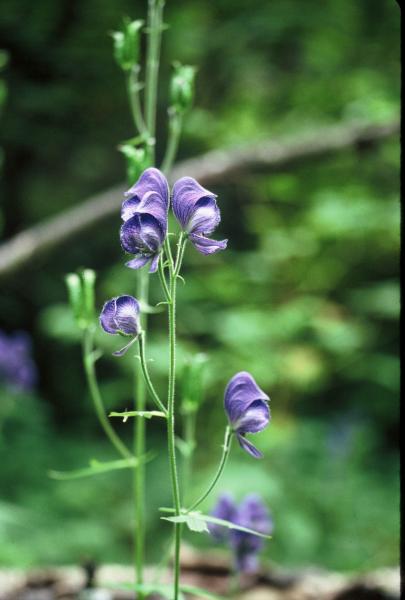
Aconitum noveboracense flowers
Stephen M. Young
- Class
- Dicotyledoneae (Dicots)
- Family
- Ranunculaceae (Buttercup Family)
- State Protection
- Endangered
Listed as Endangered by New York State: in imminent danger of extirpation in New York. For animals, taking, importation, transportation, or possession is prohibited, except under license or permit. For plants, removal or damage without the consent of the landowner is prohibited.
- Federal Protection
- Threatened
Listed as Threatened under the Federal Endangered Species Act
- State Conservation Status Rank
- S1
Critically Imperiled in New York - Especially vulnerable to disappearing from New York due to extreme rarity or other factors; typically 5 or fewer populations or locations in New York, very few individuals, very restricted range, very few remaining acres (or miles of stream), and/or very steep declines.
- Global Conservation Status Rank
- G3
Vulnerable globally - At moderate risk of extinction due to rarity or other factors; typically 80 or fewer populations or locations in the world, few individuals, restricted range, few remaining acres (or miles of stream), and/or recent and widespread declines.
Summary
Did you know?
Northern monk's-hood is considered one of the most beautiful rare plants in New York. It is the signature plant of New York's Eastern Chapter of the Nature Conservancy. Genetic studies are presently under way to determine its relationship with the more common Aconitum columbianum. Some taxonomists do not consider it a distinct species.
State Ranking Justification
There are five viable populations with plants numbering in the hundreds for each population. There are five populations which were very small in the past and have not been seen in many years. These are probably gone. Even though these populations are isolated in the Catskill Mountains, threats are high.
Short-term Trends
The species can fluctuate greatly from year to year in the stream bank populations that are subject to flooding. There is less fluctuation in the wetland populations but they may be affected by deer browse from year-to-year.
Long-term Trends
There has been a substantial decline from population sizes that were measured in the early 1980s. This is probably due to the repeated severe flooding of Catskill streams.
Conservation and Management
Threats
Rivers may be threatened by trout stream improvements and flood control projects and some populations are probably damaged by fishers and hikers as well as severe flooding along the streams.
Conservation Strategies and Management Practices
Studies need to be undertaken to see which management regime is best for this species. Do the plants need disturbance or do they flourish because of it?
Research Needs
Genetic studies are needed to determine the relationship of Catskill plants to Midwestern plants. Should they be considered a separate species or subspecies? More propagation studies are needed to see if populations can be augmented after they are destroyed by flooding or other natural or human events.
Habitat
Habitat
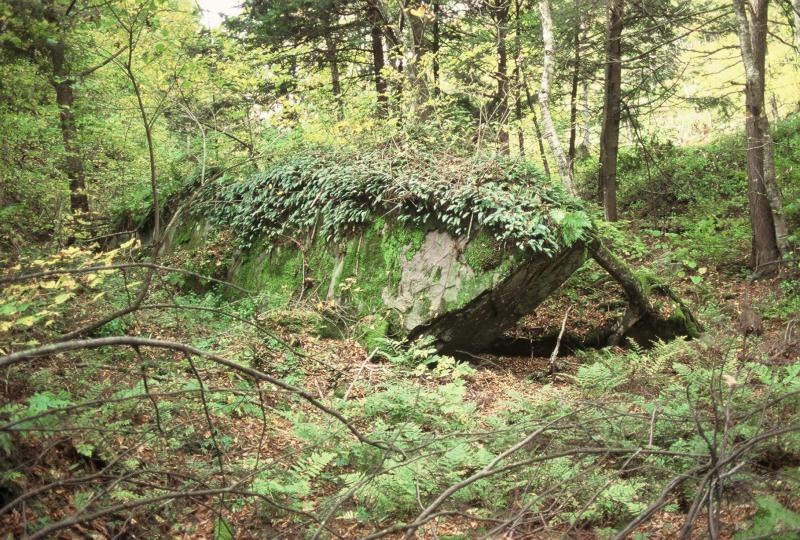
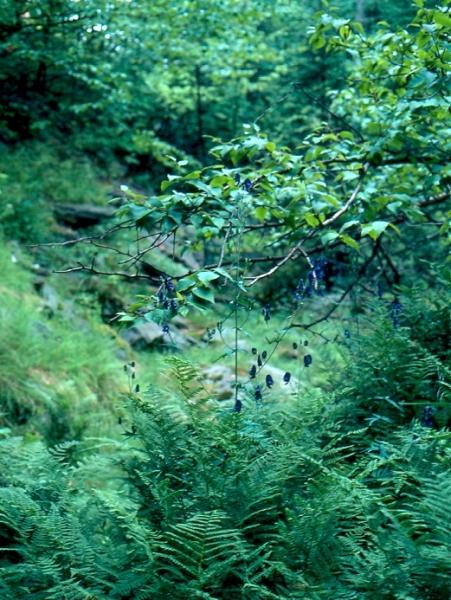
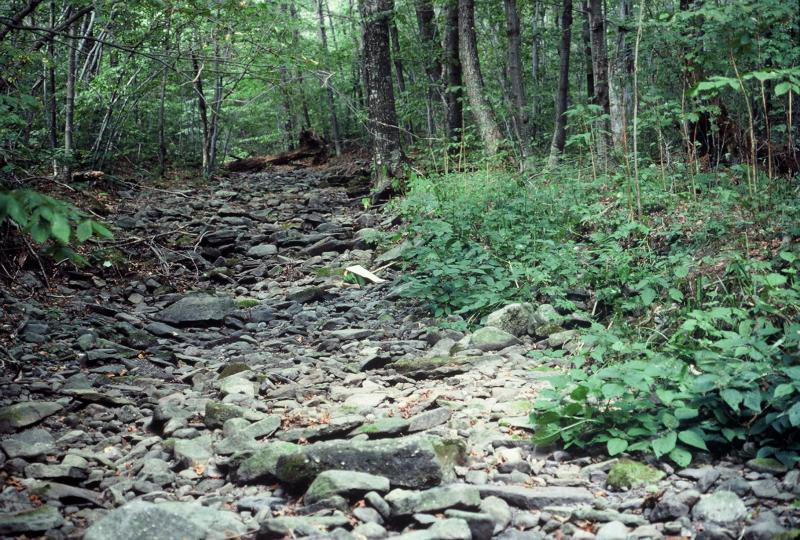
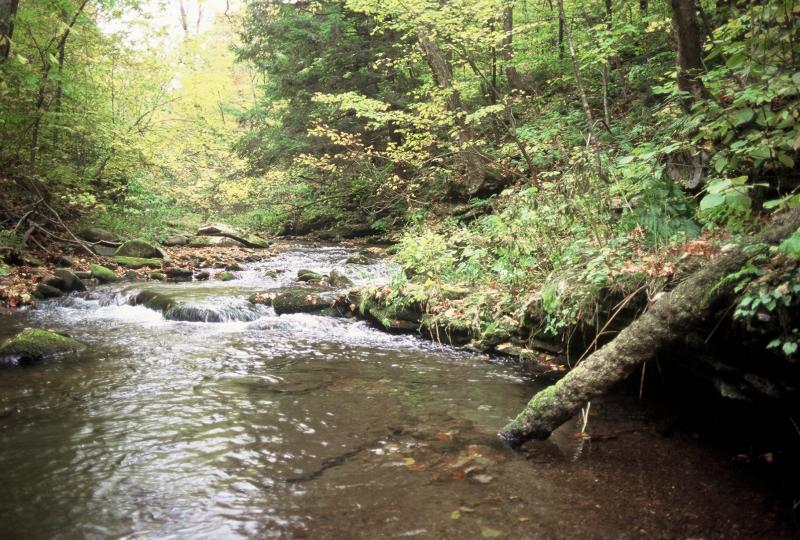
In New York, Northern Monkshood occurs along streams (or in one case, a cliffside seep), shaded by beech, sugar maple, yellow birch, or eastern hemlock. All existing occurrences have been found on sandstone-derived rocky or sandy soils, at elevations ranging between 400 and 1000 meters (New York Natural Heritage Program 2007).
Associated Ecological Communities
- Acidic talus slope woodland*
(guide)
An open to closed canopy woodland that occurs on talus slopes (slopes of boulders and rocks, often at the base of cliffs) composed of non-calcareous rocks such as granite, quartzite, or schist.
- Beech-maple mesic forest
(guide)
A hardwood forest with sugar maple and American beech codominant. This is a broadly defined community type with several variants. These forests occur on moist, well-drained, usually acid soils. Common associates are yellow birch, white ash, hop hornbeam, and red maple.
- Calcareous cliff community
(guide)
A community that occurs on vertical exposures of resistant, calcareous bedrock (such as limestone or dolomite) or consolidated material; these cliffs often include ledges and small areas of talus.
- Hemlock-northern hardwood forest
(guide)
A mixed forest that typically occurs on middle to lower slopes of ravines, on cool, mid-elevation slopes, and on moist, well-drained sites at the margins of swamps. Eastern hemlock is present and is often the most abundant tree in the forest.
- Ice cave talus community
(guide)
A community that occurs on rocks and soil at the base of slopes of loose rocks (often below cliffs; these are talus slopes) that emit cold air. The emission of cold air results from air circulation among the rocks of the talus slope where winter ice remains through the summer. The vegetation is distinctive because it includes species characteristic of climates much cooler than the climate of the area where the ice caves occur.
* probable association but not confirmed.
Associated Species
- Acer saccharum (sugar maple)
- Betula alleghaniensis (yellow birch)
- Dryopteris carthusiana (spinulose wood fern)
- Fagus grandifolia (American beech)
- Impatiens capensis (spotted jewelweed, spotted touch-me-not)
- Laportea canadensis (wood-nettle)
- Oclemena acuminata (whorled wood-aster)
- Tsuga canadensis (eastern hemlock)
- Urtica dioica
Range
New York State Distribution
In New York this species is only known from Delaware, Ulster, and Sullivan counties, and historically from Chenango County. The Catskill populations are disjunct from Ohio, Iowa, and Wisconsin, but they have a similar genetic makeup.
Global Distribution
This species is known from only three isolated geographic regions: the Catskill Mountains of New York, northeastern Ohio, and the "Driftless Area" (unglaciated portion) of northeast Iowa and southwest Wisconsin.
Identification Comments
General Description
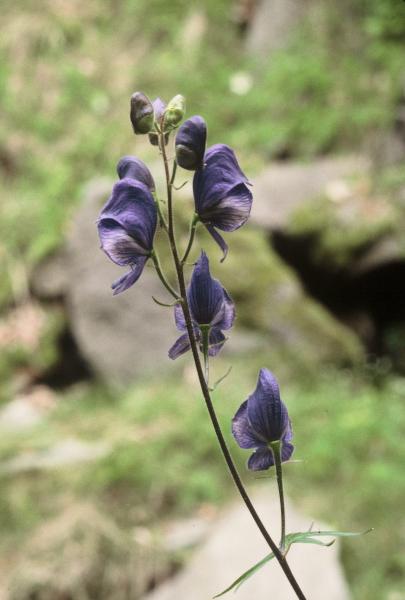
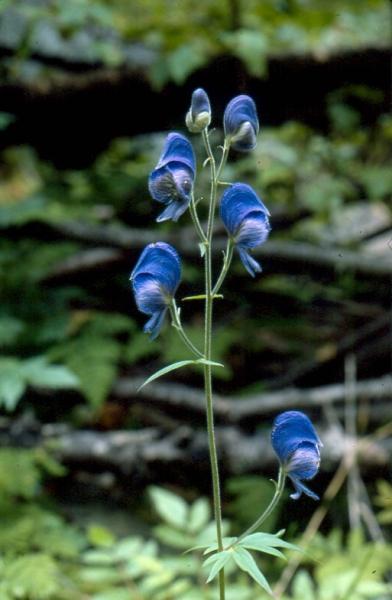
Northern Monk's hood is an upright herbaceous perennial, with alternate leaves. Each leaf is made up of five to seven wedge-shaped, coarsely-toothed lobes. The stem is topped by a spike of dark purple to blue (rarely white), larkspur-shaped flowers, with "hoods" on the top.
Best Life Stage for Proper Identification
While it's possible to identify this plant in fruit, or even from dried persisting fruit stalks, for easy identification it is best to search for it in flower.
Similar Species
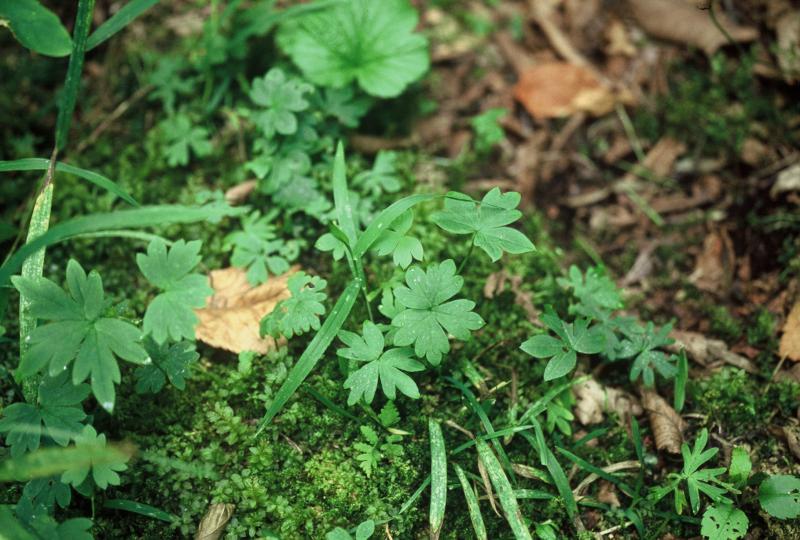
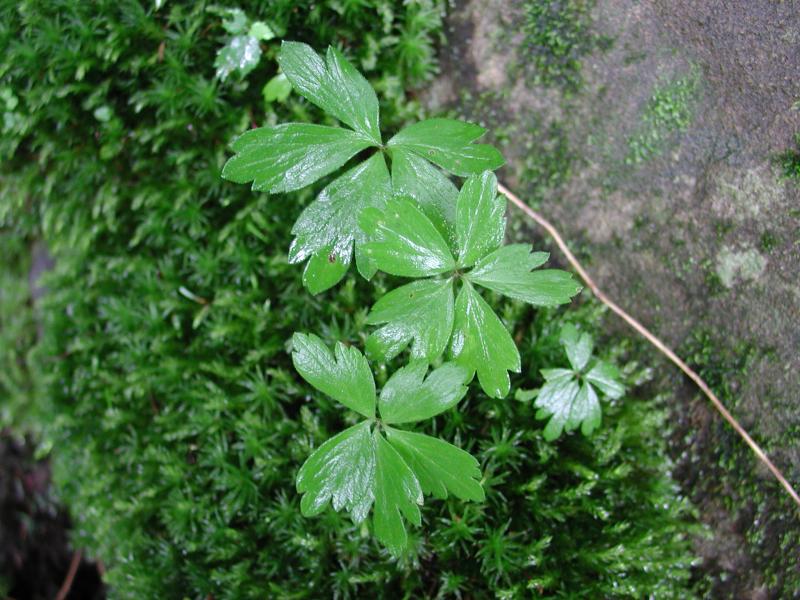
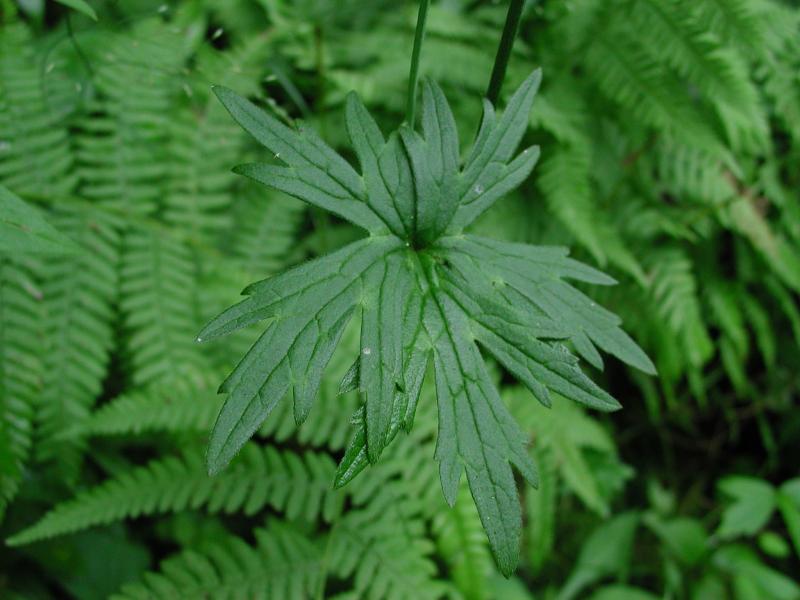
The shape of the flowers makes this genus distinctive. Garden aconite (Aconitum napellus), is the only other species of Aconitum found in New York. It is a stouter plant, with larger flowers and more deeply cleft leaves. It is rare that this species would escape from gardens and unlikely for it to co-occur with our native species. For leaf identification the following characters should be useful: Aconitum has 5 "leaflets" that are joined at the base and not on separate petioles as in Ranunculus hispidus. The first lobes from the bottom of the leaflets of Aconitum are large and angle out from the leaflet with usually 2-3 additional big secondary lobes. Leaves of Ranunculus acris are similar but in Geranium maculatum the first lobes are not much larger than the upper central leaflet and usually have small secondary lobes on them. Ranunculus hispidus has leaves with mostly three leaflets that are stalked. Ranunculus recurvatus has a central leaflet sometimes without the two larger lobes or the lateral lobes have small secondary lobes like Geranium. Ranunculus acris has unlobed basal leaves and upper leaves with a few narrow leaflets. Aconitum petioles are glabrous or have tiny white hairs that arch over and the blades are glabrous or with scattered tiny white hairs. The secondary veins are faint. Geranium maculatum and other similar Ranunculus species have sparse to dense long white hairs that cover the petiole and leaves.
Best Time to See
Northern Monk's-hood flowers in July or August, and the fruits persist well into the fall.
- Flowering
- Fruiting
The time of year you would expect to find Northern Monkshood flowering and fruiting in New York.
Northern Monkshood Images
Stephen M. Young
Stephen M. Young
Stephen M. Young
Stephen M. Young
Beth Yanuck-Platt
Beth Yanuck-Platt
Beth Yanuck-Platt
J. Platt
Stephen M. Young
Images of Similar Species
Stephen M. Young
Stephen M. Young
Taxonomy
Northern Monkshood
Aconitum noveboracense Gray ex Coville
- Kingdom Plantae
- Phylum Anthophyta
- Class Dicotyledoneae
(Dicots)
- Order Ranunculales
- Family Ranunculaceae (Buttercup Family)
- Order Ranunculales
- Class Dicotyledoneae
(Dicots)
- Phylum Anthophyta
Additional Common Names
- New York Monk's-hood
Synonyms
- Aconitum columbianum Nutt. [in part]
- Aconitum columbianum ssp. columbianum
- Aconitum columbianum var. columbianum
- Aconitum uncinatum L. [not L.; Torrey "vouchers" of A. uncinatum are apparently from out-of-state.]
Additional Resources
Best Identification Reference
Gleason, Henry A. and A. Cronquist. 1991. Manual of Vascular Plants of Northeastern United States and Adjacent Canada. The New York Botanical Garden, Bronx, New York. 910 pp.
Other References
Fernald, M. L. 1950. Gray's manual of botany. 8th edition. Corrected printing (1970). D. Van Nostrand Company, New York. 1632 pp.
Flora of North America Editorial Committee. 1997. Flora of North America, North of Mexico. Volume 3. Magnoliophyta: Magnoliidae and Hamamelidae.
Gleason, H.A. 1952. The new Britton and Brown illustrated flora of the northeastern United States and adjacent Canada. 3 volumes. Hafner Press, New York. 1732 pp.
Holmgren, Noel. 1998. The Illustrated Companion to Gleason and Cronquist's Manual. Illustrations of the Vascular Plants of Northeastern United States and Adjacent Canada. The New York Botanical Garden, Bronx, New York.
McCance, R.M., Jr., and J.F. Burns, eds. 1984. Ohio endangered and threatened vascular plants: Abstracts of state-listed taxa. Division Natural Areas and Preserves, Ohio Dept. Natural Resources, Columbus. 635 pp.
Mitchell, Richard S. and Charles J. Sheviak. 1981. Rare Plants of New York State. Bull No. 445. New York State Museum. Univ. of New York. State Ed. Department Albany, NY.
Mitchell, Richard S. and Gordon C. Tucker. 1997. Revised Checklist of New York State Plants. Contributions to a Flora of New York State. Checklist IV. Bulletin No. 490. New York State Museum. Albany, NY. 400 pp.
New York Natural Heritage Program. 2010. Biotics database. New York Natural Heritage Program. New York State Department of Environmental Conservation. Albany, NY.
New York Natural Heritage Program. 2024. New York Natural Heritage Program Databases. Albany, NY.
Office of Endangered Species. 1986. Endangered species information system, species record for Aconitum noveboracense. 19 pp.
Read, R.H., and J.B. Hale. 1981. National recovery plan for the northern monk's hood (Aconitum noveboracense). U.S. Fish and Wildlife Service, Washington, DC.
U.S. Fish and Wildlife Service (USFWS). 1978. Determination that 11 plant taxa are endangered species and 2 plant taxa are threatened species. Federal Register 43(81): 17910-17916.
Weldy, T. and D. Werier. 2010. New York flora atlas. [S.M. Landry, K.N. Campbell, and L.D. Mabe (original application development), Florida Center for Community Design and Research http://www.fccdr.usf.edu/. University of South Florida http://www.usf.edu/]. New York Flora Association http://newyork.plantatlas.usf.edu/, Albany, New York
Weldy, Troy W. and David Werier. 2005. New York Flora Atlas. [S.M. Landry, K.N. Campbell, and L.D. Mabe (original application development), Florida Center for Community Design and Research. University of South Florida]. New York Flora Association, Albany, NY. Available on the web at (http://newyork.plantatlas.usf.edu/).
Links
About This Guide
Information for this guide was last updated on: February 21, 2019
Please cite this page as:
New York Natural Heritage Program. 2024.
Online Conservation Guide for
Aconitum noveboracense.
Available from: https://guides.nynhp.org/northern-monkshood/.
Accessed April 19, 2024.