Wheat Sedge
Carex atherodes Spreng.
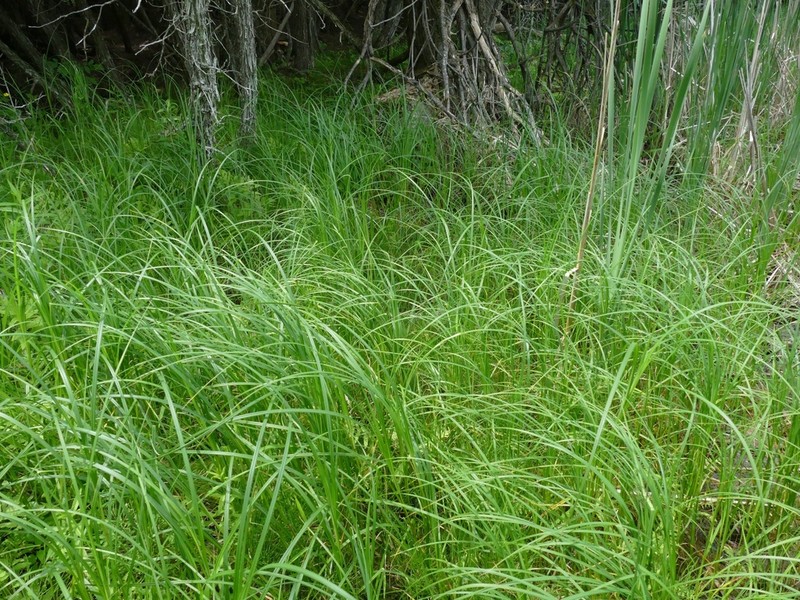
Carex atherodes
Steven Daniel
- Class
- Monocotyledoneae (Monocots)
- Family
- Cyperaceae (Sedge Family)
- State Protection
- Rare
A plant listed as Rare by New York State. Removal or damage without the consent of the landowner is prohibited.
- Federal Protection
- Not Listed
- State Conservation Status Rank
- S3
Vulnerable in New York - Vulnerable to disappearing from New York due to rarity or other factors (but not currently imperiled); typically 21 to 80 populations or locations in New York, few individuals, restricted range, few remaining acres (or miles of stream), and/or recent and widespread declines.
- Global Conservation Status Rank
- G5
Secure globally - Common in the world; widespread and abundant (but may be rare in some parts of its range).
Summary
Did you know?
The specific epithet atherodes means like an ear of wheat (Fernald 1970). This is probably in reference to the cylindrical fruit clusters which apparently reminded the author of wheat.
State Ranking Justification
There are now over 21 known populations with more being found in Jefferson, St. Lawrence, and Oswego Counties. There are 10 good or excellent occurrences. The speculation is this plant is more common than our current information indicates. More survey work is planned for the St. Lawrence River Valley and eastern Lake Ontario region. As a wetland sedge, this plant may be threatened by certain invasive species, manipulations to the hydrology, and changes in water quality.
Short-term Trends
Many new populations of Carex atherodes have been found in the western parts of northern New York in the past 20 years. Some of these populations occur in cultural habitats such as human created ponds and successional fields. It is likely that some of these populations were overlooked in the past but it also seems plausible that this species is expanding and increasing its populations into these cultural habitats. Therefore, short term trends are not clear but may indicate that C. atherodes is increasing at least in northern New York.
Long-term Trends
At least one population is believed to be extirpated. A couple other populations only known from historical records have been searched without successfully finding the populations. It is unknown if these populations are still extant. Many new populations have been found in recent years. Some of these were probably overlooked in the past but some may truly be new. Long term trends probably indicate an overall increase but perhaps only in northern New York.
Conservation and Management
Threats
Potential threats to C. atherodes populations include mowing, invasive species, shading by woody vegetation, and nutrient run off from agricultural fields. It is unknown how much of a threat these will have on populations of C. atherodes.
Conservation Strategies and Management Practices
Mowing should not occur adjacent to marshes and ponds where C. atherodes occurs. Invasive species should be controlled if they are negatively impacting populations. Succession of the habitats where C. atherodes occurs should be monitored and controlled if it is determined that succession will negatively impact populations.
Research Needs
Populations only known from historical records in western and eastern New York need to be surveyed to determine if these populations are still extant. Likely habitat needs to be surveyed in northern New York to determine if C. atherodes is more common than previously believed.
Habitat
Habitat
Carex atherodes occurs in marshes, shrub swamps, wet successional fields, and pond and stream edges, sometimes in standing water. It can form dense monospecific patches and likes wet thin soils over limestone (New York Natural Heritage Program 2006). Marshes, wet prairies and meadows, open swamps, wet, open thickets, open stream, pond, and lakeshores, ditches, often in water (to 60-80 cm deep; Reznicek and Catling 2002). Marshes and shallow water (Gleason & Cronquist 1991). Calcareous meadows, swales, and shores (Fernald 1970).
Associated Ecological Communities
- Deep emergent marsh*
(guide)
A marsh community flooded by waters that are not subject to violent wave action. Water depths can range from 6 in to 6.6 ft (15 cm to 2 m). Water levels may fluctuate seasonally, but the substrate is rarely dry, and there is usually standing water in the fall.
- Inland calcareous lake shore*
(guide)
The gravelly, sandy, or muddy shore of an inland lake or pond with calcareous water and seasonally fluctuating water levels. There may be few plants and those that are present are usually herbaceous.
- Shallow emergent marsh
(guide)
A marsh meadow community that occurs on soils that are permanently saturated and seasonally flooded. This marsh is better drained than a deep emergent marsh; water depths may range from 6 in to 3.3 ft (15 cm to 1 m) during flood stages, but the water level usually drops by mid to late summer and the soil is exposed during an average year.
- Shrub swamp
(guide)
An inland wetland dominated by tall shrubs that occurs along the shore of a lake or river, in a wet depression or valley not associated with lakes, or as a transition zone between a marsh, fen, or bog and a swamp or upland community. Shrub swamps are very common and quite variable.
- Successional old field
A meadow dominated by forbs and grasses that occurs on sites that have been cleared and plowed (for farming or development), and then abandoned or only occasionally mowed.
* probable association but not confirmed.
Associated Species
- Calamagrostis canadensis
- Carex aquatilis (water sedge)
- Carex lacustris (lake-bank sedge)
- Carex pellita (woolly sedge)
- Carex stricta (tussock sedge)
- Salix petiolaris (meadow willow)
- Typha angustifolia (narrow-leaved cat-tail)
- Typha x glauca
Range
New York State Distribution
Carex atherodes is most abundant in western northern New York. It also occurs in northern central New York and has a few scattered occurrences in eastern and western New York.
Global Distribution
Carex atherodes occurs in North America and Eurasia. In North America, it occurs from Alaska east to Quebec south to Maine, Vermont, Virginia, West Virginia, Ohio, Indiana, Illinois, Missouri, Nebraska, New Mexico, Arizona, and California. It is a very common and significant wetland species in portions of the Midwest and West. It is uncommon and local in eastern North America (Reznicek and Catling 2002).
Identification Comments
General Description
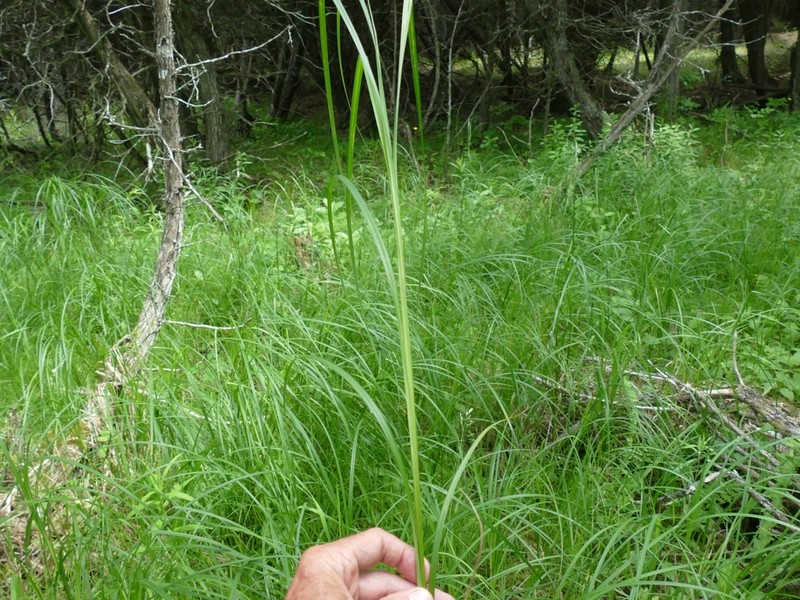
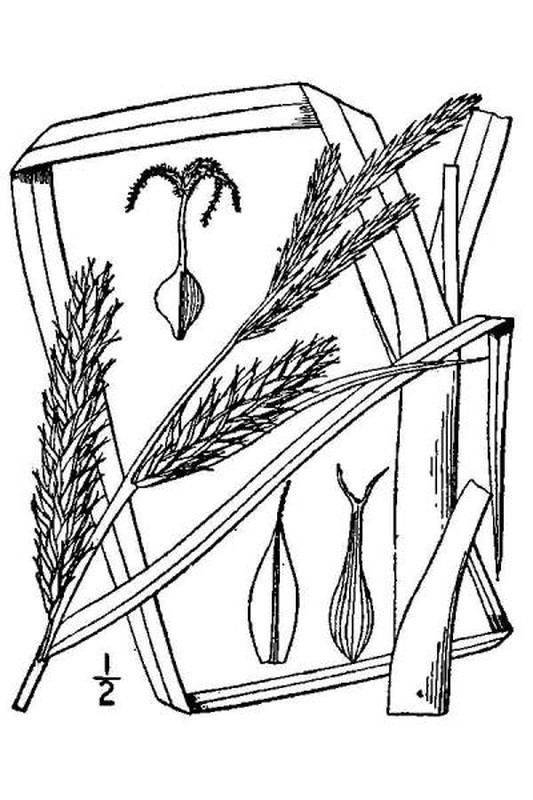
Awned sedge is a loosely tufted grass-like perennial that grows in patches. There are two kinds of stems on the plants. One type has flowers and fruits (reproductive stems) and the other lacks these structures (vegetative stems). Reproductive stems are less common than the vegetative stems and are often lacking. Reproductive stems are 35-125 cm tall. Leaves are 3-10 mm wide, usually hairy, and are clustered towards the top of the vegetative stems. The upper half of the reproductive stems have 3-11 narrowly cylindrical flower/fruit clusters (spikes). The upper 1-6 are composed of male flowers. The lower 2-5 spikes are mostly composed of female flowers which mature into fruits (perigynia). The fruits are 6.5-12.0 mm long and have a two pronged beak at their apex (Mackenzie 1931-1935, Reznicek and Catling 2002).
Identifying Characteristics
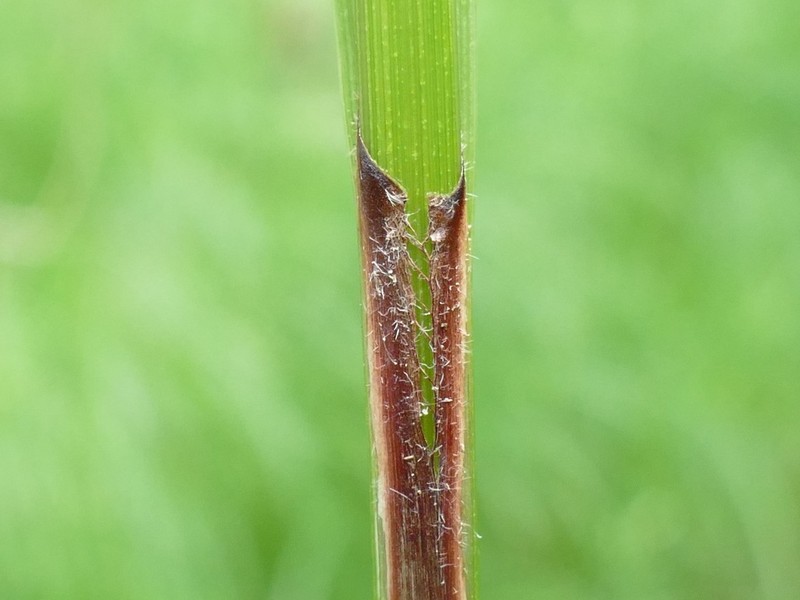
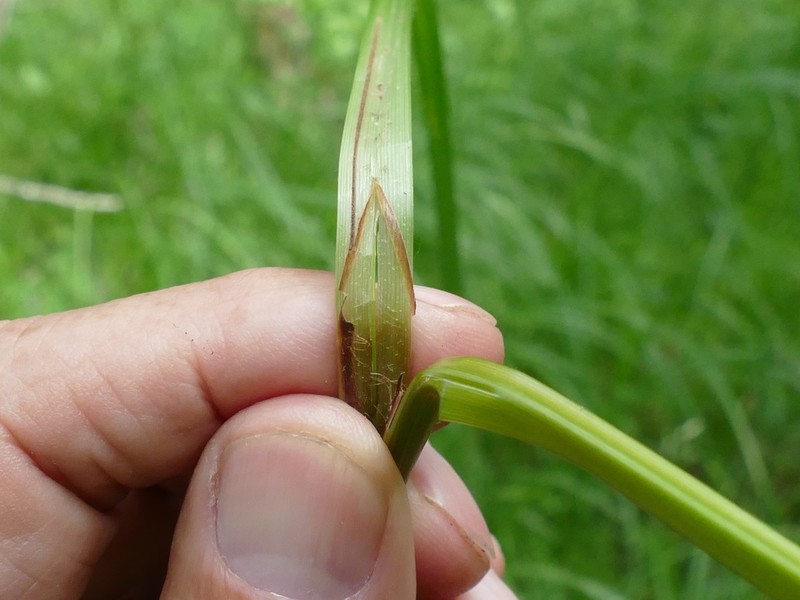
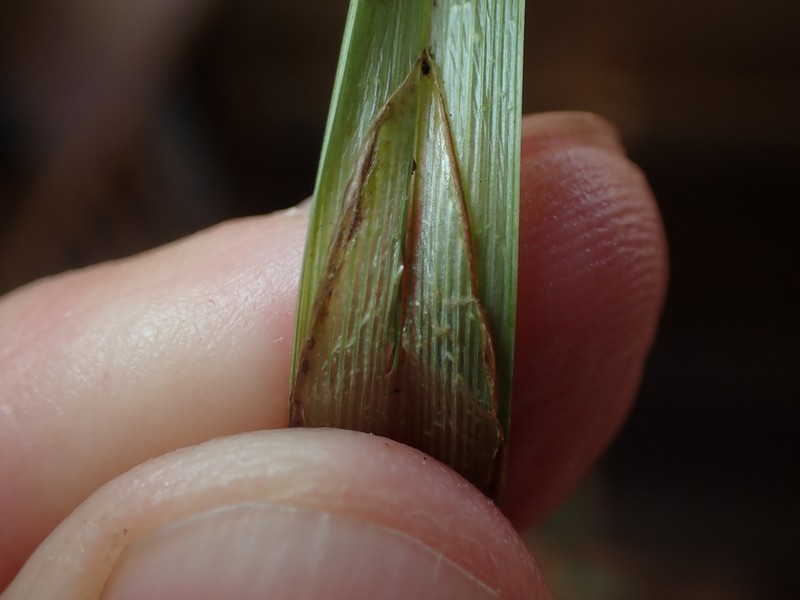
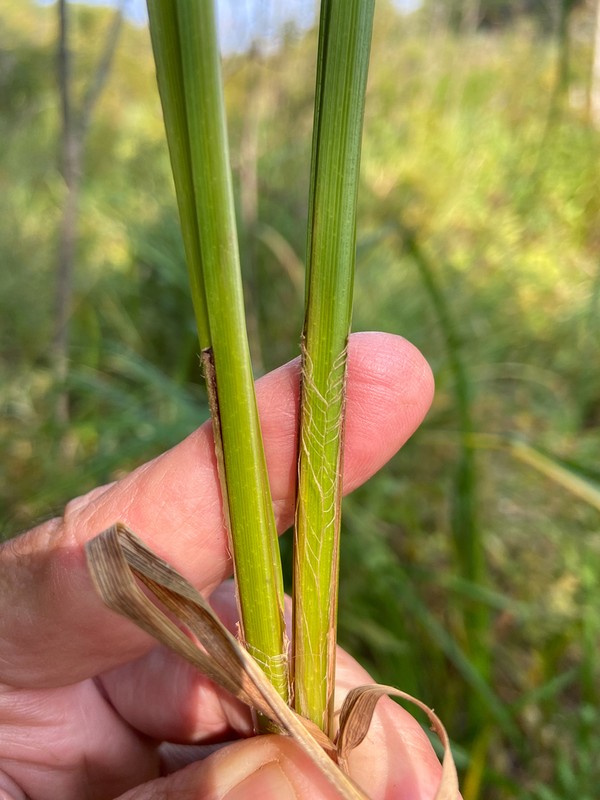
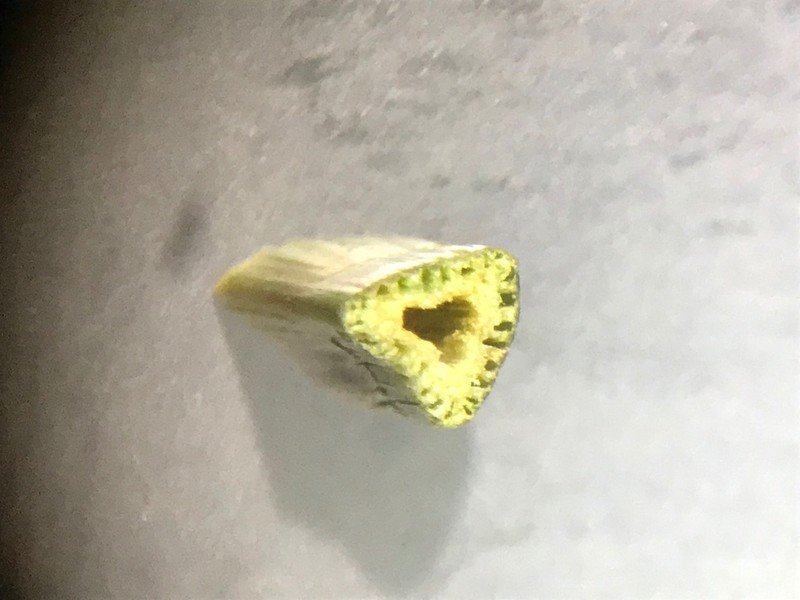
Carex atherodes is loosely cespitose and long rhizomatous. It often forms dense monospecific patches. It has true vegetative culms with nodes and internodes as well as reproductive culms. Vegetative culms are hollow or spongy toward the base. The lower leaves are composed of sheaths only which are reddish purple. Leaf sheaths are pubescent or scabrous and the summit of the leaf sheath fronts (adaxial surfaces) are pale brown to dull reddish purple.The leaf blades are 3-10 mm wide, finely papillose abaxially, and are usually pubescent at least towards the base of the blades on the abaxial surfaces of the proximal leaves. Glabrous forms are more common to the west of New York. Ligules are (6-)11-45 mm long and are longer than wide. Vegetative culms are conspicuous because they are taller than the reproductive culms and the leaves are clustered towards the apex. Reproductive culms are less frequent and sometimes absent. The distal (1-)2-6 spikes are staminate while the 2-5 proximal spikes are pistillate or slightly androgynous. Spikes are erect and sessile to short pedunculate. Perigynia are (6.5-)7-12 mm long, glabrous, long beaked, and have two teeth (1.2-)1.5-3.0 mm long that are spreading to outcurved.
Best Life Stage for Proper Identification
Many times reproductive culms are absent and identification needs to be done using vegetative material. Therefore, botanists should learn to identify this species vegetatively. Still, it is easier to identify this species when plants have immature to mature perigynia.
Similar Species
Carex atherodes differs from many other Carex species by possessing hollow true vegetative culms which have nodes and internodes. Carex trichocarpa, also a member of section Carex, is somewhat similar. Care trichocarpa can be distinguished by its pubescent perigynia, glabrous leaf blades and sheaths, strongly reddish purple summits of distal leaf sheaths, and solid vegetative culms. In comparison, C. atherodes has glabrous perigynia, usually pubescent leaf sheaths and abaxial surfaces of leaf blades, pale brown to dull reddish purple summits of distal leaf sheaths, and hollow vegetative culms. Carex lacustris which can be found with C. atherodes and also can grow in dense monospecific patches differs in having leaf blades glaucous and lacking true vegetative culms.
Best Time to See
Immature perigynia are produced in early July. These mature and persist till early August although towards the end of this season they are shedding easily. Although identification will often need to be done based on vegetative material, perigynia are useful in making identification more certain. Therefore, the best time to survey for C. atherodes is in July.
- Vegetative
- Fruiting
The time of year you would expect to find Wheat Sedge vegetative and fruiting in New York.
Wheat Sedge Images
Steven Daniel
Steven Daniel
Steven Daniel
Steven Daniel
Steven Daniel
Steven Daniel
Steven Daniel
Britton, N.L., and A. Brown (1913); downloaded from USDA-Plants Database.
Taxonomy
Wheat Sedge
Carex atherodes Spreng.
- Kingdom Plantae
- Phylum Anthophyta
- Class Monocotyledoneae
(Monocots)
- Order Cyperales
- Family Cyperaceae (Sedge Family)
- Order Cyperales
- Class Monocotyledoneae
(Monocots)
- Phylum Anthophyta
Additional Common Names
- Sedge
Synonyms
- Carex aristata R. Br. not Honck.
- Carex trichocarpa var. aristata Bailey
Comments on the Classification
Carex atherodes is currently placed in section Carex which contains species with true vegetative culms and perigynia with long beaks and long beak teeth. Rare hybrids with C. trichocarpa are known (Reznicek and Catling 2002). It has been placed in section Paludosae by Mackenzie (1931-1935), Fernald (1970), and Gleason and Cronquist (1991).
Additional Resources
Best Identification Reference
Reznicek, A.A. and P.M. Catling. 2002. Carex Linnaeus sect. Carex. Pages 498-501 in Flora of North America Editorial Committee (editors), Flora of North America, North of Mexico, Volume 23, Magnoliophyta: Commelinidae (in part): Cyperaceae. Oxford University Press, New York, NY, USA. 608pp + xxiv.
Other References
Fernald, M.L. 1950. Gray's manual of botany. 8th edition. D. Van Nostrand, New York. 1632 pp.
Gleason, Henry A. and A. Cronquist. 1991. Manual of Vascular Plants of Northeastern United States and Adjacent Canada. The New York Botanical Garden, Bronx, New York. 910 pp.
Mackenzie, K.K. 1931-1935. Cariceae. North American Flora 18: 1-478.
New York Natural Heritage Program. 2006. Biotics Database. Albany, NY.
New York Natural Heritage Program. 2024. New York Natural Heritage Program Databases. Albany, NY.
Reschke, Carol. 1990. Ecological communities of New York State. New York Natural Heritage Program, New York State Department of Environmental Conservation. Latham, NY. 96 pp. plus xi.
Links
About This Guide
Information for this guide was last updated on: November 4, 2022
Please cite this page as:
New York Natural Heritage Program. 2024.
Online Conservation Guide for
Carex atherodes.
Available from: https://guides.nynhp.org/wheat-sedge/.
Accessed April 19, 2024.