Black-edged Sedge
Carex nigromarginata Schwein.
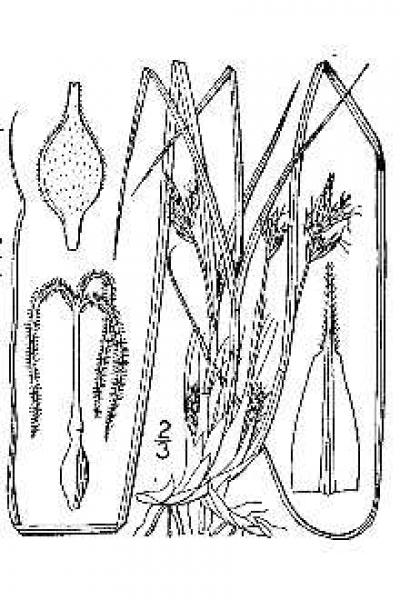
Carex nigromarginata line drawing
Britton, N.L., and A. Brown (1913); downloaded from USDA-Plants Database.
- Class
- Monocotyledoneae (Monocots)
- Family
- Cyperaceae (Sedge Family)
- State Protection
- Rare
A plant listed as Rare by New York State. Removal or damage without the consent of the landowner is prohibited.
- Federal Protection
- Not Listed
- State Conservation Status Rank
- S3
Vulnerable in New York - Vulnerable to disappearing from New York due to rarity or other factors (but not currently imperiled); typically 21 to 80 populations or locations in New York, few individuals, restricted range, few remaining acres (or miles of stream), and/or recent and widespread declines.
- Global Conservation Status Rank
- G5
Secure globally - Common in the world; widespread and abundant (but may be rare in some parts of its range).
Summary
Did you know?
Just a few years ago, this sedge was considered historical within New York (i.e. not seen in at least 20 years). David Werier rediscovered this sedge and he and others have been finding more populations. As more people learn to identify this plant, more populations will likely be encountered.
State Ranking Justification
There are eight existing populations and about 10 historical populations but more of this species are likely to be found in the Hudson Highlands if surveys are done early enough to identify the species before it sheds its perigynia.
Short-term Trends
At least five new populations of this sedge have been located since 2002. Since this sedge is difficult to identify once its fruits shed, fruits relatively early in the season (fruits mostly shed by mid-June), and is easily overlooked, these five new populations were probably overlooked in the past. Therefore, it will probably be hard to determine if this species is expanding its range north as new populations are discovered. Overall, short term trends are not clear.
Long-term Trends
There are 10 populations which have not been seen in recent years. It is unknown if these populations are still extant since searches to many of these sites have not been conducted. In addition, at least five new populations have been seen in recent years. Therefore, long term trends are not clear but most likely the species is at least not declining. This needs to be backed up by further survey work.
Conservation and Management
Research Needs
It has become abundantly clear that this sedge is being overlooked in New York. Survey work in southeastern New York early in the season (May to early June) will help clarify what the abundance of this sedge is in New York.
Habitat
Habitat
In New York, C. nigromarginata is found in rocky dry-mesic to mesic deciduous forests. Often these forests are of southern affinity and have oaks dominant. It is also known from coastal oak forests. Less frequently it occurs in more open rocky environments. It prefers S and E facing slopes probably because it is a southern plant at the northern edge of its range (New York Natural Heritage Program 2005). Acidic soils of rocky, dry woods, thickets, and clearings, in partial shade of mixed hardwood-pine forests or full sun along open roadsides and clearing edges, often adjacent to streams (Flora of North America 2002). Dry wooded slopes (Rhoads and Block 2000). Dry woods, chiefly in acid soils on the coastal plain (Gleason and Cronquist 1991). Dry woods, thickets, and clearings (Fernald 1970).
Associated Ecological Communities
- Acidic talus slope woodland
(guide)
An open to closed canopy woodland that occurs on talus slopes (slopes of boulders and rocks, often at the base of cliffs) composed of non-calcareous rocks such as granite, quartzite, or schist.
- Allegheny oak forest
(guide)
A hardwood forest that occurs on well-drained sites in the unglaciated portion of southwestern New York. This is a forest of mixed oaks with a diverse canopy and richer ground flora than other oak communities in the state.
- Appalachian oak-hickory forest
(guide)
A hardwood forest that occurs on well-drained sites, usually on ridgetops, upper slopes, or south- and west-facing slopes. The soils are usually loams or sandy loams. This is a broadly defined forest community with several regional and edaphic variants. The dominant trees include red oak, white oak, and/or black oak. Mixed with the oaks, usually at lower densities, are pignut, shagbark, and/or sweet pignut hickory.
- Appalachian oak-pine forest*
(guide)
A mixed forest that occurs on sandy soils, sandy ravines in pine barrens, or on slopes with rocky soils that are well-drained. The canopy is dominated by a mixture of oaks and pines.
- Chestnut oak forest
(guide)
A hardwood forest that occurs on well-drained sites in glaciated portions of the Appalachians, and on the coastal plain. This forest is similar to the Allegheny oak forest; it is distinguished by fewer canopy dominants and a less diverse shrublayer and groundlayer flora. Dominant trees are typically chestnut oak and red oak.
- Cliff community
(guide)
A community that occurs on vertical exposures of resistant, non-calcareous bedrock (such as quartzite, sandstone, or schist) or consolidated material; these cliffs often include ledges and small areas of talus.
- Coastal oak-beech forest*
(guide)
A hardwood forest with oaks and American beech codominant that occurs in dry well-drained, loamy sand of morainal coves of the Atlantic Coastal Plain. Some occurrences are associated with maritime beech forest.
- Coastal oak-hickory forest
(guide)
A hardwood forest with oaks and hickories codominant that occurs in dry, well-drained, loamy sand of knolls, upper slopes, or south-facing slopes of glacial moraines of the Atlantic Coastal Plain.
- Coastal oak-holly forest
(guide)
A semi-deciduous to mixed deciduous-evergreen broadleaf forest that occurs on somewhat moist and moderately well drained silt and sandy loams in low areas on morainal plateaus. In New York State this forest is best developed on the narrow peninsulas of eastern Long Island. The trees are usually not stunted, and are removed from the pruning effects of severe salt spray. The dominant canopy trees are black oak, black gum, red maple, and American beech. American holly is abundant in the subcanopy and tall shrub layers.
- Oak-tulip tree forest*
(guide)
A hardwood forest that occurs on moist, well-drained sites in southeastern New York. The dominant trees include a mixture of five or more of the following: red oak, tulip tree, American beech, black birch, red maple, scarlet oak, black oak, and white oak.
- Successional maritime forest*
(guide)
A successional hardwood forest that occurs in low areas near the seacoast. This forest is a variable type that develops after vegetation has burned or land cleared (such as pastureland or farm fields). The trees may be somewhat stunted and flat-topped because the canopies are pruned by salt spray. The forest may be dominated by a single species, or there may be two or three codominants.
- Successional shrubland*
A shrubland that occurs on sites that have been cleared (for farming, logging, development, etc.) or otherwise disturbed. This community has at least 50% cover of shrubs.
- Successional southern hardwoods*
A hardwood or mixed forest that occurs on sites that have been cleared or otherwise disturbed. Canopy trees are usually relatively young in age (25-50 years old) and signs of earlier forest disturbance are often evident. Characteristic trees and shrubs include any of the following: American elm, slippery elm, white ash, red maple, box elder, silver maple, sassafras, gray birch, hawthorn, eastern red cedar, and choke-cherry.
* probable association but not confirmed.
Associated Species
- Aristolochia serpentaria
- Betula lenta (black birch)
- Carex albicans var. albicans
- Carex communis
- Carex digitalis
- Carex willdenowii (Willdenow's sedge)
- Carya alba
- Carya glabra (pignut hickory)
- Danthonia spicata (poverty grass)
- Dichanthelium boscii (Bosc's rosette grass)
- Dichanthelium dichotomum var. dichotomum
- Lysimachia quadrifolia (whorled-loosestrife)
- Polygonatum biflorum
- Quercus alba (white oak)
- Quercus montana (chestnut oak)
- Quercus rubra (northern red oak)
- Quercus velutina (black oak)
Range
New York State Distribution
In New York, populations are known only from the southeastern part of the state; from Long Island north to the southern Hudson Valley (Orange and perhaps Ulster County). A specimen of C. pedunculata from Monroe County was erroneously labeled C. nigromarginata and led to false reports of C. nigromarginata from Monroe County. There is a disjunct population known from Ontario on the northern edge of Lake Ontario (Reznicek and Catling 1982) so Carex nigromarginata should be sought in more southern habitats in other parts of New York.
Global Distribution
A plant typical of the dry woods from Quebec and Ontario south along the Atlantic Coast and west to the Mississippi Valley; possibly disjunct to Saskatchewan.
Identification Comments
General Description
Cusick (1992) describes Carex nigromarginata as "a beautiful sedge with brightly-colored scales of rich chestnut or purple with a green midrib".
The plants are perennial herbs, 4-12 in. tall, growing in dense tufts, often producing short branches which root. The whole plant often has a flattened appearance as if it had been stepped on. Each stem produces a single inflorescence with these flowering stems of varying height. Some of the culms are short and hidden in the leaves while others are longer and more apparent. The principal leaf blades are very narrow (1.4-4.5 mm wide) and mostly arising from the base. The flowers are unisexual. Staminate flowers occur on the end of the elongated flower structure, the pistillate below. Staminate flowers contain three small, slender, erect stamens which project beyond the petals when pollen is produced. There are 1-4 pistillate flowers (usually 2 or 3) up to .25 in. long, stemless, often crowded, and the lowest sometimes slightly separated but overlapping the next above. The small dry fruit does not open at maturity, is three-angled or nearly round, and contains 3 stigmas. The scales that subtend the pistillate flowers/fruits are often dark red to dark purple sub-marginally. These scales also have a green mid-stripe and pale narrow margins (derived from Gleason 1952 and Crins and Rettig 2002).
Identifying Characteristics
Carex nigromarginata has the widest leaves (1.9-)2.2-3.4(-4.5) mm wide. The culms vary in height with the tallest one (measured from the base of the culm to the base of the inflorescence) (4.5) 5.4-17.4 (23.6) mm long. The inflorescence is composed of a terminal staminate spike and 2-3 lateral pistillate spikes, which arise toward the end of the culm (i.e. no basal spikes). All the spikes are approximate. The scales that subtend the pistillate flowers/perigynia are about the same length as the perigynia and usually have a dark-red to dark-purple sub-margin. The actual margin is often white or hyaline in a narrow stripe and the mid vein is green. Occasionally these scales are paler but in most populations most plants have the darker scales. Perigynia are (2.6-)2.8-4.0 mm long with ellipsoid bodies (Crins and Rettig 2002, New York Natural Heritage Program 2005).
Best Life Stage for Proper Identification
This sedge is most easily identified while in fruit. Full ample specimens are useful for identification purposes. These specimens should include the entire plant (i.e. roots, stems, leaves, and fruit).
Similar Species
Carex nigromarginata is a member of section Acrocystis. A few other members of this section are a little similar although C. nigromarginata is really quite a distinctive sedge.
Carex umbellata, C. tonsa var. tonsa, and C. tonsa var. rugosperma should not be confused with C. nigromarginata. The former three all have at least some spikes arising from the base of the culm. These basal spikes can have elongated peduncles and therefore can appear to arise towards the upper parts of the culm. In addition, C. nigromarginata often has some culms that are very short but again these culms have all the spikes arising from the upper portion of the culm.
Carex albicans var. albicans has wider leaves 1.3-2.5(-2.6) mm wide (vs. (1.9-)2.2-3.4(-4.5)mm wide); and most culms are as long as or longer than the leaves (vs. many culms shorter than the leaves). Carex albicans var. emmonsii has the widest leaves (1.4-)1.5-2.5 mm wide; staminate spike peduncle (0.5-)0.7-1.5 mm long (vs. 0.4-0.8 mm long); and perigynia 2.3-3.3 mm (vs. (2.6-)2.8-4.0 mm).
Best Time to See
The species is one of the earliest of the sedges to flower and fruit. It flowers from early April to mid May and is in fruit from late April to early June. The best time to survey for this species is May to very early June.
- Fruiting
The time of year you would expect to find Black-edged Sedge fruiting in New York.
Black-edged Sedge Images
Britton, N.L., and A. Brown (1913); downloaded from USDA-Plants Database.
Taxonomy
Black-edged Sedge
Carex nigromarginata Schwein.
- Kingdom Plantae
- Phylum Anthophyta
- Class Monocotyledoneae
(Monocots)
- Order Cyperales
- Family Cyperaceae (Sedge Family)
- Order Cyperales
- Class Monocotyledoneae
(Monocots)
- Phylum Anthophyta
Additional Common Names
- Black-edge Sedge
- Sedge
Comments on the Classification
Some authors included various other members of section Acrocystis as varieties under C. nigromarginata. These include C. nigromarginata var. elliptica (Boott) Gleason = C. peckii; C. nigromarginata var. muhlenbergii (Gray) Gleason = C. albicans var. albicans; C. nigromarginata var. minor (Boott) Gleason = C. albicans var. emmonsii; and C. nigromarginata var. floridana (Schweinitz) Kükenthal (which only occurs south of New York) (Gleason 1952, Crins and Rettig 2002). Rettig (1988, 1990) and Rettig and Giannasi (1990) have placed C. nigromarginata in the C. nigromarginata complex comprised of C. nigromarginata, C. floridana, C. albicans var. albicans, C. albicans var. emmonsii, C. albicans var. australis, and C. peckii. In these studies the researchers found C. nigromarginata to be distinct at the species level. Roalson and Friar (2004) found that the C. nigromarginata complex is not monophyletic. Possibilities for the non-monophyly of this complex include cryptic species, hybridization, and gene paralogs.
Additional Resources
Best Identification Reference
Crins, W.J. and J.H. Rettig. 2002. Carex Linnaeus sect. Acrocystis Dumortier. Pages 532-545 in Flora of North America Editorial Committee (editors), Flora of North America, north of Mexico, Volume 23, Magnoliophyta: Commelinidae (in part): Cyperaceae. Oxford University Press, New York, New York, USA. 608pp + xxiv.
Other References
Fernald, M.L. 1950. Gray's manual of botany. 8th edition. D. Van Nostrand, New York. 1632 pp.
Gleason, H.A. 1952. Change of Name for Certain plants on the 'Manual Range.' Phytologia 4(1): 20-25.
Gleason, Henry A. and A. Cronquist. 1991. Manual of Vascular Plants of Northeastern United States and Adjacent Canada. The New York Botanical Garden, Bronx, New York. 910 pp.
Holmgren, Noel. 1998. The Illustrated Companion to Gleason and Cronquist's Manual. Illustrations of the Vascular Plants of Northeastern United States and Adjacent Canada. The New York Botanical Garden, Bronx, New York.
New York Natural Heritage Program. 2010. Biotics database. New York Natural Heritage Program. New York State Department of Environmental Conservation. Albany, NY.
New York Natural Heritage Program. 2024. New York Natural Heritage Program Databases. Albany, NY.
Reschke, Carol. 1990. Ecological communities of New York State. New York Natural Heritage Program, New York State Department of Environmental Conservation. Latham, NY. 96 pp. plus xi.
Rettig, J.H. 1988. A biosystematic study of the Carex pensylvanica group (section Acrocystis) in North America. Ph.D. dissertation. University of Georgia, Athens.
Rettig, J.H. 1990. Achene micromorphology of the Carex nigromarinata complex (section Acrocystis, Cyperaceae). Rhodora 92: 70-79.
Rettig, J.H. and D.E. Giannasi. 1990. Foliar flavonoids of the Carex nigromarginata complex (section Acrocystis, Cyperaceae). Biochemical Syst. and Ecol. 18: 393-397.
Reznicek, A.A. and P.M. Catling. 1982. Cyperaceae new to Canad from Long Point, Morfolk County. Can. Field Nat. 96: 184-188.
Rhoads, Ann F. and Timothy A. Block. 2000. The Plants of Pennsylvania, an Illustrated Manual. University of Pennsylvania Press, Philadelphia, PA.
Roalson, E.H. and E.A. Friar. 2004. Phylogenetic relationships and biogeographic patterns in North American members of Carex section Acrocystis (Cyperaceae) using nrDNA its and ETs sequence data. Plant Systematics and Evolution 243: 175-187
Weldy, T. and D. Werier. 2010. New York flora atlas. [S.M. Landry, K.N. Campbell, and L.D. Mabe (original application development), Florida Center for Community Design and Research http://www.fccdr.usf.edu/. University of South Florida http://www.usf.edu/]. New York Flora Association http://newyork.plantatlas.usf.edu/, Albany, New York
Links
About This Guide
Information for this guide was last updated on: January 14, 2009
Please cite this page as:
New York Natural Heritage Program. 2024.
Online Conservation Guide for
Carex nigromarginata.
Available from: https://guides.nynhp.org/black-edge-sedge/.
Accessed April 25, 2024.