Yellow Flat Sedge
Cyperus flavescens L.
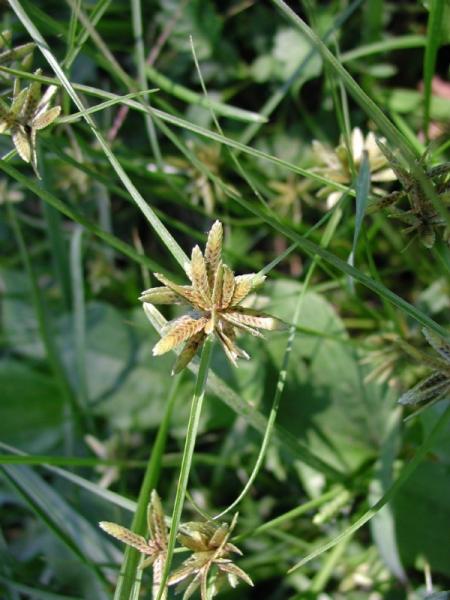
Cyperus flavescens
Stephen M. Young
- Class
- Monocotyledoneae (Monocots)
- Family
- Cyperaceae (Sedge Family)
- State Protection
- Endangered
Listed as Endangered by New York State: in imminent danger of extirpation in New York. For animals, taking, importation, transportation, or possession is prohibited, except under license or permit. For plants, removal or damage without the consent of the landowner is prohibited.
- Federal Protection
- Not Listed
- State Conservation Status Rank
- S1
Critically Imperiled in New York - Especially vulnerable to disappearing from New York due to extreme rarity or other factors; typically 5 or fewer populations or locations in New York, very few individuals, very restricted range, very few remaining acres (or miles of stream), and/or very steep declines.
- Global Conservation Status Rank
- G5
Secure globally - Common in the world; widespread and abundant (but may be rare in some parts of its range).
Summary
Did you know?
The first species of the smut fungi genus Entorrhiza, Entorrhiza cypericola, was described from the roots of yellow flatsedge in the late 1800s. These fungi are now put in the genus Melanotaenium. In New York this species was first collected in Yonkers in 1875 but almost half of the 15 historical records are now considered extirpated by development around New York City.
State Ranking Justification
There are five existing populations but four of these populations are from specimens and observations that need more survey work. There are 15 historical locations but about half of these are considered extirpated and the other half have not been relocated.
Short-term Trends
One existing population has survived for 10 years in a highly disturbed area but there is not enough information about four other populations to understand short-term trends.
Long-term Trends
Development on Long Island and Staten Island has significantly reduced the habitat for this species and none of the 15 historical records have been relocated. Half of the historical records are now considered extirpated.
Conservation and Management
Threats
One population is threatened by roadside management, another by the invasion of phragmites and the threats to the remaining populations is unknown because they have not been surveyed in detail.
Conservation Strategies and Management Practices
Phragmites control is needed to prevent the destruction of saltmarsh habitat where these populations exist. The largest population is along a roadside where it needs to be protected from road maintenance that could destroy the plants.
Research Needs
Habitat availability for this species in New York seems to be very large but it only occupies a very small portion of that habitat. More research is needed to determine its habitat preference and if present populations can be augmented.
Habitat
Habitat
Yellow Flatsedge occurs at wet sandy sites. In New York such habitats have included salt marshes, coastal plain pond shores, wet, sandy, weedy roadsides (New York Natural Heritage Program 2007). Wet soil (Gleason & Cronquist 1991).
Associated Ecological Communities
- Coastal plain pond shore
(guide)
The gently sloping shore of a coastal plain pond with seasonally and annually fluctuating water levels. Plants growing on the pond shore vary with water levels. In dry years when water levels are low there is often a dense growth of annual sedges, grasses, and herbs. Submerged and floating-leaved aquatic plants, such as fragrant waterlily and pondweeds, may become "stranded" on the exposed shore. In wet years when the water level is high only a few emergents and floating-leaved aquatics may be noticeable. T
- High salt marsh*
(guide)
A coastal marsh community that occurs in sheltered areas of the seacoast, in a zone extending from mean high tide up to the limit of spring tides. It is periodically flooded by spring tides and flood tides. High salt marshes typically consist of a mosaic of patches that are mostly dominated by a single graminoid species.
- Mowed roadside/pathway
A narrow strip of mowed vegetation along the side of a road, or a mowed pathway through taller vegetation (e.g., meadows, old fields, woodlands, forests), or along utility right-of-way corridors (e.g., power lines, telephone lines, gas pipelines). The vegetation in these mowed strips and paths may be dominated by grasses, sedges, and rushes; or it may be dominated by forbs, vines, and low shrubs that can tolerate infrequent mowing.
- Unpaved road/path
A sparsely vegetated road or pathway of gravel, bare soil, or bedrock outcrop. These roads or pathways are maintained by regular trampling or scraping of the land surface. The substrate consists of the soil or parent material at the site which may be modified by the addition of local organic material (woodchips, logs, etc.) or sand and gravel. Abandoned railroad beds where tracks have been removed are included here. One characteristic plant is path rush.
* probable association but not confirmed.
Associated Species
- Cyperus strigosus (false yellow nut sedge)
- Juncus effusus
- Panicum dichotomiflorum
- Panicum virgatum (switch grass)
Range
New York State Distribution
Yellow Flatsedge occurs in the southeastern New York, from as far north as Orange County through parts of the New York City area and Long Island.
Global Distribution
Yellow Flatsedge reaches the northern edge of its range in Ontario, New York, and Massachusetts, and its range extends south to Florida and along the Gulf Coast to Texas (and Central and South America), and west to Michigan and Illinois. It is disjunct to California.
Identification Comments
General Description
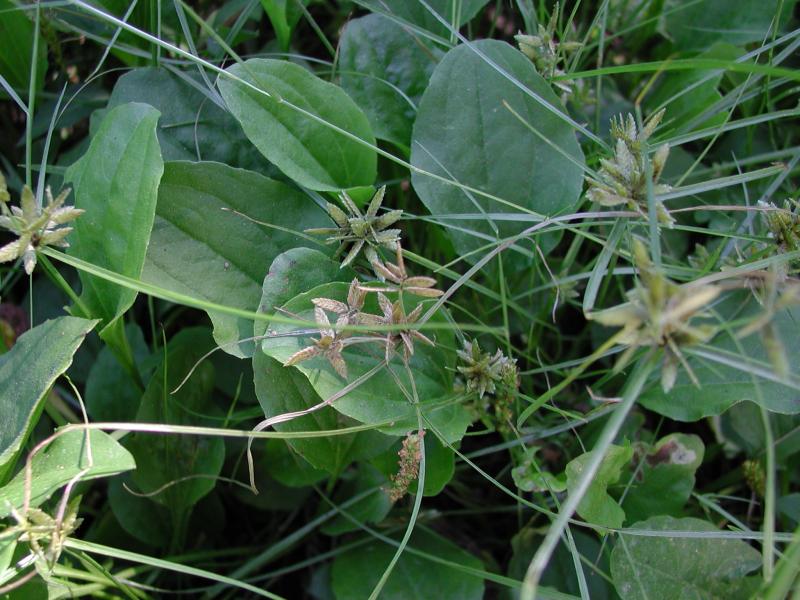
Yellow flatsedge is a tuft-forming sedge. Its stems are from 5 to 30 cm tall, 3-sided, and glabrous. There are 1-5 leaves, often lacking blades butsimply sheathing the stem, and 10-18 cm long. The infloresence consists of 1-3 spikes, each 1-3 cm long, each of these usually subtended by a bract (reduced leaf) 1-12 cm long. Each spike, in turn, contains 1-6 yellow to yellowish brown spikelets compressed and layered together like shingles. The flowers are subtended by straw-colored (stramineous) scales no more than twice as long as wide, and have 2 stigmas. The fruit (achenes) are hard, black to reddish-brown, lens-shaped, and 1-1.2 mm long.
Similar Species
Cyperus polystachyos and C. filicinus have narrower scales, about 3 times as long as wide.
Best Time to See
Cyperus flavescens fruits from July through October.
- Fruiting
The time of year you would expect to find Yellow Flat Sedge fruiting in New York.
Yellow Flat Sedge Images
Stephen M. Young
Stephen M. Young
Taxonomy
Yellow Flat Sedge
Cyperus flavescens L.
- Kingdom Plantae
- Phylum Anthophyta
- Class Monocotyledoneae
(Monocots)
- Order Cyperales
- Family Cyperaceae (Sedge Family)
- Order Cyperales
- Class Monocotyledoneae
(Monocots)
- Phylum Anthophyta
Additional Common Names
- Cyperus
- Flat Sedge
- Yellow Flatsedge
Synonyms
- Cyperus flavescens var. flavescens
- Cyperus flavescens var. poaeformis (Pursh) Fern.
- Cyperus flavescens var. poiformis (Pursh) Fern.
Additional Resources
Best Identification Reference
Flora of North America Editorial Committee. 2002. Flora of North America, North of Mexico. Volume 23. Magnoliophyta: Commelinidae (in part): Cyperaceae. Oxford University Press, New York. 608 pp.
Other References
Crow, Garrett E. and C. Barre Hellquist. 2000. Aquatic and wetland plants of northeastern North America: A revised and enlarged edition or Norman C. Fassett's a manual of aquatic plants. Volume two angiosperms: Monocotyledons. The University of Wisconsin Press. Madison, Wisconsin. 456 pp.
Fernald, M.L. 1950. Gray's manual of botany. 8th edition. D. Van Nostrand, New York. 1632 pp.
Gleason, Henry A. and A. Cronquist. 1991. Manual of Vascular Plants of Northeastern United States and Adjacent Canada. The New York Botanical Garden, Bronx, New York. 910 pp.
Holmgren, Noel. 1998. The Illustrated Companion to Gleason and Cronquist's Manual. Illustrations of the Vascular Plants of Northeastern United States and Adjacent Canada. The New York Botanical Garden, Bronx, New York.
New York Natural Heritage Program. 2010. Biotics database. New York Natural Heritage Program. New York State Department of Environmental Conservation. Albany, NY.
New York Natural Heritage Program. 2024. New York Natural Heritage Program Databases. Albany, NY.
Rhoads, Ann F. and Timothy A. Block. 2000. The Plants of Pennsylvania, an Illustrated Manual. University of Pennsylvania Press, Philadelphia, PA.
Tucker, Gordon. 1983. The taxonomy of Cyperus in Costa Rica and Panama.
Voss, E.G. 1972. Michigan Flora, Part I. Gymnosperms and Monocots. Cranbrook Institute of Science Bulletin 55 and the University of Michigan Herbarium. Ann Arbor. 488 pp.
Weldy, T. and D. Werier. 2010. New York flora atlas. [S.M. Landry, K.N. Campbell, and L.D. Mabe (original application development), Florida Center for Community Design and Research http://www.fccdr.usf.edu/. University of South Florida http://www.usf.edu/]. New York Flora Association http://newyork.plantatlas.usf.edu/, Albany, New York
Weldy, Troy W. and David Werier. 2005. New York Flora Atlas. [S.M. Landry, K.N. Campbell, and L.D. Mabe (original application development), Florida Center for Community Design and Research. University of South Florida]. New York Flora Association, Albany, NY. Available on the web at (http://newyork.plantatlas.usf.edu/).
Links
About This Guide
Information for this guide was last updated on: January 18, 2008
Please cite this page as:
New York Natural Heritage Program. 2024.
Online Conservation Guide for
Cyperus flavescens.
Available from: https://guides.nynhp.org/yellow-flatsedge/.
Accessed April 26, 2024.