Schweinitz's Flat Sedge
Cyperus schweinitzii Torr.
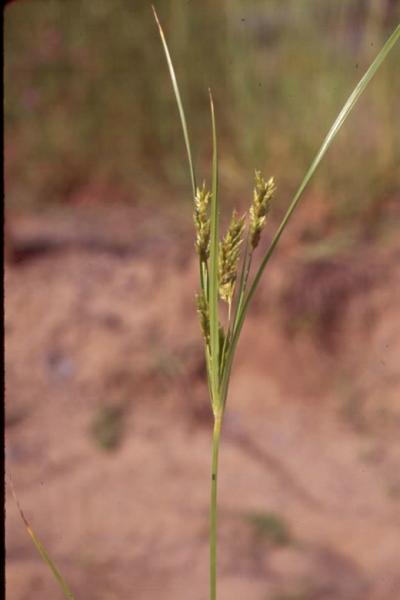
Cyperus schweinitzii
Stephen M. Young
- Class
- Monocotyledoneae (Monocots)
- Family
- Cyperaceae (Sedge Family)
- State Protection
- Rare
A plant listed as Rare by New York State. Removal or damage without the consent of the landowner is prohibited.
- Federal Protection
- Not Listed
- State Conservation Status Rank
- S3
Vulnerable in New York - Vulnerable to disappearing from New York due to rarity or other factors (but not currently imperiled); typically 21 to 80 populations or locations in New York, few individuals, restricted range, few remaining acres (or miles of stream), and/or recent and widespread declines.
- Global Conservation Status Rank
- G5
Secure globally - Common in the world; widespread and abundant (but may be rare in some parts of its range).
Summary
Did you know?
This is a good example of a plant that can seed bank for many years. In the Albany Pine Bush hundreds of plants of Schweinitz's flatsedge reappeared in a sandy area that had been covered for decades by a concrete parking lot. The species name honors Louis David von Schweinitz (1780-1834) whose main profession was a minister but who also developed a parallel career in botany and mycology. He described over 3000 species of fungi and is regarded as the founder of American mycology.
State Ranking Justification
There are 24 existing populations. Eight of these are small and 12 are good to excellent. The species depends on continued disturbance for maintenance. There are 17 historical populations which need to be checked, most from the 1920s through the 1940s.
Short-term Trends
Known populations which have had multiple visits appear to be persisting, but many sites have been visited only once or lack precise population data, so the overall trend is not clear.
Long-term Trends
There are currently slightly more verified populations than historically known ones, so the species appears to be persisting well where appropriate habitat exists.
Conservation and Management
Threats
Succession is a threat to the persistence of this species at many sites (though as has been mentioned, the plants may persist in the seed bank).
Conservation Strategies and Management Practices
Activities which create exposed sandy soils (such as burning or clearing) will benefit the species so long as they are done in a manner and at a season which prevents destruction of the plants themselves.
Habitat
Habitat
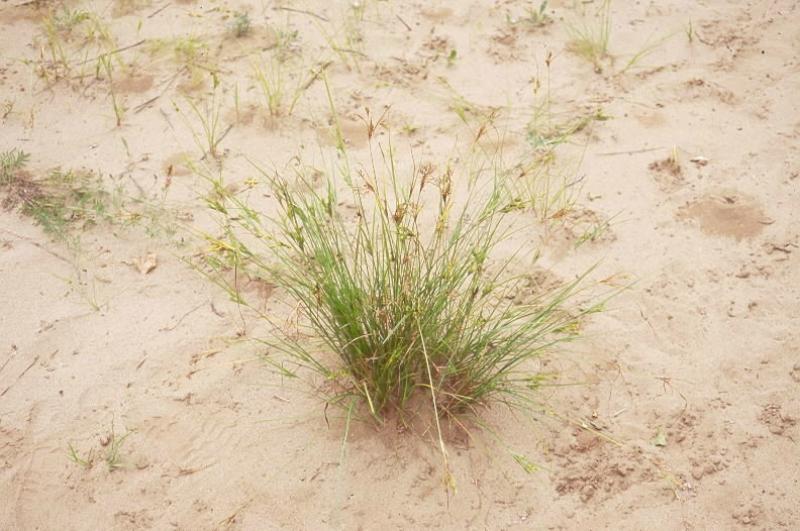
Schweinitz's Flatsedge occupies sites with exposed, sandy soil, including Atlantic and Great Lakes dunes, as well as disturbed sites at pine barrens and oak openings in the interior of the state. It may persist in the seed bank for many years and rapidly colonize a site when disturbance creates good habitat. (New York Natural Heritage Program 2008). Sandy soil (Gleason and Cronquist 1991). Riverbanks, sand bars, lakeshores, sand dunes, sandy openings in woods; 1-1000m (FNA 2002). Sandy shores, dunes, dry prairies, fields, and roadsides (Voss 1972).
Associated Ecological Communities
- Great Lakes dunes
(guide)
A community dominated by grasses and shrubs that occurs on active and stabilized sand dunes along the shores of the Great Lakes. Unstable dunes are sparsely vegetated, whereas the vegetation of stable dunes is more dense, and can eventually become forested.
- Maritime dunes
(guide)
A community dominated by grasses and low shrubs that occurs on active and stabilized dunes along the Atlantic coast. The composition and structure of the vegetation is variable depending on stability of the dunes, amounts of sand deposition and erosion, and distance from the ocean.
- Maritime pitch pine dune woodland*
(guide)
A maritime woodland that occurs on stabilized parabolic dunes. The substrate is wind and wave deposited sand that is usually excessively well-drained and nutrient poor. The community is subject to high winds, sand-blasting, salt spray, and shifting substrate.
- Oak openings
(guide)
A grass-savanna community that occurs on well-drained soils. In New York, these savannas originally occurred as openings within extensive oak-hickory forests. The best remnants occur on dolomite knobs.
- Pitch pine-heath barrens*
(guide)
A shrub-savanna community that occurs on well-drained, sandy or rocky soils. The most abundant tree is pitch pine and the shrublayer is dominated by heath shrubs.
- Pitch pine-oak-heath woodland*
(guide)
A pine barrens community that occurs on well-drained, infertile, sandy soils. The structure of this community is intermediate between a shrub-savanna and a woodland. Pitch pine and white oak are the most abundant trees.
- Pitch pine-scrub oak barrens
(guide)
A shrub-savanna community that occurs on well-drained, sandy soils that have developed on sand dunes, glacial till, and outwash plains.
* probable association but not confirmed.
Associated Species
- Asclepias tuberosa (butterfly-weed)
- Centaurea stoebe
- Cyperus filiculmis
- Danthonia spicata (poverty grass)
- Digitaria cognata (fall witch grass)
- Lespedeza capitata (round-headed bush-clover)
- Lupinus perennis
- Melilotus albus (white sweet-clover)
- Saponaria officinalis (bouncing-bet, common soapwort)
- Schizachyrium scoparium
- Silene vulgaris (bladder campion)
Range
New York State Distribution
This species is known from Long island, Albany and nearby counties, and from scattered locations in northwestern and western New York, particularly from counties bordering the Great Lakes.
Global Distribution
Cyperus schweinitzii is found in the Great Plains and Great Lakes regions of the U.S. and Canada, and north and east from Kentucky to New Jersey, New York, and Quebec.
Identification Comments
General Description
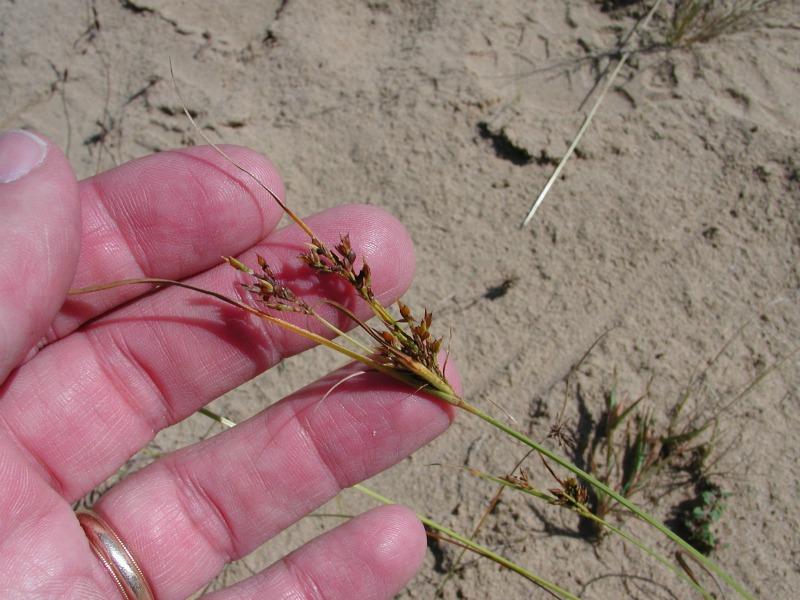
Schweinitz' Flatsedge is a grass-like perennial, with quite noticeably 3-sided, scabrous stems 10-50 cm high, arising from short, irregularly swollen rhizomes. The leaves are 1-4 mm wide and located mostly near the base of the plant. The inflorescence is subtended by 3-6 long, leaf-like bracts, some of which are wider than the leaves, and which extend above the fruits. The infloresence is made up of clusters of 5-10 quadrangular spikelets, 7-10 mm long and 3.2 to 4 mm wide. The flowers consist of a small, rounded scale, about 3-4 mm long, subtending 3 stamens and a single ovary. The seeds are light to dark brown or nearly black, ellipsoid (infrequently obovoid), and 2 to 2.4 mm long by .9 to 1.4 mm wide (FNA 2002, Gleason and Cronquist 1991).
Best Life Stage for Proper Identification
Specimens with mature fruit are best for identification.
Similar Species
Cyperus houghtonii, C. grayi, and C. lupulinus have stems which are smooth and thinner below the infloresence (.4 to 1.3 mm) than those of C. schweinitzii, which are usually scabrous (at least on the upper half), and 1 to 2.5 mm thick below the infloresence (Voss 1972, Gleason and Cronquist 1991, FNA 2002).
Best Time to See
The fruits mature in July and persist into October.
- Fruiting
The time of year you would expect to find Schweinitz's Flat Sedge fruiting in New York.
Schweinitz's Flat Sedge Images
Stephen M. Young
Stephen M. Young
Stephen M. Young
Taxonomy
Schweinitz's Flat Sedge
Cyperus schweinitzii Torr.
- Kingdom Plantae
- Phylum Anthophyta
- Class Monocotyledoneae
(Monocots)
- Order Cyperales
- Family Cyperaceae (Sedge Family)
- Order Cyperales
- Class Monocotyledoneae
(Monocots)
- Phylum Anthophyta
Additional Common Names
- Cyperus
- Flat Sedge
Additional Resources
References
Edinger, Gregory J., D.J. Evans, Shane Gebauer, Timothy G. Howard, David M. Hunt, and Adele M. Olivero (editors). 2002. Ecological Communities of New York State. Second Edition. A revised and expanded edition of Carol Reschke's Ecological Communities of New York State. (Draft for review). New York Natural Heritage Program, New York State Department of Environmental Conservation. Albany, NY. 136 pp.
Fernald, M.L. 1950. Gray's manual of botany. 8th edition. D. Van Nostrand, New York. 1632 pp.
Flora of North America Editorial Committee. 2002b. Flora of North America north of Mexico. Vol. 23. Magnoliophyta: Commelinidae (in part): Cyperaceae. Oxford Univ. Press, New York. xxiv + 608 pp.
Gleason, Henry A. and A. Cronquist. 1991. Manual of Vascular Plants of Northeastern United States and Adjacent Canada. The New York Botanical Garden, Bronx, New York. 910 pp.
Holmgren, Noel. 1998. The Illustrated Companion to Gleason and Cronquist's Manual. Illustrations of the Vascular Plants of Northeastern United States and Adjacent Canada. The New York Botanical Garden, Bronx, New York.
New York Natural Heritage Program. 2005. Biotics Database. Albany, NY.
New York Natural Heritage Program. 2024. New York Natural Heritage Program Databases. Albany, NY.
Rhoads, Ann F. and Timothy A. Block. 2000. The Plants of Pennsylvania, an Illustrated Manual. University of Pennsylvania Press, Philadelphia, PA.
Voss, E.G. 1972. Michigan Flora, Part I. Gymnosperms and Monocots. Cranbrook Institute of Science Bulletin 55 and the University of Michigan Herbarium. Ann Arbor. 488 pp.
Weldy, Troy W. and David Werier. 2005. New York Flora Atlas. [S.M. Landry, K.N. Campbell, and L.D. Mabe (original application development), Florida Center for Community Design and Research. University of South Florida]. New York Flora Association, Albany, NY. Available on the web at (http://newyork.plantatlas.usf.edu/).
Links
About This Guide
Information for this guide was last updated on: January 26, 2009
Please cite this page as:
New York Natural Heritage Program. 2024.
Online Conservation Guide for
Cyperus schweinitzii.
Available from: https://guides.nynhp.org/schweinitzs-flat-sedge/.
Accessed April 20, 2024.