Deer's Hair Club Sedge
Trichophorum cespitosum ssp. cespitosum None
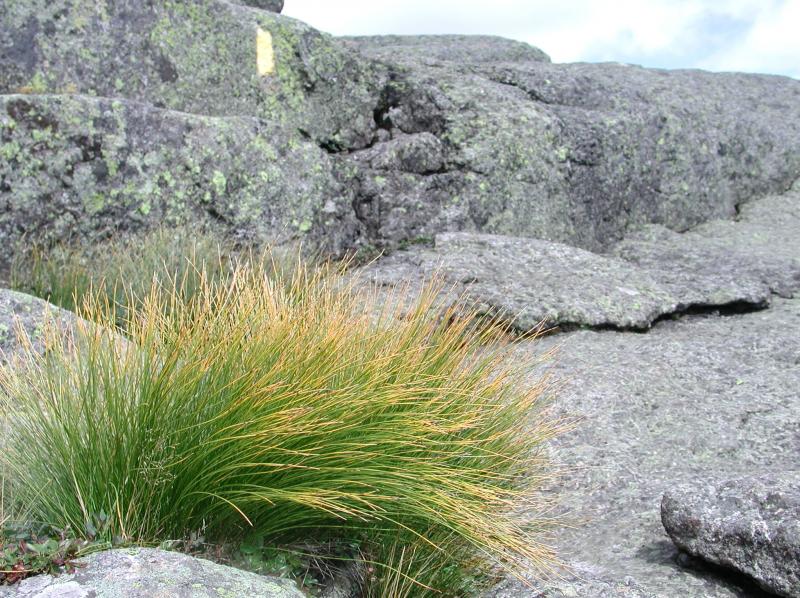
Trichophorum cespitosum ssp. cespitosum
Julia Goren
- Class
- Monocotyledoneae (Monocots)
- Family
- Cyperaceae (Sedge Family)
- State Protection
- Threatened
Listed as Threatened by New York State: likely to become Endangered in the foreseeable future. For animals, taking, importation, transportation, or possession is prohibited, except under license or permit. For plants, removal or damage without the consent of the landowner is prohibited.
- Federal Protection
- Not Listed
- State Conservation Status Rank
- S2
Imperiled in New York - Very vulnerable to disappearing from New York due to rarity or other factors; typically 6 to 20 populations or locations in New York, very few individuals, very restricted range, few remaining acres (or miles of stream), and/or steep declines.
- Global Conservation Status Rank
- G5
Secure globally - Common in the world; widespread and abundant (but may be rare in some parts of its range).
Summary
Did you know?
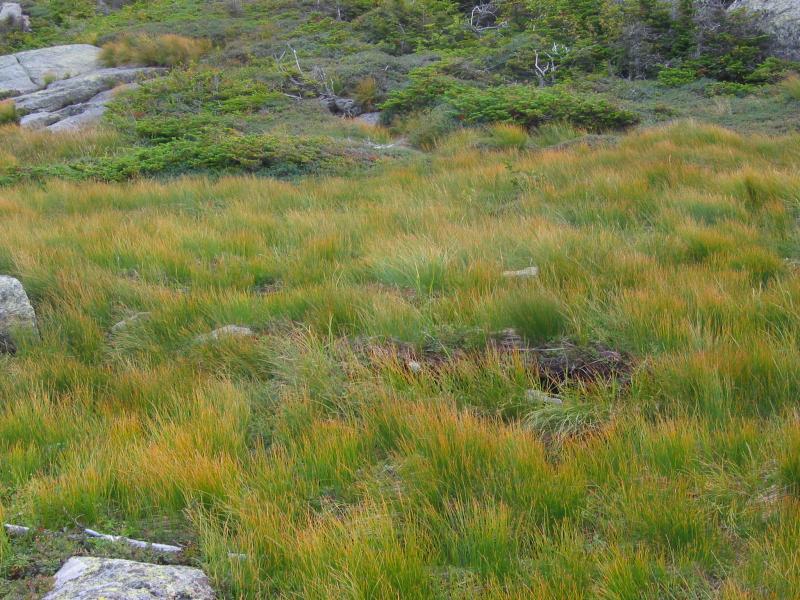
The species name cespitosum means tufted, and refers to the dense tussocks that this plant makes. This is the most common graminoid in New York's alpine ecosystem, and gives the meadows their distinctive "grassy" appearance. It turns a beautiful golden color in the fall.
State Ranking Justification
There are currently 20 known populations. There are also two populations which have not been seen in over twenty years, but additional survey work is needed to determine their status. All but one of the known extant populations occurs in the high peaks region of the Adirondacks. The other extant population is disjunct in a fen in western New York. Almost all of the populations in the Adirondacks are threatened by trampling by hiker traffic but many are quite large.
Short-term Trends
Trampling by hiker traffic is threatening at least some of the populations, but it is unclear if this impact is leading to a decline in the sizes of populations. Fourteen of the 20 known extant populations were first documented since 1988. It is unlikely that these represent new populations; rather they were probably overlooked in the past. Some populations are quite large, but overall, short-term trends are unclear.
Long-term Trends
Two populations from western New York are only known from historical records. The exact locations of these populations is not clear, but they are from towns that have had a lot of human impact. Further investigations and survey work are needed to determine the status of these populations. Fourteen of the 20 known extant populations were first documented since 1988. It is unlikely that these represent new populations; rather they were probably overlooked in the past. No populations are known to have become extirpated in the past 100+ years. Overall, long-term trends are unclear but do not indicate a rapid decline.
Conservation and Management
Threats
Trampling by hiker traffic threatens at least parts of most of the populations. At least parts of the only known extant population in western New York are potentially threatened by Phragmites australis ssp. australis. Management to remove this non-native Phragmites has been implemented at this site.
Conservation Strategies and Management Practices
The Summit Steward program which works to inform hikers of the fragile nature of alpine plants is a critical program which is helping to reduce trampling of alpine vegetation. This program and other efforts designed to reduce trampling of alpine meadows are needed. Continued control of Phragmites australis ssp. australis at the one western New York population is needed.
Research Needs
Research to help determine the location of the two historical populations from western New York should be conducted. Follow up survey work to these populations is needed to determine if they are still extant. A few of the known extant populations need to be surveyed to better assess their condition.
Habitat
Habitat
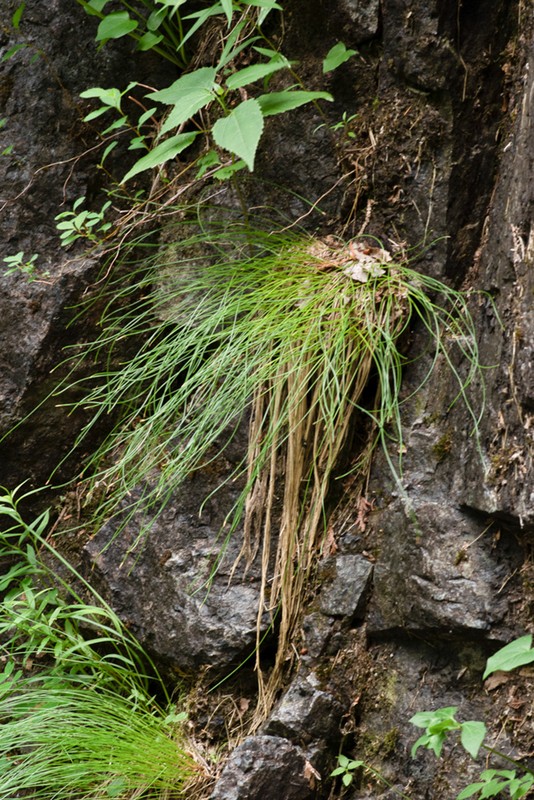
In New York, this taxon primarily grows in alpine regions of the highest peaks in the Adirondacks. In this area it is found in open alpine meadows, adjacent to krummholz, occasionally on exposed rocky ledges below the alpine zone, and in acidic peat bogs. It is also disjunct in western New York in very rich peat fens including marl fens (New York Natural Heritage Program 2007). Open, wet, rocky or peaty meadows, fens, bogs, shores (Crins 2002). Bogs, alpine areas (Haines and Vining 1998). Tundra, alpine mats, and acid bogs (Gleason and Cronquist 1991). Forming extensive turf on tundra, acid bogs and peat. Calcareous gravels, shores, and cliffs for var. delicatulus (Fernald 1970).
Associated Ecological Communities
- Marl fen
(guide)
A wetland that occurs on a bed of marl. Marl is a whitish substance that is deposited from water that has a lot of calcium dissolved in it. The whitish substance is calcium carbonate, people used to harvest marl to lime agricultural fields. The marl substrate is always saturated, may be flooded, and has a very high pH, generally greater than 7.5. The main source of water is always groundwater. The plants are often sparse and stunted. Marl fens may occur as small patches within a rich graminoid fen.
- Open alpine community
(guide)
An open community consisting of a mosaic of sedge/dwarf shrub meadows, dwarf heath shrublands, small boggy depressions, and exposed bedrock covered with lichens and mosses. The open alpine community occurs above timberline (about 4,900 ft or 1,620 m) on the higher mountain summits and exposed ledges of the Adirondacks. The flora includes arctic-alpine species that are restricted (in New York) to these areas, as well as boreal species that occur in forests and bogs at lower elevations. The soils are thin and organic, primarily composed of peat derived from peat mosses (Sphagnum spp.) or black muck. The soils are often saturated because they can be recharged by atmospheric moisture.
- Rich graminoid fen
(guide)
A wetland of mostly grasses usually fed by water from highly calcareous springs or seepage. These waters have high concentrations of minerals and high pH values, generally from 6.0 to 7.8. Plant remains do not decompose rapidly and these grasses usually grow on older, undecomposed plant parts.
Associated Species
- Agrostis mertensii (northern bent)
- Betula glandulosa (alpine birch, resin birch)
- Calamagrostis pickeringii (Pickering's reed grass)
- Carex bigelowii
- Carex oligosperma (few-seeded sedge)
- Diapensia lapponica var. lapponica
- Eleocharis rostellata (walking spike-rush)
- Empetrum eamesii ssp. atropurpureum
- Empetrum nigrum ssp. hermaphroditum
- Geocaulon lividum (false toadflax)
- Hierochloe alpina ssp. orthantha
- Huperzia appressa (mountain firmoss)
- Juniperus horizontalis (creeping juniper)
- Prenanthes boottii
- Rhododendron lapponicum var. lapponicum
- Salix uva-ursi (bearberry willow)
- Solidago leiocarpa (Cutler's alpine goldenrod)
- Solidago simplex var. randii
- Thuja occidentalis (northern white cedar, arbor vitae)
- Triantha glutinosa (sticky false asphodel)
- Vaccinium boreale (northern lowbush blueberry)
- Vaccinium uliginosum (bog bilberry)
Range
New York State Distribution
In New York, this species is almost entirely restricted to the highest mountains in the high peaks region of the Adirondacks. There are also three disjunct populations (one current and two historical) known from western New York (Monroe and Genesee Counties).
Global Distribution
Trichophorum cespitosum ssp. cespitosum is a circumboreal species. It occurs in Asia, Europe, as well as North America. It grows in the northern parts of North America from Alaska east to Greenland south in western North America to Oregon, Utah, and Montana and in eastern North America to the mountains of northern New England and New York, disjunct in western New York, and in the highest mountains of western North Carolina, eastern Tennessee, southwestern South Carolina, and northeastern Georgia (Fernald 1970, Crins 2002, Weakley 2006).
Identification Comments
General Description
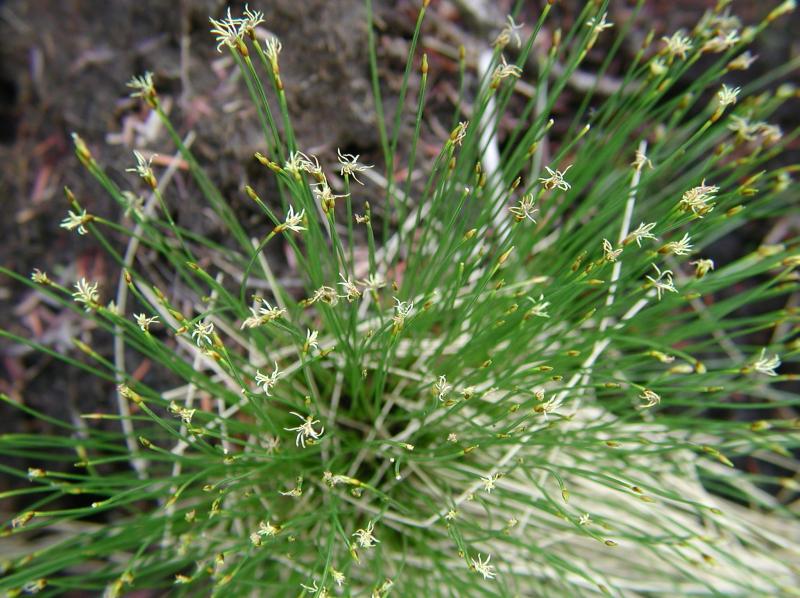
Deer's hair sedge is a densely tufted grass-like perennial. The stiff and narrow stems are 5-45 cm tall. The leaves are inconspicous and mostly appear as scales at the base of the stem. One leaf occurs further up the stem. At the tip of the stem is a tiny (up to 1/4 inch long) cluster of small inconspicuous flowers (spikelet). Each spikelet contains between 3-9 flowers enclosed at the base by small scales. The fruits are one seeded, hard walled, and less than 1/16th of an inch long (Fernald 1970, Crins 2002).
Identifying Characteristics
Trichophorum cespitosum ssp. cespitosum is a densely cespitose perennial sedge without rhizomes. The culms are terete and have longitudinal rows of stomata with stomatal cavities interior to the stomata. The base of the culms are covered with numerous brown sheaths. There is also one leaf that occurs further up the culms. This leaf is composed of a sheath and a blade 1.5-8.0 mm long. The sheath opening is about 1 mm in diameter and suborbicular. To see and measure this opening, the culm should first be pulled out from the sheath. The spikelets are 3-9 flowered, 3.3-7.0 mm long, and are subtended by a bract which equals the length of the spikelet. All the scales of the spikelets subtend florets and are reddish to dark brown. The achenes are subtended by six smooth to scabrous perianth bristles, compressed trigonous, and 1.4-1.7 mm long (Fernald 1970, Case 1999, Crins 2002).
Best Life Stage for Proper Identification
This species is easiest to identify when it is in flower or fruit. Specimens should include full culms including the basal sheaths.
Similar Species
Trichophorum cespitosum can be distinguished from the three other Trichophorum spp. that occur in New York by its smooth, round to nearly round stems compared to the scabrous, triangular stems of the three other taxa.
Although not recognized by Crins (2002) and other authors (Gleason and Cronquist 1991, Haines and Vining 1998), Fernald's var. delicatulus is distinguished by less stiff stems, blackish or lead colored basal sheaths, and calcareous habitats.
Some Eleocharis species can look superficially similar with upper leaves that are without distinct blades and achenes that are terminated by tubercles. Eriophorum vaginatum perhaps could look superficially similar as well. It has at least 10, long, cottony-white, hairlike perianth bristles, and 10 or more empty sterile scales at the base of the spikelets.
Best Time to See
This species starts to flower in June and is in fruit through September. Therefore, the best time to survey for this species is from mid-June until early September.
- Vegetative
- Flowering
- Fruiting
The time of year you would expect to find Deer's Hair Club Sedge vegetative, flowering, and fruiting in New York.
Deer's Hair Club Sedge Images
Julia Goren
Tim Howard
Julia Goren
Kyle J. Webster
Taxonomy
Deer's Hair Club Sedge
Trichophorum cespitosum ssp. cespitosum None
- Kingdom Plantae
- Phylum Anthophyta
- Class Monocotyledoneae
(Monocots)
- Order Cyperales
- Family Cyperaceae (Sedge Family)
- Order Cyperales
- Class Monocotyledoneae
(Monocots)
- Phylum Anthophyta
Additional Common Names
- Deergrass
- Deer's Hair Sedge
- Tufted Bulrush
Synonyms
- Scirpus cespitosus L.
- Scirpus cespitosus var. callosus Bigelow
- Scirpus cespitosus var. delicatulus Fernald [Not known from New York]
- Trichophorum cespitosum (L.) Hartman
Comments on the Classification
The segregate genus Trichophorum has been used as a separate genus distinct from Scirpus or as a section of Scirpus since 1805. The type for this genus has been conserved as T. alpinum (Salmenkallio and Kukkonen 1989, Greuter et al. 2000). Trichophorum is currently accepted as a distinct genus of nine species worldwide including T. cespitosum (Crins 2002). The name Baeothryon has sometimes been applied to this group but is now considered a synonym for Eleocharis (Salmenkallio and Kukkonen 1989). As Fernald (1921) pointed out, the name used by Linnaeus in the original publication was Scirpus cespitosus, and therefore, should not be altered to S. caespitosus (Greuter et al. 2000) as has been done by some authors (Palla 1897). When placed in the genus Trichophorum, the specific epithet should be altered to cespitosum, to agree grammatically with the new genus name (Greuter et al. 2000). The transfer of S. cespitosus to T. cespitosum was done by both Hartman in 1849 and Schur in 1853 (International Plant Name Index 2007). Therefore, Schur's authorship is considered a later isonym and disregarded. The correct authorship is T. cespitosum Hartman. Two taxa within T. cespitosum have been recognized as long ago as 1897 (Palla 1897, Swan 1999). At the subspecific rank these are T. cespitosum ssp. cespitosum and T. cespitosum ssp. germanicum. Subspecies germanicum is restricted to Atlantic and Subatlantic Europe while ssp. cespitosum is circumpolar and occurs in North America, Europe, and Asia. There has been differing opinion as to which of these taxa applies to the species Linnaeus described as Scirpus cespitosus. Swan (1999) designated the lectotype thereby fixing the circumpolar taxa as the type of the species. In North America, the name S. cespitosus var. callosus has been applied to the circumpolar taxa and now clearly needs to be considered a syno
Additional Resources
Best Identification Reference
Crins, W.J. 2002. Trichophorum Persoon. Pages 28-31 in Flora of North America Editorial Committee (Editors), Flora of North America, North of Mexico, Volume 23, Magnoliophyta: Commelinidae (in part): Cyperaceae. Oxford University Press, New York, NY, USA. 608pp + xxiv.
Other References
Fernald, M.L. 1921. The North American representatives of Scirpus cespitosus. Rhodora 23: 22-25.
Fernald, M.L. 1950. Gray's manual of botany. 8th edition. D. Van Nostrand, New York. 1632 pp.
Gleason, Henry A. and A. Cronquist. 1991. Manual of Vascular Plants of Northeastern United States and Adjacent Canada. The New York Botanical Garden, Bronx, New York. 910 pp.
Greuter, W., J. McNeill, F.R. Barrie, H.M. Burdet, V. Demoulin, T.S. Filgueiras, D.H. Nicolson, P.C. Silva, J.E. Skog, P. Trehane, N.J. Turland, and D.L. Hawksworth (editors). 2000. International Code of Botanical Nomenclature (Saint Louis Code) adopted by the Sixteenth International Botanical Congress, St. Louis, Missouri, July-August 1999. Koeltz Scientific Books, Königstein, Germany.
Haines, A. and T.F. Vining. 1998. Flora of Maine, A Manual for Identification of Native and Naturalized Vascular Plants of Maine. V.F.Thomas Co., Bar Harbor, Maine.
Hollingsworth, P.M. and G.A. Swan. 1999. Genetic differentiation and hybridisation among subspecies of deergrass (Trichophorum cespitosum (L.) Hartman) in Northumberland. Watsonia 22: 235-242.
Holmgren, Noel. 1998. The Illustrated Companion to Gleason and Cronquist's Manual. Illustrations of the Vascular Plants of Northeastern United States and Adjacent Canada. The New York Botanical Garden, Bronx, New York.
Mitchell, Richard S. and Gordon C. Tucker. 1997. Revised Checklist of New York State Plants. Contributions to a Flora of New York State. Checklist IV. Bulletin No. 490. New York State Museum. Albany, NY. 400 pp.
New York Natural Heritage Program. 2010. Biotics database. New York Natural Heritage Program. New York State Department of Environmental Conservation. Albany, NY.
New York Natural Heritage Program. 2024. New York Natural Heritage Program Databases. Albany, NY.
Palla, A. 1897. Einige bemerkungen über Trichophorum atrichum und caespitosum. Berichte Der Deutschen Botanischen Gesellschaft 15: 467-471.
Reschke, Carol. 1990. Ecological communities of New York State. New York Natural Heritage Program, New York State Department of Environmental Conservation. Latham, NY. 96 pp. plus xi.
Salmenkallio, M. and I. Kukkonen. 1989. Proposal to Conserve 466a Trichophorum (Cyperaceae) with a Conserved Type. Taxon 38: 313-316.
Swan, G.A. 1999. Identification, distribution, and a new nothosubspecies of Trichophorum cespitosum (L.) Hartman (Cyperaceae) in the British Isles and N.W. Europe. Watsonia 22: 209-233.
Weldy, T. and D. Werier. 2010. New York flora atlas. [S.M. Landry, K.N. Campbell, and L.D. Mabe (original application development), Florida Center for Community Design and Research http://www.fccdr.usf.edu/. University of South Florida http://www.usf.edu/]. New York Flora Association http://newyork.plantatlas.usf.edu/, Albany, New York
Links
About This Guide
Information for this guide was last updated on: February 1, 2023
Please cite this page as:
New York Natural Heritage Program. 2024.
Online Conservation Guide for
Trichophorum cespitosum ssp. cespitosum.
Available from: https://guides.nynhp.org/deers-hair-sedge/.
Accessed April 25, 2024.