Fairywand
Chamaelirium luteum (L.) Gray
Chamaelirium luteum
Troy Weldy
- Class
- Monocotyledoneae (Monocots)
- Family
- Melanthiaceae
- State Protection
- Endangered
Listed as Endangered by New York State: in imminent danger of extirpation in New York. For animals, taking, importation, transportation, or possession is prohibited, except under license or permit. For plants, removal or damage without the consent of the landowner is prohibited.
- Federal Protection
- Not Listed
- State Conservation Status Rank
- S1S2
Critically Imperiled or Imperiled in New York - Especially or very vulnerable to disappearing from New York due to rarity or other factors; typically 20 or fewer populations or locations in New York, very few individuals, very restricted range, few remaining acres (or miles of stream), and/or steep declines. More information is needed to assign either S1 or S2.
- Global Conservation Status Rank
- G4G5
Apparently or Demonstrably Secure globally - Uncommon to common in the world, but not rare; usually widespread, but may be rare in some parts of its range; possibly some cause for long-term concern due to declines or other factors. More information is needed to assign either G4 or G5.
Summary
Did you know?
This plant has seen a severe decline in numbers over the last 100 years. One factor in its decline may have been the overcollection of its highly valued root which was used to cure many ailments. The legend goes that the devil was so envious of its curative properties that he bit off most of its rhizome leaving only the short rhizomes seen today, hence the name Devil's-bit. Its Latin name means dwarf yellow lily but this description may have come from a shriveled herbarium specimen since the plant is neither dwarf nor yellow.
State Ranking Justification
While there have been as many as fifty populations historically present in the state, today we only know of seven populations. This severe decline is due in part to natural succession.
Short-term Trends
There has been a continual decline in numbers of plants in known populations over the past 10-25 years. The factors for this decline are not completely understood, but succession/canopy closure is probably a major reason.
Long-term Trends
There were approximately fifty historical occurrences known of this plant but presently less than ten are known. In the early 1900s, the roots of this plant were collected and sold for medicinal purposes. Collectors received 30 to 45 cents per pound. The amount of root stock collected from New York is not known and the impact from this collection is not known. This may be one of the reasons for the decline of the plant over the last 100 years. Another reason for the decline is likely due to habitat loss through succession, degradation, or destruction.
Conservation and Management
Threats
Many plants are threatened by succession and lack of additional habitat in which to spread. These long-lived plants can survive for many years under canopy closure, but they fail to reproduce. Should the plants be lost to competition, deer browse, picking, trampling, etc., there are no means for recovery once the canopy has closed.
Conservation Strategies and Management Practices
Some populations have benefited from the creation of light gaps. At one site in the southern Hudson Valley where few to no plants were producing flowers, many trees were cut in order to create light gaps. The following season, many of the plants in this setting produced flowers and set seed. This resulted in the recruitment of juvenile plants. Using this site as an example, the other sites may also benefit from the controlled removal of select trees and shrubs.
Research Needs
More research is needed to determine factors affecting the amount and timing of flowering in New York populations. We would like to see a study that compares multiple light gap treatments to various control populations to determine the optimal canopy cover for flowering and recruitment.
Habitat
Habitat
A long-lived plant that is often a calciphile of oak woodlands, mesic woodlands, oak barrens, mixed young mesophytic woods, old pastures with red cedars, moist thickets, calcareous seeps in red maple-tamarack swamps; calcareous wet meadows within old successional woods, calcareous rocky summits, and rich sloping fens. In areas where the canopy is closed, the plants may remain vegetative; however, flowers typically appear as soon as the canopy is opened (New York Natural Heritage Program 2004). Moist meadows, thickets, rich wooded slopes, and covers (Flora of North America 2002). Moist woods and bogs (Gleason and Cronquist 1991). Moist meadows and woods (Newcomb 1977). Meadows, thickets and rich woods (Fernald 1970).
Associated Ecological Communities
- Allegheny oak forest*
(guide)
A hardwood forest that occurs on well-drained sites in the unglaciated portion of southwestern New York. This is a forest of mixed oaks with a diverse canopy and richer ground flora than other oak communities in the state.
- Calcareous talus slope woodland*
(guide)
An open or closed canopy community that occurs on talus slopes composed of calcareous bedrock such as limestone or dolomite. The soils are usually moist and loamy; there may be numerous rock outcrops.
- Limestone woodland
(guide)
A woodland that occurs on shallow soils over limestone bedrock in non-alvar settings, and usually includes numerous rock outcrops. There are usually several codominant trees, although one species may become dominant in any one stand.
- Maple-basswood rich mesic forest*
(guide)
A species rich hardwood forest that typically occurs on well-drained, moist soils of circumneutral pH. Rich herbs are predominant in the ground layer and are usually correlated with calcareous bedrock, although bedrock does not have to be exposed. The dominant trees are sugar maple, basswood, and white ash.
- Red cedar rocky summit
(guide)
A community that occurs on warm, dry, rocky ridgetops and summits where the bedrock is calcareous (such as limestone or dolomite, but also marble, amphibolite, and calcsilicate rock), and the soils are more or less calcareous. The vegetation may be sparse or patchy, with numerous lichen covered rock outcrops.
- Red maple-tamarack peat swamp*
(guide)
A swamp that occurs on organic soils (peat or muck) in poorly drained depressions. These swamps are often spring fed or enriched by seepage of mineral-rich groundwater resulting in a stable water table and continually saturated soil. The dominant trees are red maple and tamarack. These species usually form an open canopy (50 to 70% cover) with numerous small openings dominated by shrubs or sedges.
- Rich mesophytic forest
(guide)
A hardwood or mixed forest that resembles the mixed mesophytic forests of the Allegheny Plateau south of New York but is less diverse. It occurs on rich, fine-textured, well-drained soils that are favorable for the dominance of a wide variety of tree species. A canopy with a relatively large number of codominant trees characterizes this forest. Canopy codominants include five or more of the following species: red oak, red maple, white ash, American beech, sugar maple, black cherry, cucumber tree, and black birch.
- Rich sloping fen*
(guide)
A small, gently sloping wetland that occurs in a shallow depression on a slope composed of calcareous glacial deposits. Sloping fens are fed by small springs or groundwater seepage. Like other rich fens, their water sources have high concentrations of minerals and high pH values, generally from 6.0 to 7.8. They often have water flowing at the surface in small channels or rivulets.
- Successional northern hardwoods*
A hardwood or mixed forest that occurs on sites that have been cleared or otherwise disturbed. Canopy trees are usually relatively young in age (25-50 years old) and signs of earlier forest disturbance are often evident. Characteristic trees and shrubs include any of the following: quaking aspen, big-tooth aspen, balsam poplar, paper birch, gray birch, pin cherry, black cherry, red maple, and white pine.
- Successional old field
A meadow dominated by forbs and grasses that occurs on sites that have been cleared and plowed (for farming or development), and then abandoned or only occasionally mowed.
* probable association but not confirmed.
Associated Species
- Acer rubrum var. rubrum (common red maple)
- Carex eburnea (bristle-leaved sedge)
- Carpinus caroliniana
- Castanea dentata (American chestnut)
- Cornus florida (flowering dogwood)
- Fagus grandifolia (American beech)
- Fraxinus americana (white ash)
- Juniperus virginiana
- Magnolia acuminata (cucumber tree, cucumber magnolia)
- Maianthemum canadense (Canada mayflower)
- Monotropa uniflora (Indian-pipe)
- Parthenocissus quinquefolia (Virginia-creeper)
- Prunus serotina
- Prunus virginiana
- Quercus rubra (northern red oak)
- Quercus velutina (black oak)
- Tilia americana var. americana (American basswood)
- Viburnum acerifolium (maple-leaved viburnum)
Range
New York State Distribution
This plant is historically documented from Rensselaer County south through the Hudson Valley and westward throughout the state south of the Adirondacks. While historically this plant has had a broad distribution, today it is only known from a few populations in western New York and the southern Hudson Valley.
Global Distribution
Chamaelirium luteum occurs in eastern North America from Michigan and Ontario, east to Massachusetts, and south to Louisiana and Florida. It is relatively rare in the northern portion of the range and more common in Pennsylvania, Virginia, and North Carolina.
Identification Comments
General Description
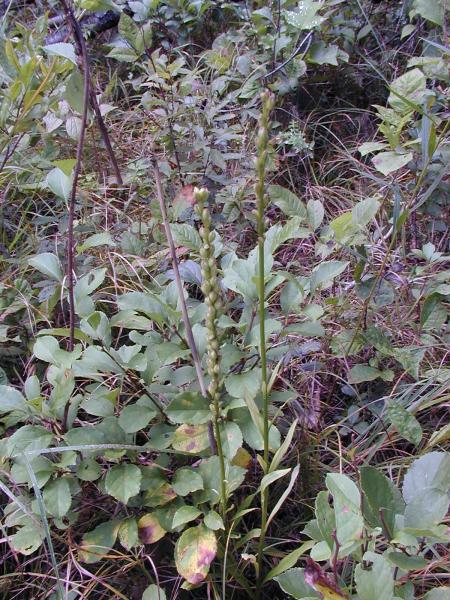
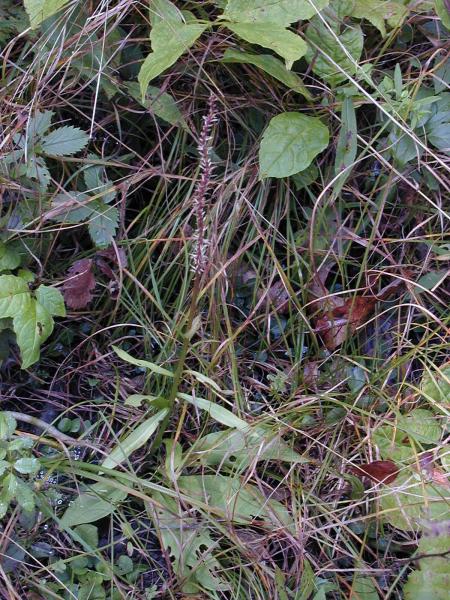
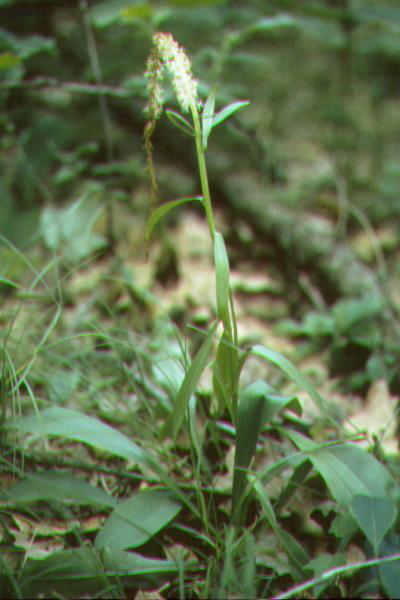
This attractive wildflower has a single flower stalk growing up to a meter tall from a rosette of 5-10 lance-shaped leaves 8-15 cm long. There are also a few narrow leaves along the flower stalk. Above these leaves is a long spike of tiny white flowers that are either male or female and turn yellow as they age. The female flowers mature into small, erect, oval, green fruits.
Identifying Characteristics
A dioecious (each plant is a either male or female) plant 25-95 cm tall with its basal leaves in a rosette. These basal leaves are elongate-spatulate to obovate, 8-15 cm long. The stem leaves are narrower and progressively smaller up the stem. Both male and female flowers are whitish, but drying to a yellowish color. These small flowers (2-4 mm) are in a slender spikelike raceme.
Best Life Stage for Proper Identification
The best stage for identifying this plant is while it is in flower; however, it can be identified vegetatively.
Similar Species
When in flower, not likely to be confused with other species. Vegetatively, this may look like a number of other liliaceous plants to somebody not intimately familiar with this species.
Best Time to See
Vegetative plants may be present from early spring to late fall. If the plant flowers, these flowers will begin to appear late-May and may persist to late July or even early August. The flowering stalks should persist into the winter. Surveys may take place anytime from early spring to late summer, but the plants stand out more in flower. Since the plants do not flower every though, surveys that target the flowers may be difficult. The recommended survey time is May and June.
- Vegetative
- Flowering
- Fruiting
The time of year you would expect to find Fairywand vegetative, flowering, and fruiting in New York.
Fairywand Images
Troy Weldy
Troy Weldy
Edith Schrot
Taxonomy
Fairywand
Chamaelirium luteum (L.) Gray
- Kingdom Plantae
- Phylum Anthophyta
- Class Monocotyledoneae
(Monocots)
- Order Liliales
- Family Melanthiaceae
- Order Liliales
- Class Monocotyledoneae
(Monocots)
- Phylum Anthophyta
Additional Common Names
- Blazing-star
- Blazing Star
- Devil's-bit
- Drooping Starwort
- Helonias
- Rattlesnake-root
- Starwort
- Unicorn Root
- Unicorn's-horn
Synonyms
- Helonias dioca Pursh
- Helonias lutea Ait.
- Veratrum luteum L.
Additional Resources
Best Identification Reference
Gleason, Henry A. and A. Cronquist. 1991. Manual of Vascular Plants of Northeastern United States and Adjacent Canada. The New York Botanical Garden, Bronx, New York. 910 pp.
Other References
Fernald, M.L. 1950. Gray's manual of botany. 8th edition. D. Van Nostrand, New York. 1632 pp.
Flora of North America Editorial Committee. 2002. Flora of North America, North of Mexico. Volume 26. Magnoliophyta: Liliidae: Liliales and Orchidales. Oxford University Press, New York. 723 pp.
Holmgren, Noel. 1998. The Illustrated Companion to Gleason and Cronquist's Manual. Illustrations of the Vascular Plants of Northeastern United States and Adjacent Canada. The New York Botanical Garden, Bronx, New York.
Mitchell, Richard S. and Gordon C. Tucker. 1997. Revised Checklist of New York State Plants. Contributions to a Flora of New York State. Checklist IV. Bulletin No. 490. New York State Museum. Albany, NY. 400 pp.
New York Natural Heritage Program. 2010. Biotics database. New York Natural Heritage Program. New York State Department of Environmental Conservation. Albany, NY.
New York Natural Heritage Program. 2024. New York Natural Heritage Program Databases. Albany, NY.
Newcomb, Lawrence. 1977. Newcomb's Wildflower Guide: An Ingenious New Key System for Quick, Positive Field Identification of the Wildflowers, Flowering Shrubs, and Vines of Northeastern and North-Central North America. Little, Brown and Company. Boston.
Reschke, Carol. 1990. Ecological communities of New York State. New York Natural Heritage Program, New York State Department of Environmental Conservation. Latham, NY. 96 pp. plus xi.
Weldy, T. and D. Werier. 2010. New York flora atlas. [S.M. Landry, K.N. Campbell, and L.D. Mabe (original application development), Florida Center for Community Design and Research http://www.fccdr.usf.edu/. University of South Florida http://www.usf.edu/]. New York Flora Association http://newyork.plantatlas.usf.edu/, Albany, New York
Links
About This Guide
Information for this guide was last updated on: September 8, 2004
Please cite this page as:
New York Natural Heritage Program. 2024.
Online Conservation Guide for
Chamaelirium luteum.
Available from: https://guides.nynhp.org/fairywand/.
Accessed April 19, 2024.