Side Oats Grama
Bouteloua curtipendula var. curtipendula None
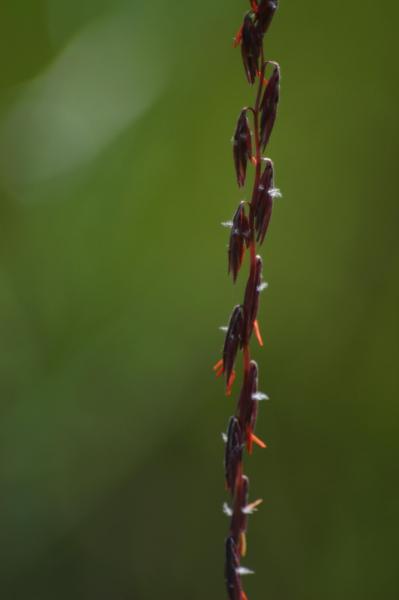
Bouteloua curtipendula spikelets
Troy Weldy
- Class
- Monocotyledoneae (Monocots)
- Family
- Poaceae (Grass Family)
- State Protection
- Endangered
Listed as Endangered by New York State: in imminent danger of extirpation in New York. For animals, taking, importation, transportation, or possession is prohibited, except under license or permit. For plants, removal or damage without the consent of the landowner is prohibited.
- Federal Protection
- Not Listed
- State Conservation Status Rank
- S2
Imperiled in New York - Very vulnerable to disappearing from New York due to rarity or other factors; typically 6 to 20 populations or locations in New York, very few individuals, very restricted range, few remaining acres (or miles of stream), and/or steep declines.
- Global Conservation Status Rank
- G5T5
Secure globally - Both the species as a whole and the subspecies/variety are common in the world; widespread and abundant (but may be rare in some parts of its range).
Summary
Did you know?
Side-oats grama is a very widespread and common grass west of New York but only occurs here in fewer than ten places. Many of them are close to or along current or historical railroad lines. It is one of the most beautiful and easy-to-recognize grasses in New York.
State Ranking Justification
There are eight existing populations, half of them good or excellent. The other half are small or under threat. There are about 10 historical populations and most of those are probably extirpated.
Short-term Trends
The short-term trend appears good as most current populations have have not changed in size over the last 30 years.
Long-term Trends
The long-term trend has been somewhat negative as many of the historical populations in the Hudson River Valley have not been found again. This was a result of habitat succession and the introduction of weedy species through the suppression of fire and other human disturbances.
Conservation and Management
Threats
Populations are moderately threatened by succession and human disturbance which has introduced weedy species such as phragmites and European herbs. Unprotected populations may be threatened by development at the sites.
Conservation Strategies and Management Practices
The control of invasive species is important in the open habitat where this grass occurs.
Research Needs
There seems to be a specific rock and soil type that the species prefers, otherwise it would be much more common in the state. There is a need to understand these habitat preferences. Most of the occurrences are also near existing or old railroad tracks and this correlation needs to be studied.
Habitat
Habitat
In New York this species is strongly associated with dry limestone-derived soils, as well as with disturbance, both natural and artificial, since it is also prefers open habitats. It occurs at riverside bluffs, shale cliffs and barrens, cedar glades, and limestone pavements as well as abandoned sandpits and pastures, railroads, and powerlines. (New York Natural Heritage Program 2007). Dry hills and plains (Fernald 1970). Dry woods (Gleason & Cronquist 1991).
Associated Ecological Communities
- Alvar pavement grassland
(guide)
This community consists of exposed, flat limestone or dolostone pavement with grassy or mossy patches interspersed throughout. Some examples may be solely grassland with no pavement.
- Calcareous cliff community*
(guide)
A community that occurs on vertical exposures of resistant, calcareous bedrock (such as limestone or dolomite) or consolidated material; these cliffs often include ledges and small areas of talus.
- Calcareous red cedar barrens
(guide)
A small-patch calcareous rocky summit community occurring on dry, south-facing to southwest-facing slopes and low summits. These sites are characterized by stunted, sparse woodlands with small grassland openings.
- Calcareous talus slope woodland*
(guide)
An open or closed canopy community that occurs on talus slopes composed of calcareous bedrock such as limestone or dolomite. The soils are usually moist and loamy; there may be numerous rock outcrops.
- Limestone woodland*
(guide)
A woodland that occurs on shallow soils over limestone bedrock in non-alvar settings, and usually includes numerous rock outcrops. There are usually several codominant trees, although one species may become dominant in any one stand.
- Northern white cedar rocky summit*
(guide)
A community that occurs on cool, dry, rocky ridgetops and summits where the bedrock is calcareous (such as limestone or dolomite), and the soils are more or less calcareous. The vegetation may be sparse or patchy, with numerous rock outcrops. The species have predominantly boreal distributions.
- Red cedar rocky summit
(guide)
A community that occurs on warm, dry, rocky ridgetops and summits where the bedrock is calcareous (such as limestone or dolomite, but also marble, amphibolite, and calcsilicate rock), and the soils are more or less calcareous. The vegetation may be sparse or patchy, with numerous lichen covered rock outcrops.
- Shale cliff and talus community*
(guide)
A community that occurs on nearly vertical exposures of shale bedrock and includes ledges and small areas of talus. Talus areas are composed of small fragments that are unstable and steeply sloping; the unstable nature of the shale results in uneven slopes and many rock crevices.
* probable association but not confirmed.
Associated Species
- Asclepias viridiflora (green milkweed)
- Carex bicknellii (Bicknell's sedge)
- Carex crawei (Crawe's sedge)
- Centaurea melitensis
- Juniperus communis
- Liatris borealis
- Lonicera morrowii (Morrow's honeysuckle)
- Melilotus albus (white sweet-clover)
- Monarda fistulosa
- Ostrya virginiana (hop hornbeam, ironwood)
- Phleum pratense
- Rhamnus cathartica (European buckthorn)
- Schizachyrium scoparium
- Spiranthes cernua (nodding ladies'-tresses)
- Sporobolus heterolepis (prairie dropseed)
- Sporobolus neglectus (small dropseed)
- Toxicodendron radicans
Range
New York State Distribution
In New York Side-oats Grama is found in scattered locations primarily from Long Island and the Hudson Valley, as well as a few sites on alvar or limestone regions in Western New York.
Global Distribution
Side-oats Grama is found throughout most of the United States, as well as Ontario, and Saskatchewan.
Identification Comments
General Description
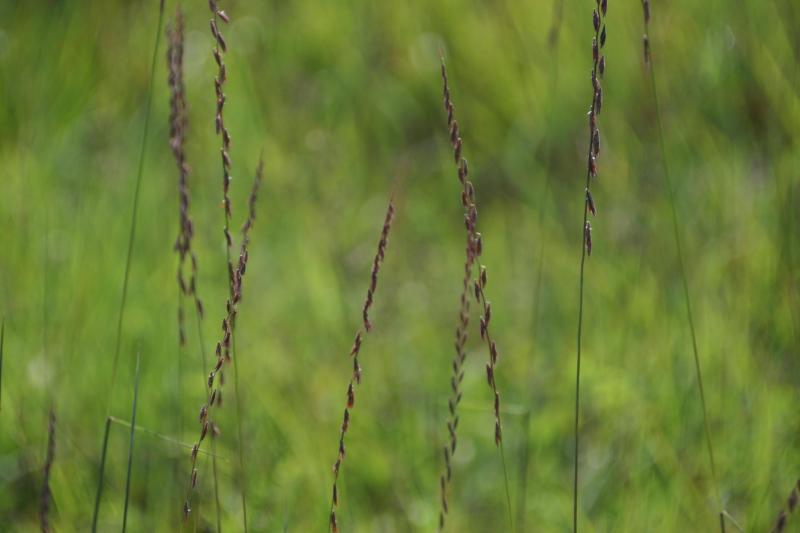
Side-oats grama is a attractive perennial grass with erect stems up to 1m tall (usually less). The numerous spikes are relatively large (.8-2cm long) and well-spaced along a mostly 1-sided raceme.
Best Life Stage for Proper Identification
Side-oats Grama is most easily identified when flowering or fruiting. The distinctive flower stalks may sometimes be recognized even in winter.
Similar Species
There are no other species of Bouteloua in New York, and the overall form of this grass is quite distinctive.
Best Time to See
Side-oats grama flowers in mid-summer and the fruits persist from mid-July through the fall.
- Flowering
- Fruiting
The time of year you would expect to find Side Oats Grama flowering and fruiting in New York.
Side Oats Grama Images
Troy Weldy
Troy Weldy
Taxonomy
Side Oats Grama
Bouteloua curtipendula var. curtipendula None
- Kingdom Plantae
- Phylum Anthophyta
- Class Monocotyledoneae
(Monocots)
- Order Cyperales
- Family Poaceae (Grass Family)
- Order Cyperales
- Class Monocotyledoneae
(Monocots)
- Phylum Anthophyta
Additional Common Names
- Side-oats Grama
Additional Resources
Best Identification Reference
Flora of North America Editorial Committee. 2003. Flora of North America, North of Mexico. Volume 25. Magnoliophyta: Commelinidae (in part): Poaceae, part 2. Oxford University Press, New York. 783 pp.
Other References
Fernald, M.L. 1950. Gray's manual of botany. 8th edition. D. Van Nostrand, New York. 1632 pp.
Gleason, Henry A. and A. Cronquist. 1991. Manual of Vascular Plants of Northeastern United States and Adjacent Canada. The New York Botanical Garden, Bronx, New York. 910 pp.
Hitchcock, A.S. 1951. Manual of the grasses of the United States. 2nd edition revised by Agnes Chase. [Reprinted, 1971, in 2 vols., by Dover Publications, Incorporated, New York.]
Holmgren, Noel. 1998. The Illustrated Companion to Gleason and Cronquist's Manual. Illustrations of the Vascular Plants of Northeastern United States and Adjacent Canada. The New York Botanical Garden, Bronx, New York.
New York Natural Heritage Program. 2010. Biotics database. New York Natural Heritage Program. New York State Department of Environmental Conservation. Albany, NY.
New York Natural Heritage Program. 2024. New York Natural Heritage Program Databases. Albany, NY.
Reschke, Carol. 1990. Ecological communities of New York State. New York Natural Heritage Program, New York State Department of Environmental Conservation. Latham, NY. 96 pp. plus xi.
Rhoads, Ann F. and Timothy A. Block. 2000. The Plants of Pennsylvania, an Illustrated Manual. University of Pennsylvania Press, Philadelphia, PA.
Voss, E.G. 1972. Michigan Flora, Part I. Gymnosperms and Monocots. Cranbrook Institute of Science Bulletin 55 and the University of Michigan Herbarium. Ann Arbor. 488 pp.
Weldy, T. and D. Werier. 2010. New York flora atlas. [S.M. Landry, K.N. Campbell, and L.D. Mabe (original application development), Florida Center for Community Design and Research http://www.fccdr.usf.edu/. University of South Florida http://www.usf.edu/]. New York Flora Association http://newyork.plantatlas.usf.edu/, Albany, New York
Weldy, Troy W. and David Werier. 2005. New York Flora Atlas. [S.M. Landry, K.N. Campbell, and L.D. Mabe (original application development), Florida Center for Community Design and Research. University of South Florida]. New York Flora Association, Albany, NY. Available on the web at (http://newyork.plantatlas.usf.edu/).
Links
About This Guide
Information for this guide was last updated on: January 18, 2008
Please cite this page as:
New York Natural Heritage Program. 2024.
Online Conservation Guide for
Bouteloua curtipendula var. curtipendula.
Available from: https://guides.nynhp.org/side-oats-grama/.
Accessed April 19, 2024.