Small Bur-reed
Sparganium natans L.
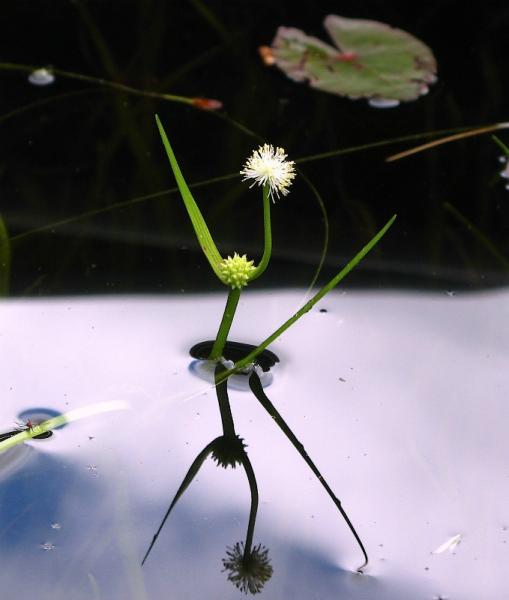
Sparganium natans in flower
Jackie Donnelly
- Class
- Monocotyledoneae (Monocots)
- Family
- Typhaceae
- State Protection
- Threatened
Listed as Threatened by New York State: likely to become Endangered in the foreseeable future. For animals, taking, importation, transportation, or possession is prohibited, except under license or permit. For plants, removal or damage without the consent of the landowner is prohibited.
- Federal Protection
- Not Listed
- State Conservation Status Rank
- S2
Imperiled in New York - Very vulnerable to disappearing from New York due to rarity or other factors; typically 6 to 20 populations or locations in New York, very few individuals, very restricted range, few remaining acres (or miles of stream), and/or steep declines.
- Global Conservation Status Rank
- G5
Secure globally - Common in the world; widespread and abundant (but may be rare in some parts of its range).
Summary
State Ranking Justification
There are 11 verified occurrences, 23 historical occurrences.
Conservation and Management
Habitat
Habitat
In New York, Small Bur-reed has been found in a wide variety of habitats with still, open water. It occurs in small pools within both bogs and fens, as well as in Northern White-cedar swamps, beaver ponds, and shrub swamps (New York Natural Heritage Program 2011). Small open water pools at edge of fen mat; open water sections of fen near open stream flow; mucky shrub swamps with open water zones; mountain pool surrounded by trees; small swamps surrounded by northern white cedar woods; open water within willow swamps; open water in dwarf shrub bogs; submergent/emergent communities along a beaver affected area along streams; dwarf shrub bogs with small stream channels of wet peat; shallow depressions within shrub and hummock swamps; (New York Natural Heritage Program 2011). Cool, quiet, slightly acid to somewhat basic waters of bays, pools, ditches, and peat bogs, usually in shallow water but sometimes to 60 cm depth (FNA 2000). Clean, relatively still, shallow waters of lakes, ponds, bog pools, limestone sinkholes, small creeks, interdunal ponds, and deepwater marshes; often in alkaline water (Jenkins 1990). Ponds, bogs, beach pools and interdunal swales (of the Great Lakes), and other wet places (Voss 1972). Shallow pools, brooks, springs, etc. (Fernald 1970).
Associated Ecological Communities
- Bog lake/pond*
(guide)
the aquatic community of a dystrophic lake that typically occurs in a small, shallow basin (e.g., a kettehole) that is protected from wind and is poorly drained. These lakes occur in areas with non-calcareous bedrock or glacial till; many are fringed or surrounded by a floating mat of vegetation (in New York usually either bog or poor fen).
- Dwarf shrub bog
(guide)
A wetland usually fed by rainwater or mineral-poor groundwater and dominated by short, evergreen shrubs and peat mosses. The surface of the peatland is usually hummocky, with shrubs more common on the hummocks and peat moss throughout. The water in the bog is usually nutrient-poor and acidic.
- Hemlock-hardwood swamp*
(guide)
A swamp that occurs on mineral soils and deep muck in depressions which receive groundwater discharge. These swamps usually have a fairly closed canopy (70 to 90% cover), sparse shrub layer, and low species diversity. The tree canopy is typically dominated by eastern hemlock and co-dominated by yellow birch and red maple.
- Inland poor fen*
(guide)
A wetland fed by acidic water from springs and seeps. Plant remains in these fens do not decompose rapidly and thus the plants in these fens usually grow on older, undecomposed plant parts of mostly sphagnum mosses.
- Medium fen*
(guide)
A wetland fed by water from springs and seeps. These waters are slightly acidic (pH values generally range from 4.5 to 6.5) and contain some dissolved minerals. Plant remains in these fens do not decompose rapidly and thus the plants in these fens usually grow on older, undecomposed plant parts of woody material, grasses, and mosses.
- Northern white cedar swamp
(guide)
A swamp that occurs on organic soils in cool, poorly drained depressions in central and northern New York, and along lakes and streams in the northern half of the state. These swamps are often spring-fed with continually saturated soils. Soils are often rich in calcium. The characteristic tree is northern white cedar, which makes up more than 30% of the canopy cover.
- Oligotrophic pond*
(guide)
The aquatic community of a small, shallow, nutrient-poor pond. The water is very clear, and the bottom is usually sandy or rocky.
- Rich graminoid fen*
(guide)
A wetland of mostly grasses usually fed by water from highly calcareous springs or seepage. These waters have high concentrations of minerals and high pH values, generally from 6.0 to 7.8. Plant remains do not decompose rapidly and these grasses usually grow on older, undecomposed plant parts.
- Rich shrub fen*
(guide)
A wetland with many shrubs that is usually fed by water from springs and seeps. These waters have high concentrations of minerals and high pH values, generally from 6.0 to 7.8. Plant remains in these fens do not decompose rapidly and thus the plants in these fens usually grow on older, undecomposed woody plant parts.
- Shrub swamp
(guide)
An inland wetland dominated by tall shrubs that occurs along the shore of a lake or river, in a wet depression or valley not associated with lakes, or as a transition zone between a marsh, fen, or bog and a swamp or upland community. Shrub swamps are very common and quite variable.
* probable association but not confirmed.
Associated Species
- Abies balsamea (balsam fir)
- Acer rubrum
- Alisma triviale (northern water-plantain)
- Alnus incana ssp. rugosa (speckled alder)
- Asclepias incarnata
- Brasenia schreberi (water-shield)
- Calla palustris (wild calla)
- Carex comosa (bristly sedge)
- Carex flava (yellow sedge)
- Carex gynandra (nodding sedge)
- Carex magellanica
- Carex pseudocyperus (cyperus-like sedge)
- Carex retrorsa (backward-fruited sedge)
- Carex scoparia (pointed broom sedge)
- Ceratophyllum demersum (common coon-tail)
- Chamaedaphne calyculata (leatherleaf)
- Chelone glabra (white turtle-head)
- Cicuta bulbifera (bulb-bearing water-hemlock)
- Comarum palustre (marsh-cinquefoil)
- Cornus sericea (red-osier dogwood)
- Eleocharis acicularis (needle spike-rush)
- Eleocharis intermedia (intermediate spike-rush)
- Eriophorum virginicum (tawny cotton-grass)
- Fraxinus nigra (black ash)
- Gaylussacia baccata (black huckleberry)
- Hydrocharis morsus-ranae (European frog's-bit)
- Impatiens capensis (spotted jewelweed, spotted touch-me-not)
- Iris versicolor (blue flag)
- Juncus effusus
- Kalmia angustifolia
- Larix laricina (tamarack)
- Ludwigia
- Menyanthes trifoliata (buck-bean)
- Najas flexilis (common water-nymph, common naiad)
- Nemopanthus mucronatus
- Nuphar variegata (common yellow pond-lily, common spatter-dock)
- Onoclea sensibilis (sensitive fern)
- Osmunda cinnamomea
- Osmunda regalis
- Pontederia cordata (pickerelweed)
- Potamogeton
- Proserpinaca palustris (coastal marsh mermaid-weed)
- Salix bebbiana (Bebb's willow)
- Scirpus atrovirens (dark-green bulrush)
- Sparganium emersum (emersed bur-reed)
- Sphagnum
- Thelypteris palustris
- Thuja occidentalis (northern white cedar, arbor vitae)
- Triadenum virginicum
- Typha latifolia (wide-leaved cat-tail)
- Utricularia intermedia (flat-leaved bladderwort)
- Utricularia macrorhiza
- Utricularia minor (lesser bladderwort)
- Vaccinium angustifolium (common lowbush blueberry)
- Vaccinium corymbosum (highbush blueberry)
Range
New York State Distribution
Scattered throughout the state north of Long Island.
Identification Comments
Identifying Characteristics
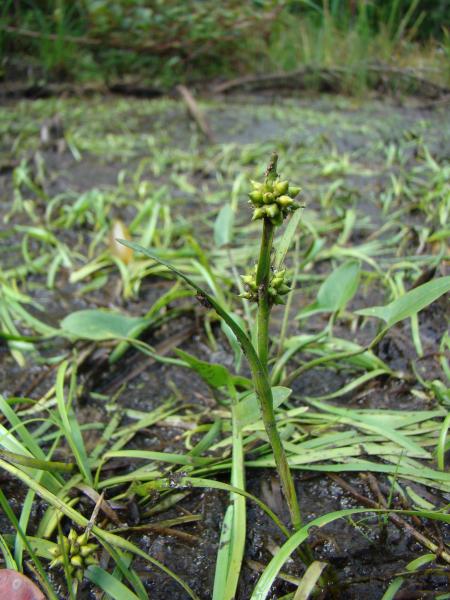
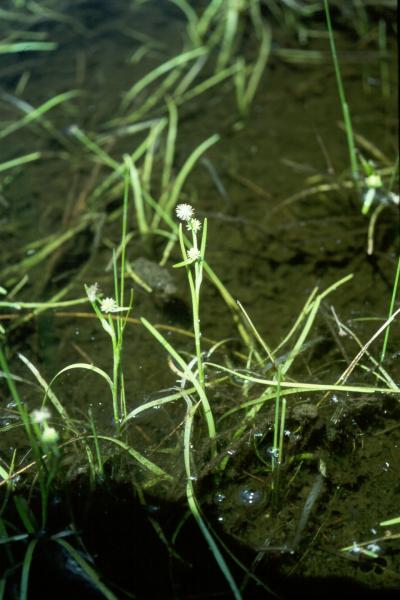
Distinguishing characteristics: small aquatic plants with slender creeping rhizomes; stems 10-40 cm long, decumbent or ascending, often floating, slender, flexuous, or rarely suberect and emergent in very shallow water or on mud and then short; lower leaves 10-40 cm long, (1.5) 3-7 (9) mm wide, flat and keelless; inflorescence unbranched with 1-4 (usually 2 or 3) equally spaced axillary, pistillate heads and 1 (2) remote staminate head(s), all but the lowest most pistillate head sessile; stigma ovate to lanceolate, 0.3-0.8 mm long; fruiting heads (5) 7-12 mm in diameter; achenes 2-3.5 mm long, 1-2.5 mm thick, tapering to an obconic base and a conic beak 0.5-1.5 mm long, only slightly if at all contracted near middle; sepals elliptic or cuneate-spatulate, one-half to two-thirds as long as the body of the fruit. Best life stage for ID: with mature fruit. Characteristics needed to ID: complete plant with mature fruits.
Similar Species
Sparganium hyperboreum is the most closely related plant, but this is a more northern plant that reaches in southern limit around Nova Scotia. Other small Sparganium species that may be confused with S. natans include S. angustifolium, S. erectum and S. fluctuans. The achene beak in all three of these species is 1.5-6 mm long with a stipe 1-5 mm, and two or more staminate heads. Sparganium fluctuans usually has branched flowering heads with several male flowers, the achenes are typically 4-5 mm long with a conspicuous stipe, and the beaks are 2-3 mm long and curved. Sparganium angustifolium has some pistillate flowers which are attached to the stalk 5+ mm above the axil of the subtending bract (super-axillary) with achenes 3-5 mm long contracted abruptly to a 1 mm beak. Sparganium chlorocarpum will have some super-axillary flowers and achene beaks 3-6 mm long.
Best Time to See
Surveys should be done when fruiting plants may be found, from mid-July through mid-September.
- Flowering
- Fruiting
The time of year you would expect to find Small Bur-reed flowering and fruiting in New York.
Small Bur-reed Images
Jackie Donnelly
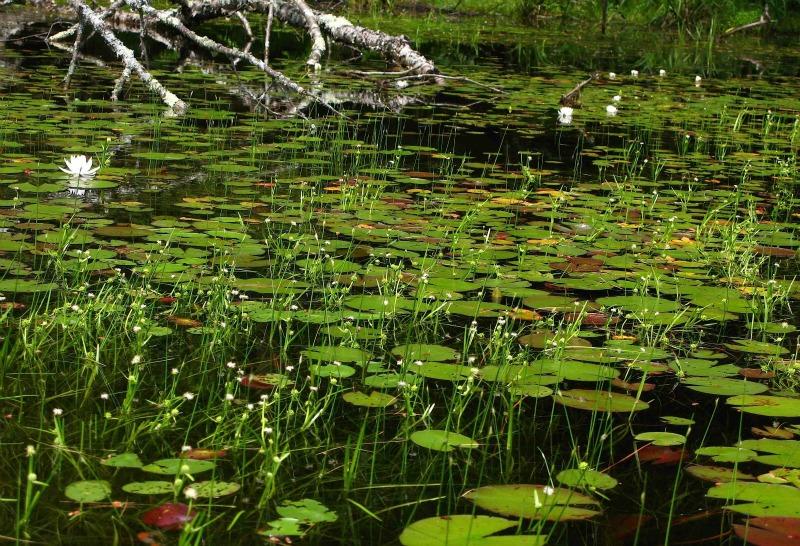
Jackie Donnelly
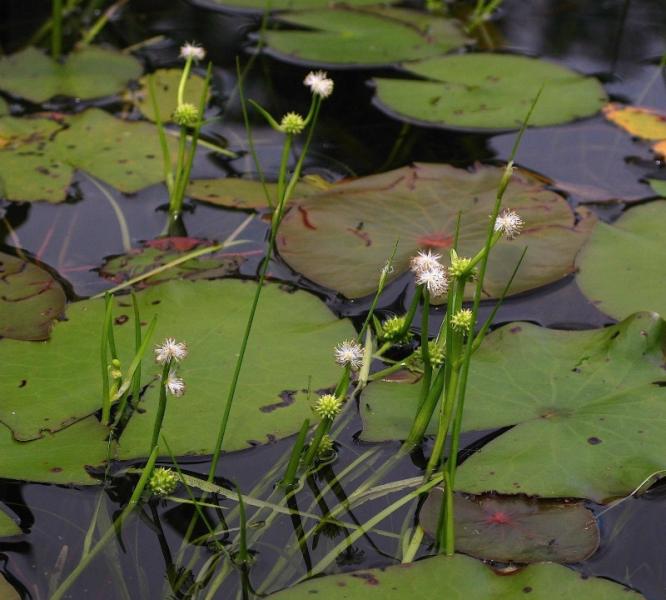
Jackie Donnelly
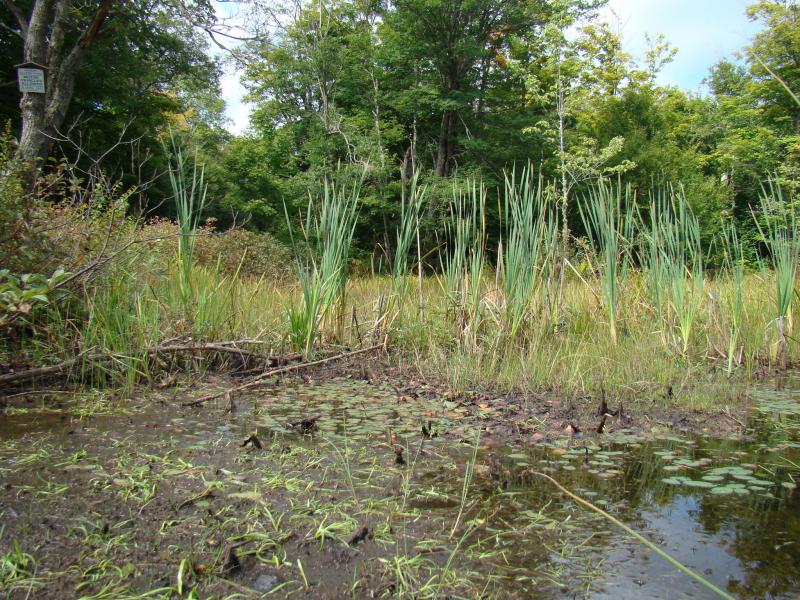
Kimberly J. Smith
Kimberly J. Smith
Stephen M. Young
Taxonomy
Small Bur-reed
Sparganium natans L.
- Kingdom Plantae
- Phylum Anthophyta
- Class Monocotyledoneae
(Monocots)
- Order Typhales
- Family Typhaceae
- Order Typhales
- Class Monocotyledoneae
(Monocots)
- Phylum Anthophyta
Synonyms
- Sparganium minimum (Hartman) Wallr.
Additional Resources
References
Crow, G.E. and C.B. Hellquist 1981. Aquatic vascular plants of New England: part 2. Typhaceae and Sparganiaceae. New Hampshire Agricultural Experiment Station University of New Hampshire. Station Bull. 517.
Fernald, M.L. 1950. Gray's manual of botany. 8th edition. D. Van Nostrand, New York. 1632 pp.
Gleason, Henry A. and A. Cronquist. 1991. Manual of Vascular Plants of Northeastern United States and Adjacent Canada. The New York Botanical Garden, Bronx, New York. 910 pp.
Harms, V.L. 1973. Taxonomic studies of North American Sparganium, Sparganium hyperboreum, and Sparganium minimum. Can. J. of Botany 51: 1629-1641.
Holmgren, Noel. 1998. The Illustrated Companion to Gleason and Cronquist's Manual. Illustrations of the Vascular Plants of Northeastern United States and Adjacent Canada. The New York Botanical Garden, Bronx, New York.
House, Homer D. 1924. Annotated list of the ferns and flowering plants of New York State. New York State Museum Bulletin 254:1-758.
Jenkins, Jerry. 1990. A preliminary report on the status of the least bur-reed (Sparganium minimum) in Vermont. Unpublished report. White Creek, NY. January 22. 24 pp.
Mitchell, Richard S. and Gordon C. Tucker. 1997. Revised Checklist of New York State Plants. Contributions to a Flora of New York State. Checklist IV. Bulletin No. 490. New York State Museum. Albany, NY. 400 pp.
New York Natural Heritage Program. 2010. Biotics database. New York Natural Heritage Program. New York State Department of Environmental Conservation. Albany, NY.
New York Natural Heritage Program. 2024. New York Natural Heritage Program Databases. Albany, NY.
Ogden, E.C. 1974. Potamogeton in New York. New York State Museum Bulletin. 423:1-20.
Ogden, E.C., J.K. Dean, C.W. Boylen, R.B. Sheldon 1976. Field guide to the aquatic plants of Lake George, New York. New York State Museum Bull. 426.
Reschke, Carol. 1990. Ecological communities of New York State. New York Natural Heritage Program, New York State Department of Environmental Conservation. Latham, NY. 96 pp. plus xi.
Seymour, F.C. 1982. The flora of New England. A manual for the identification of all vascular plants including ferns and fern allies growing without cultivation in New England. Moldenka, Plainfield, New Jersey.
Taylor, Norman. 1915. Flora of the vicinity of New York. Memoirs of the New York Botanical Garden vol. V. New York, NY.
Voss, E.G. 1972. Michigan Flora, Part I. Gymnosperms and Monocots. Cranbrook Institute of Science Bulletin 55 and the University of Michigan Herbarium. Ann Arbor. 488 pp.
Weldy, T. and D. Werier. 2010. New York flora atlas. [S.M. Landry, K.N. Campbell, and L.D. Mabe (original application development), Florida Center for Community Design and Research http://www.fccdr.usf.edu/. University of South Florida http://www.usf.edu/]. New York Flora Association http://newyork.plantatlas.usf.edu/, Albany, New York
Links
About This Guide
This guide was authored by: Richard M. Ring
Information for this guide was last updated on: August 8, 2012
Please cite this page as:
New York Natural Heritage Program. 2024.
Online Conservation Guide for
Sparganium natans.
Available from: https://guides.nynhp.org/small-bur-reed/.
Accessed April 19, 2024.