Mountain Firmoss
Huperzia appressa (Desv.) A. Löve & D. Löve
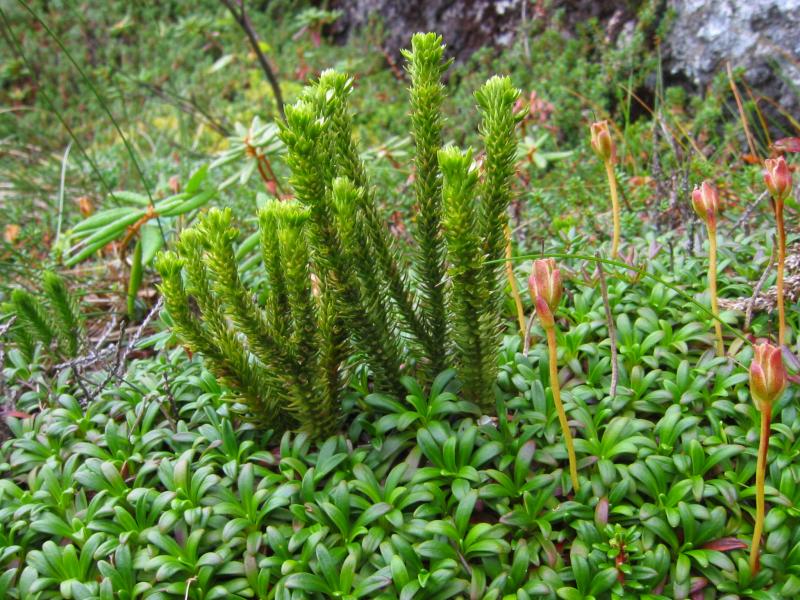
Huperzia appressa
Tim Howard
- Class
- Lycopodiopsida (Clubmosses)
- Family
- Lycopodiaceae (Club-moss Family)
- State Protection
- Rare
A plant listed as Rare by New York State. Removal or damage without the consent of the landowner is prohibited.
- Federal Protection
- Not Listed
- State Conservation Status Rank
- S3
Vulnerable in New York - Vulnerable to disappearing from New York due to rarity or other factors (but not currently imperiled); typically 21 to 80 populations or locations in New York, few individuals, restricted range, few remaining acres (or miles of stream), and/or recent and widespread declines.
- Global Conservation Status Rank
- G5
Secure globally - Common in the world; widespread and abundant (but may be rare in some parts of its range).
Summary
Did you know?
Applachian Firmoss and its close relatives grow only a few inches high, but fossils dating from before the evolution of flowering plants (about 160 million years ago) have revealed that the ancestors of modern clubmoss species grew to the size of our modern-day trees. Hybrids of Appalachian Firmoss with other closely related species are relatively common in certain parts of its range. This is probably the result of asexual propagules (gemmae) that help to maintain the hybrids even if the spores are not viable.
State Ranking Justification
There are 24 existing populations and 10 of these populations are considered to have good to excellent viability. There are 3 historical populations. One of the historical populations was searched for without success but there is more habitat to search at the site and more survey work is needed. All but a few populations are known from the high peaks region of the Adirondacks. The others are known from the Catskills. Many of the populations in the Adirondacks are threatened by trampling from hiker traffic.
Short-term Trends
Trampling by hiker traffic has apparently had some negative impact on some of the populations,but clear data is not available. Nine populations were first documented in the past 20 years. These populations were probably overlooked in the past and likely do not represent truly new populations. Overall, short-term trends are unclear but probably represent a small decline.
Long-term Trends
There are no populations which are known to have become extirpated. There are about three historical populations which have not been seen in recent years. One of these populations was searched for twice without success. Still, surveyors concluded that there is abundant habitat present, and further survey work is needed to determine if this population is still extant. The other historical populations also need to be searched for before a determination can be made on their condition. Population size varies considerably. Some have only 15 patches while others have 10's of thousands of individuals. Overall, long-term trends are unclear.
Conservation and Management
Threats
Many sites are threatened by trampling from hiker traffic, and one site from rock climbing activities, but the extent of the damage is not known. One site is potentially threatened by habitat succession.
Conservation Strategies and Management Practices
The Summit Steward program, which works to inform hikers of the fragile nature of alpine plants, is a critical program which is helping to reduce trampling of alpine vegetation. This program and other efforts designed to reduce trampling of alpine meadows are needed. Education is also needed at the one site where rock climbing activities threaten the population.
Research Needs
All historical populations need further survey work to determine if they are still extant. Specimens and sites should be examined carefully for the hybrid taxon H. x josephbeitelii. The one population that is potentially threatened by habitat succession should be monitored on a relatively frequent basis to determine if management actions are needed. Other cliffs and alpine areas should be searched for additional populations.
Habitat
Habitat
In New York, this species occurs in alpine meadows, in openings or edges of krummholz, and on ledges and cracks in vertical cliffs. In alpine meadows it often occurs associated with exposed bedrock and cracks or crevices of rocks. The plants usually grow in exposed habitat on mosses or very thin soil or detritus over rock (New York Natural Heritage Program 2007). Exposed, harsh environments, such as cliff faces, talus slopes, and alpine summits (Haines 2003). Damp, acidic, igneous rocks in alpine zone or exposed cliffs and talus slopes elsewhere (Wagner and Beitel 2003).
Associated Ecological Communities
- Alpine krummholz
(guide)
A dwarf woodland dominated by balsam fir that occurs at or near the summits of the high peaks of the Adirondacks.
- Cliff community
(guide)
A community that occurs on vertical exposures of resistant, non-calcareous bedrock (such as quartzite, sandstone, or schist) or consolidated material; these cliffs often include ledges and small areas of talus.
- Open alpine community
(guide)
An open community consisting of a mosaic of sedge/dwarf shrub meadows, dwarf heath shrublands, small boggy depressions, and exposed bedrock covered with lichens and mosses. The open alpine community occurs above timberline (about 4,900 ft or 1,620 m) on the higher mountain summits and exposed ledges of the Adirondacks. The flora includes arctic-alpine species that are restricted (in New York) to these areas, as well as boreal species that occur in forests and bogs at lower elevations. The soils are thin and organic, primarily composed of peat derived from peat mosses (Sphagnum spp.) or black muck. The soils are often saturated because they can be recharged by atmospheric moisture.
Associated Species
- Agrostis mertensii (northern bent)
- Anthoxanthum monticolum ssp. monticolum
- Carex bigelowii
- Carex scirpoidea ssp. scirpoidea (Canadian single-spike sedge)
- Diapensia lapponica var. lapponica
- Empetrum nigrum ssp. hermaphroditum
- Geocaulon lividum (false toadflax)
- Minuartia groenlandica
- Prenanthes boottii
- Rhododendron groenlandicum (Labrador-tea)
- Rhododendron lapponicum var. lapponicum
- Salix uva-ursi (bearberry willow)
- Solidago leiocarpa (Cutler's alpine goldenrod)
- Solidago simplex var. monticola
- Thuja occidentalis (northern white cedar, arbor vitae)
- Trichophorum cespitosum ssp. cespitosum (deer's-hair club sedge)
- Vaccinium boreale (northern lowbush blueberry)
Range
New York State Distribution
In New York, almost all populations are known from the high peaks region of the Adirondacks. There are a few populations (at least historically) known from the Catskills.
Global Distribution
Huperzia aprressa occurs in northeastern North America and perhaps Europe. In North America, it grows from Greenland south to Newfoundland, Labrador, New England, New York, and the mountains of the southern Appalachians including Virginia, North Carolina, Tennessee, and Georgia. It is also disjunct around Lake Superior in Ontario, Minnesota, and Michigan (Wagner and Beitel 1993).
Identification Comments
General Description
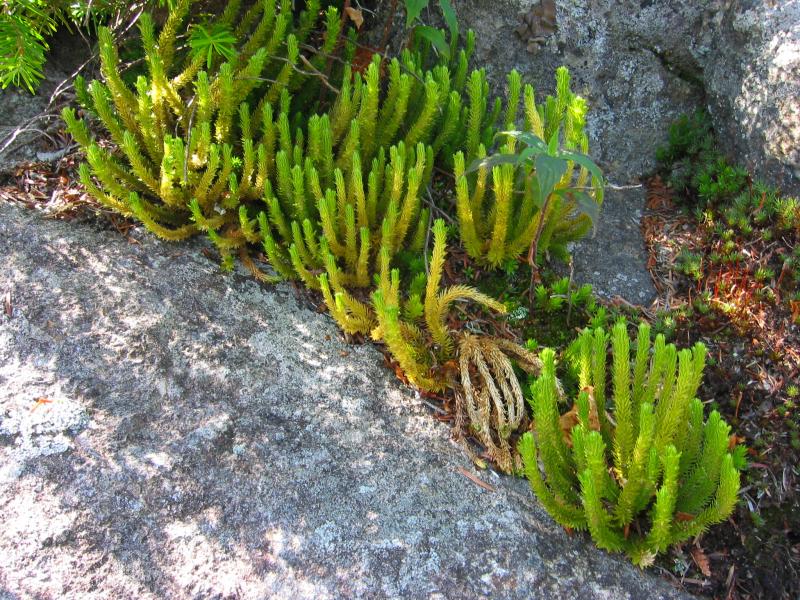
Appalachian Firmoss is not a true moss as the common name implies. It is an evergreen, non-flowering vascular plant (or tracheophyte, reproducing by means of spores rather than seeds). Its stems occur in tufts and branch from the bases or from further up the stem. The stems are 6-10 cm tall and live for about 12-15 years before dying. The green to yellow-green leaves occur singly along the stems and are 2-6 mm long. The spore producing structures (sporagnia) are yellow, and occur in zones along the stems in the axils of the leaves. Asexual propagules, known as gemmae, are produced throughout the upper portion of the stems. These gemmae fall from the plants and start new individuals (Beitel and Mickel 1992, Wagner and Beitel 1993, Haines 2003).
Identifying Characteristics
The upper regions of the stems are 3-7 mm wide (incuding the leaves). The stems do not have winter bud constrictions and when they become 12-15 years old, the leaves turn yellow, senesce, and the whole plant dies. The leaves are entire, triangular to narrowly lanceolate, widest below the middle, and have stomates on both surfaces with 35-60 (per 1/2 leaf) on the adaxial surface. The lower leaves are longer (4-6 mm long) and more spreading (ascending to spreading) than the upper leaves which are 2-3.5 mm long and ascending to appressed. Plants growing in full sun have the leaves relatively shorter and more ascending than plants growing in shade. Gemmae are 3-4 mm long, 2.5-3.5 mm wide, their lateral lobes (leaves) are 0.5-1.1(-1.2) mm wide, and occur throughout the upper portion of the stems, rather than being restricted to distinct whorls at the apex of the annual growth.
Best Life Stage for Proper Identification
Mature spores are needed to confidently distinguish this species from other closely related taxa including hybrids.
Similar Species
Huperzia selago is superficially similar although it does not grow in alpine settings. It can be distinguished by having gemmae produced in distinct single whorls at the apex of annual growth, lateral lobes (leaves) of gemmae 1.5-2.0 mm wide, and leaves from the upper and lower portions of the stems relatively more similar in length and orientation. Also, the shoots do not senesce, turn yellow, and die with age.
Huperzia lucidula is also superficially similar, but again does not grow in alpine settings and instead prefers cool moist forested habitat. It can be distinguished by its toothed leaves, widest above the middle, and by having stomates only on the abaxial surfaces. The gemmae are produced in distinct single whorls at the apex of annual growth, the lateral lobes (leaves) of gemmae are 1.5-2.5 mm wide, leaves from the upper and lower portions of the stems are relatively more similar in length and orientation, and obvious winter bud constrictions are present (represented by narrow zones of short ascending leaves). Also the shoots do not senesce, turn yellow, and die with age.
Huperzia x josephbeitellii, the hybrid between H. appressa and H. selago is similar to and is often found in the same alpine habitats as H. appressa. The hybrid is very similar to H. appressa plants that grow in the shade. Therefore, all specimens of H. appressa should be carefully compared to this hybrid. Huperzia x josephbeitellii can be distinguished by the production of abortive spores. Abortive spores are spores which are sunken or mis-shapen and have less luster than non-abortive spores. In the hybrid about 25-50% of the spores are abortive. Immature and spores from a previous season may appear abortive. Therefore, spores should only be assessed from plants late in their growing season (mid-August through October in New York). Huperzia x josephbeitellii is similar to H. appressa in that the gemmae are produced throughout the upper portions of the stems and leaves from the upper and lower portions of the stems are dis-similar in size and orientation. Characters that distinguish the hybrid from H. appressa are that the hybrid plants are more robust with the upper portions of the stems 7-10 mm wide (incuding the leaves) and the lateral lobes (leaves) of the gemmae are 1.1-1.5(-1.7) mm wide.
Best Time to See
This species starts to have mature spores in late August and these remain in good shape through October. Therefore, since spore morphology is important in distinguishing this species from similar taxa, the best time to survey for this species is during this time period.
- Vegetative
- Fruiting
The time of year you would expect to find Mountain Firmoss vegetative and fruiting in New York.
Mountain Firmoss Images
Tim Howard
Tim Howard
Taxonomy
Mountain Firmoss
Huperzia appressa (Desv.) A. Löve & D. Löve
- Kingdom Plantae
- Phylum Lycophyta
- Class Lycopodiopsida
(Clubmosses)
- Order Lycopodiales
- Family Lycopodiaceae (Club-moss Family)
- Order Lycopodiales
- Class Lycopodiopsida
(Clubmosses)
- Phylum Lycophyta
Additional Common Names
- Appalachian Firmoss
- Mountain Fir Clubmoss
Synonyms
- Huperzia appalachiana Beitel & Mickel
- Huperzia selago (L.) Bernh. ex Mart. & Schrank [misapplied]
- Huperzia selago var. appressum Desv.
- Huperzia selago var. selago [missapplied]
- Lycopodium selago L. [misapplied]
Comments on the Classification
Huperzia appressa has long been considered part of H. selago (Fernald 1970, Gleason and Cronquist 1991 as Lycopodium selago). Beitel and Mickel (1992) discuss the distinctiveness of H. appressa (as H. appalachiana) from H. selago and describe it as H. appalachiana. The older name H. appressa (Desv.) Löve & Löve takes priority. There are other closely related species known from boreal and arctic areas globally that may be found to be conspecific with H. appressa. It is possible that some of these taxa including H. appressa will need to be lumped under H. haleakalae, which is the oldest name for species in this complex (Haines 2003). The hybrid H. x josephbeitelii A. Haines (H. appressa x H. selago) is frequent on some mountain peaks in New England and is documented from Newfoundland, Ontario, and Quebec (Haines 2003). It is known from where the two parental species overlap in the northern Appalachians and the north shore of Lake Ontario (Beitel and Mickel 1993). It has not been documented from New York but since the two parental species overlap slightly in New York, it may occur here. The genus Huperzia has long been considered part of Lycopodium. Wagner and Beitel (1993) maintain it at the genus level because of the complex and specialized shoots, gemmiferous branchlets and gemmae, and the unbranched gametophytes.
Additional Resources
Best Identification Reference
Haines, A. 2003. The families Huperizaceae and Lycopodiaceae of New England: a taxonomic and ecological reference. V.F. Thomas Co., Bowdoin, ME.
Other References
Beitel, J.M. and J.T. Mickel. 1992. The Appalachian Firmoss, a New Species in the Huperzia selago (Lycopodiaceae) Complex in Eastern North America, with a New Combination for the Western Firmoss. American Fern Journal 82: 41-46.
Fernald, M.L. 1950. Gray's manual of botany. 8th edition. D. Van Nostrand, New York. 1632 pp.
Gleason, Henry A. and A. Cronquist. 1991. Manual of Vascular Plants of Northeastern United States and Adjacent Canada. The New York Botanical Garden, Bronx, New York. 910 pp.
Holmgren, Noel. 1998. The Illustrated Companion to Gleason and Cronquist's Manual. Illustrations of the Vascular Plants of Northeastern United States and Adjacent Canada. The New York Botanical Garden, Bronx, New York.
Mitchell, Richard S. and Gordon C. Tucker. 1997. Revised Checklist of New York State Plants. Contributions to a Flora of New York State. Checklist IV. Bulletin No. 490. New York State Museum. Albany, NY. 400 pp.
New York Natural Heritage Program. 2010. Biotics database. New York Natural Heritage Program. New York State Department of Environmental Conservation. Albany, NY.
New York Natural Heritage Program. 2024. New York Natural Heritage Program Databases. Albany, NY.
Reschke, Carol. 1990. Ecological communities of New York State. New York Natural Heritage Program, New York State Department of Environmental Conservation. Latham, NY. 96 pp. plus xi.
Wagner, H.W. Jr. and J.M. Beitel. 1993. Lycopodiaceae Mirbel. Pages 18-37 in Flora of North America Editorial Committee (Editors), Flora of North America, north of Mexico, Volume 2, Pteridophytes and Gymnosperms. Oxford University Press, New York, NY, USA. 475pp + xvi.
Weldy, T. and D. Werier. 2010. New York flora atlas. [S.M. Landry, K.N. Campbell, and L.D. Mabe (original application development), Florida Center for Community Design and Research http://www.fccdr.usf.edu/. University of South Florida http://www.usf.edu/]. New York Flora Association http://newyork.plantatlas.usf.edu/, Albany, New York
Links
About This Guide
Information for this guide was last updated on: December 11, 2008
Please cite this page as:
New York Natural Heritage Program. 2024.
Online Conservation Guide for
Huperzia appressa.
Available from: https://guides.nynhp.org/appalachian-firmoss/.
Accessed April 29, 2024.