Salt Shrub
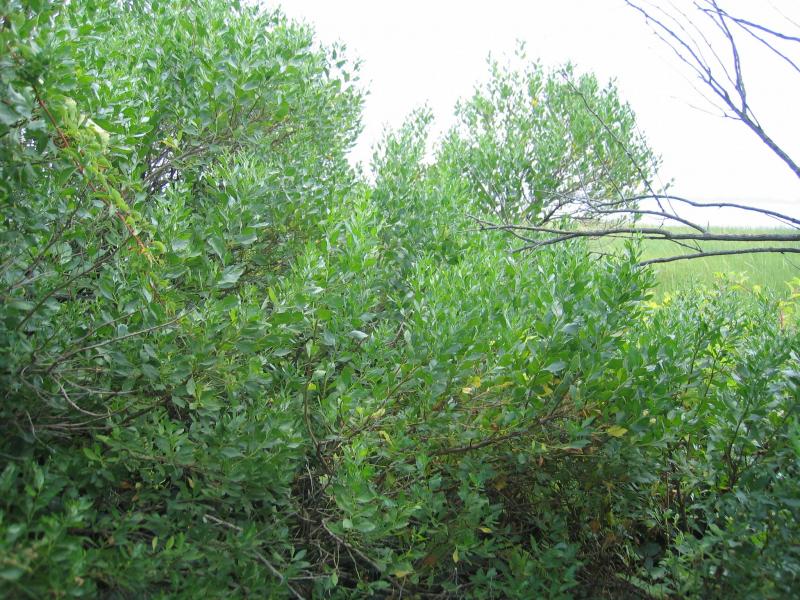
Salt shrub at Canarsie Pier, Gateway National Recreation Area
Gregory J. Edinger
- System
- Estuarine
- Subsystem
- Estuarine Intertidal
- State Protection
- Not Listed
Not listed or protected by New York State.
- Federal Protection
- Not Listed
- State Conservation Status Rank
- S1
Critically Imperiled in New York - Especially vulnerable to disappearing from New York due to extreme rarity or other factors; typically 5 or fewer populations or locations in New York, very few individuals, very restricted range, very few remaining acres (or miles of stream), and/or very steep declines.
- Global Conservation Status Rank
- G5
Secure globally - Common in the world; widespread and abundant (but may be rare in some parts of its range).
Summary
Did you know?
Salt shrub is perhaps one of the best communities to see the interaction of the landscape and tidal range. Large areas of salt shrub can be found where there are broad, gentle slopes intersecting the upper range of spring and storm tides. Where slopes of the marsh basin are steep and the intersection with the tidal range is narrow, salt shrub is condensed into a thin band (MacDonald and Edinger 2000).
State Ranking Justification
There are estimated to be between 20 and 50 occurrences statewide. The very few documented occurrences have good viability and are protected on public land. The community is restricted to sheltered areas of the seacoast in the Coastal Lowlands and Manhattan Hills ecozones. The current trend of the community is declining and the primary threat to this community is invasion by common reed (Phragmites australis). Secondary threats, common to all salt marsh complexes, include ditching and draining, dredging and filling, poor water quality, diking and impoundment, inlet stabilization, shoreline hardening, wrack accumulation, altered sediment budget, subsidence, changes in water circulation patterns, restricted tidal connection, and altered tidal hydrodynamics.
Short-term Trends
In recent decades, the number, aerial extent, and quality of salt shrub (and salt marsh complexes) in New York has declined significantly. These losses are primarily due to invasion by common reed (Phragmites australis), dredging and filling for urban development, and to pollution, including airborne particulates, pesticides, and sewage and stormwater discharge. It is suspected that losses will continue, resulting from ongoing invasive species encroachment, shoreline development, declining water quality, and hydrologic alterations. The degradation and loss of salt shrub, which forms an upland buffer for lower elevation salt marsh communities, may have profound adverse effects on those tidal wetlands, causing increased sediment flow, altered ground water elevations and flow, loss of nutrient filtering vegetation, and loss of wildlife habitat for wetland edge species (MacDonald and Edinger 2000).
Long-term Trends
The number, aerial extent, and integrity of salt marsh complexes and associated salt shrub communities in New York are suspected to have declined substantially from their historical state. These declines are likely correlated with coastal development; dredging, ditching, and filling; and changes in hydrology, water quality, and natural processes.
Conservation and Management
Threats
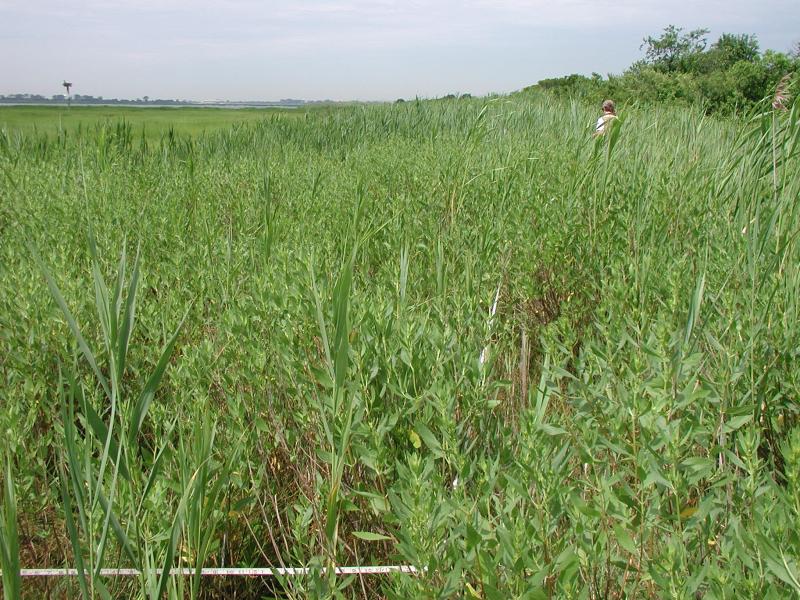
The primary threat to this community is invasion by common reed (Phragmites australis). Additional threats to this community and to salt marsh complexes generally include dredging and filling for development, ditching and draining for mosquito control, poor water quality (from sewage and stormwater discharge; nonpoint source runoff; landfill leachate; boat traffic; particulate aircraft, vehicular, and power plant emissions; jet fuel; ethylene glycol from aircraft deicing; and pesticides used in mosquito management), diking and impoundment, inlet stabilization, shoreline hardening, wrack accumulation, altered sediment budget (decreased sediment input to marshes), subsidence, changes in water circulation patterns because of changes in shoreline and benthic topography, restricted tidal connection, and altered tidal hydrodynamics resulting from changes to hydrology (including groundwater levels, overland flow, and in-channel volume) in the surrounding watershed, road construction, and urbanization (GNRA and JBWPPAC 2007, Niedowski 2000, New York State Department of Environmental Conservation 2009b, 2009c, 2009d). Response to sea level rise is uncertain.
Conservation Strategies and Management Practices
Monitor the abundance of invasive species, particularly common reed (Phragmites australis), in this community and, as needed, control their encroachment. Remove excessive wrack accumulation. Remove shoreline armoring to increase overland sediment input; improve water quality by reducing or eliminating sewer and stormwater discharge and pesticide application; restore tidal regime by removing culverts, dikes, and impoundments, plugging ditches, and replacing static flow restriction devices with those that are calibrated for local tidal hydrology. Restoration and monitoring protocols are available (Niedowski 2000).
Development and Mitigation Considerations
Strive to minimize or eliminate hardened shorelines and maintain low-sloped shorelines within the tidal zone to increase overland sediment input. Maintain functional connectivity between the open ocean and bays with salt marsh complexes to enable full tidal flushing during each tidal cycle. For example, barriers such as railway causeways should have numerous culverts to allow sufficient hydrologic connectivity. If flow restriction devices are needed, those that are calibrated for local tidal hydrology can be used. Avoid dumping dredge spoil onto salt shrub communities. This community is best protected as part of a large salt marsh complex. Protected areas should encompass the full mosaic of low salt marsh, high salt marsh, marine intertidal mudflats, saltwater tidal creek, salt panne, and salt shrub communities to allow dynamic ecological processes (sedimentation, erosion, tidal flushing, and nutrient cycling) to continue. Connectivity to brackish and freshwater tidal communities, upland beaches and dunes, and to shallow offshore communities should be maintained. Connectivity between these habitats is important not only for nutrient flow and seed dispersal, but also for animals that move between them seasonally. Development of site conservation plans that identify wetland threats and their sources and provide management and protection recommendations would ensure their long-term viability.
Inventory Needs
Additional inventory is needed on the north and south shore of Long Island and in Peconic Bay. Leads include the sixteen sites that were not selected as reference wetlands by MacDonald and Edinger (2000). North shore leads include Lloyd Neck Marsh, Flax Pond, and Crab Meadow Marsh. Peconic Bay leads include Orient Point Marsh, Accabonac Harbor Marsh, Cow Neck Marsh, Mashomack Point Marsh, Downs Creek, West Creek, and Northwest Creek. South shore leads include Moriches Inlet Backbarrier Beach, West Beach-Tiana Beach, Floyd Point Marsh, Gilgo Beach Back Barrier Marsh, Hempstead Bay Wetlands, and Apple Tree Neck Wetlands.
Research Needs
Research on salt shrub should include monitoring common reed (Phragmites australis) encroachment in conjunction with indicators of community health to determine whether healthy communities are more resistant to invasion. Additional work could investigate community response to rising sea level (MacDonald and Edinger 2000).
Rare Species
- Atriplex dioica (Thick-leaved Orach) (guide)
- Chenopodium berlandieri var. macrocalycium (Large-calyxed Goosefoot) (guide)
- Circus hudsonius (Northern Harrier) (guide)
- Fimbristylis castanea (Marsh Fimbry) (guide)
- Salicornia bigelovii (Bigelow's Glasswort) (guide)
- Symphyotrichum subulatum var. subulatum (Annual Saltmarsh Aster) (guide)
Range
New York State Distribution
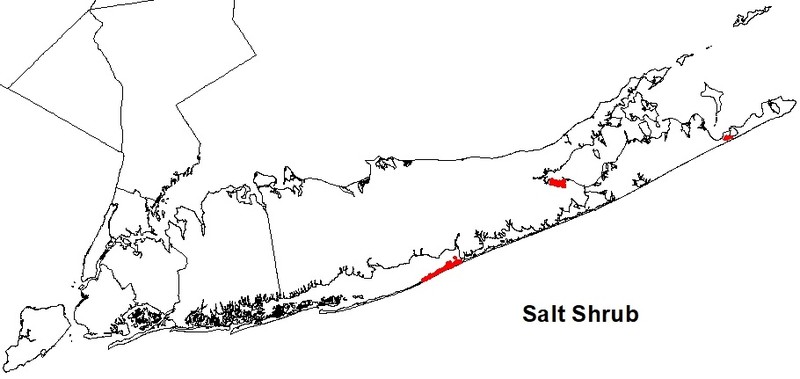
Salt shrub communities are restricted to sheltered areas of the seacoast in the Coastal Lowlands and Manhattan Hills ecozones. Salt shrub occurs in the Peconic Bay area and along backbarrier fringe marshes located from Moriches Inlet west to Fire Island Wilderness on the south shore. It is poorly developed in mainland fringe marshes on the south shore and in all marshes along the north shore where tidal areas are steep.
Global Distribution
This community extends from Massachusetts to South Carolina (NatureServe 2009).
Best Places to See
- Hubbard County Parkland (Suffolk County)
- Flanders Bay Wetlands SCFWH (Suffolk County)
Identification Comments
General Description
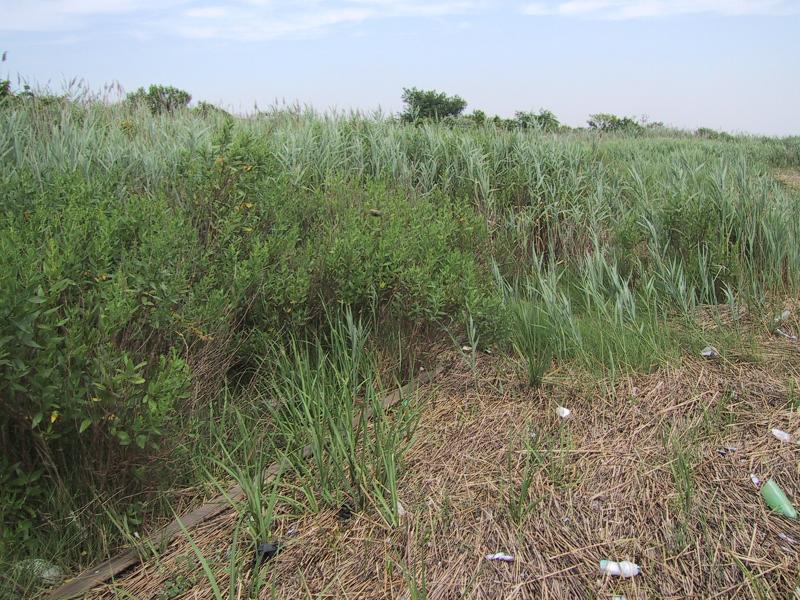
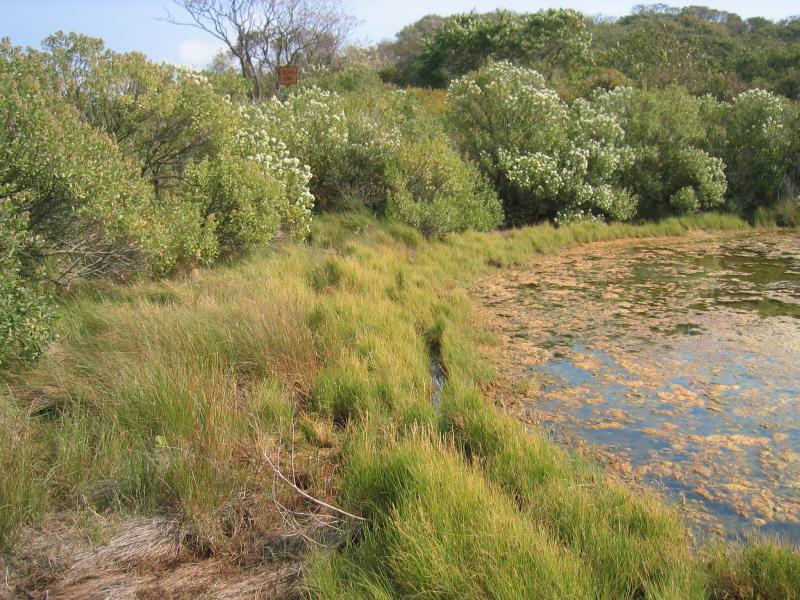
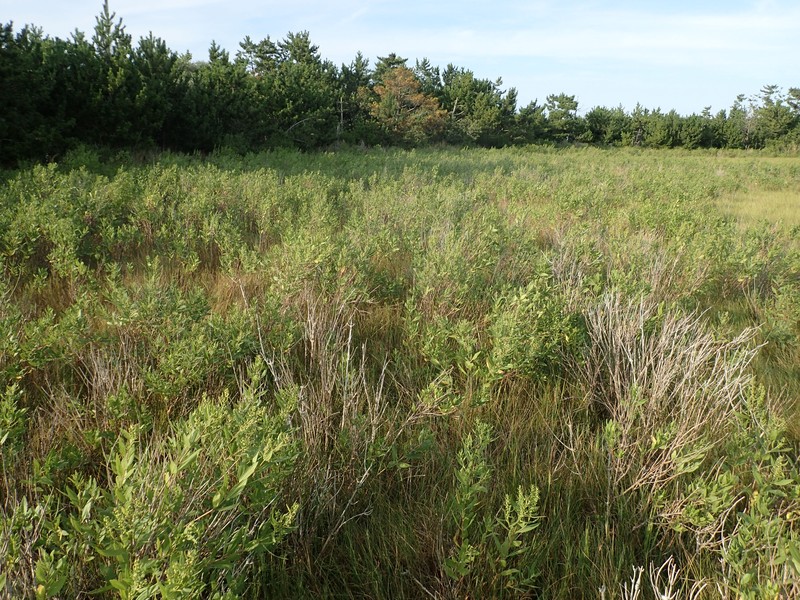
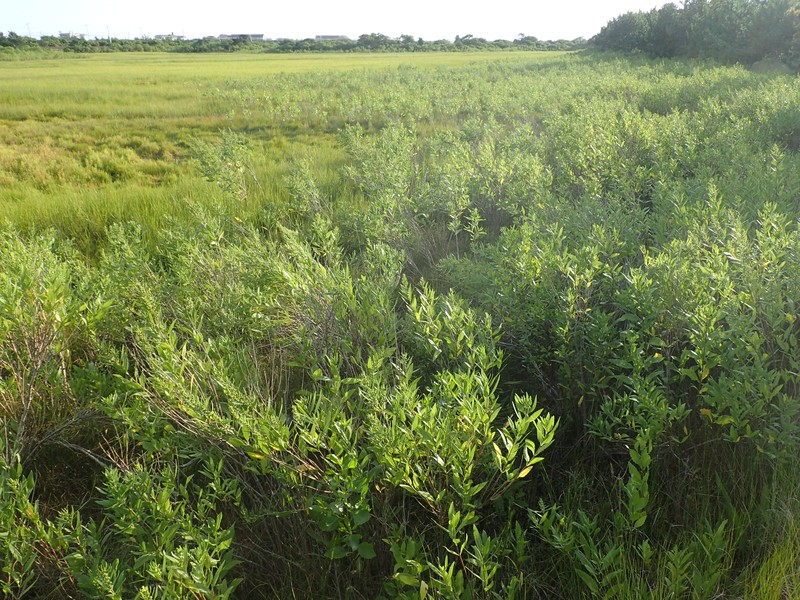
A shrubland community that forms the ecotone between salt marsh and upland vegetation. Salinity levels are generally lower here than in the salt marsh (soil pore salinity ranges 7 ppt to 27 ppt) and thus technically brackish. Salt shrub areas are slightly higher in elevation than the salt marsh. Salt shrub does not usually develop on deep peat. More often, it occurs on a thin (0-10 cm) layer of peat, and soils share characteristics of both estuarine and maritime terrestrial settings. Periodic disturbance associated with storms causes die-back of shrubs. Salt shrub is usually present as a linear feature at the upper edge of a salt marsh marking the limit of the highest spring and storm tides within a given estuarine basin. In areas where the local topography is nearly level an extensive shrubland, or brackish meadow may occur. This community is often invaded by common reed (Phragmites australis).
Characters Most Useful for Identification
Salt shrub forms the ecotone between salt marsh and upland vegetation. Characteristic shrubs are groundsel-tree (Baccharis halimifolia), saltmarsh-elder (Iva frutescens), and pasture rose (Rosa carolina); salt-meadow grass (Spartina patens), black-grass (Juncus gerardii), and switchgrass (Panicum virgatum) are typical herbs. Salt shrub is almost always dominated by a stunted leading edge of Iva frutescens on the marshward side of the community. Baccharis halimifolia becomes more dominant only in the older, more developed, landward side. The landward side of salt shrub is usually the most diverse.
Best Time to See
In late summer and early fall, the two characteristic shrubs of this community, groundsel-tree and saltmarsh-elder, come into flower.
Salt Shrub Images
Gregory J. Edinger
Aissa L. Feldmann
Aissa L. Feldmann
Gregory J. Edinger
Gregory J. Edinger
Gregory J. Edinger
Classification
International Vegetation Classification Associations
This New York natural community encompasses all or part of the concept of the following International Vegetation Classification (IVC) natural community associations. These are often described at finer resolution than New York's natural communities. The IVC is developed and maintained by NatureServe.
- Groundsel-tree - Jesuit's-bark / Switchgrass Saline Shrubland (CEGL003921)
NatureServe Ecological Systems
This New York natural community falls into the following ecological system(s). Ecological systems are often described at a coarser resolution than New York's natural communities and tend to represent clusters of associations found in similar environments. The ecological systems project is developed and maintained by NatureServe.
- Northern Atlantic Coastal Plain Tidal Salt Marsh (CES203.519)
Characteristic Species
-
Shrubs 2 - 5m
- Baccharis halimifolia (groundsel-tree)
- Iva frutescens (salt marsh-elder)
-
Shrubs < 2m
- Baccharis halimifolia (groundsel-tree)
- Iva frutescens (salt marsh-elder)
- Morella caroliniensis (bayberry)
- Rubus pubescens (dwarf raspberry)
-
Vines
- Toxicodendron radicans ssp. radicans (eastern poison-ivy)
-
Herbs
- Bidens connata (purple-stemmed beggar-ticks)
- Carex hormathodes (marsh straw sedge)
- Distichlis spicata (salt grass)
- Eupatorium perfoliatum (boneset)
- Hibiscus moscheutos ssp. moscheutos (swamp rose-mallow)
- Juncus canadensis (Canada rush)
- Juncus gerardi (black-grass)
- Limonium carolinianum (sea-lavender)
- Lycopus uniflorus (northern bugleweed, northern water-horehound)
- Panicum virgatum (switch grass)
- Phragmites australis (old world reed grass, old world phragmites)
- Pluchea odorata (salt marsh-fleabane)
- Schoenoplectus americanus (chair-maker's bulrush)
- Spartina patens (salt-meadow cord grass)
Similar Ecological Communities
- Brackish meadow
(guide)
While both communities often occur in the same position in the landscape (upper fringe of tidal salt marsh), salt shub is dominated by woody plants and brackish meadows are dominated by herbs (mostly grasses) and lack shrubs.
- Maritime shrubland
(guide)
Maritime shrublands are upland communities dominated by bayberry (Myrica pensylvanica) with shadbush (Amelanchier canadensis), black cherry (Prunus serotina), arrowwood (Viburnum dentatum), and shining sumac (Rhus copallinum). Salt shrub communities form an ecotone between salt marsh and the uplands. They are dominated by groundsel-tree and saltmarsh-elder. Bayberry can be present, but in low abundance.
Vegetation
Percent cover
This figure helps visualize the structure and "look" or "feel" of a typical Salt Shrub. Each bar represents the amount of "coverage" for all the species growing at that height. Because layers overlap (shrubs may grow under trees, for example), the shaded regions can add up to more than 100%.
Additional Resources
References
Clark, J.S. 1985. The development of a tidal marsh: upland and oceanic influences. Ecol. Monogr. 55(2): 189-217.
Clark, J.S. 1986. Dynamism in the barrier-beach vegetation of Great South Beach, New York. Ecological Monographs 56(2):97-126.
Conard, H.S. 1935. The plant associations of central Long Island. American Midland Naturalist 16:433-515.
Edinger, G. J., D. J. Evans, S. Gebauer, T. G. Howard, D. M. Hunt, and A. M. Olivero (editors). 2014. Ecological Communities of New York State. Second Edition. A revised and expanded edition of Carol Reschke’s Ecological Communities of New York State. New York Natural Heritage Program, New York State Department of Environmental Conservation, Albany, NY. https://www.nynhp.org/ecological-communities/
Edinger, Gregory J., D.J. Evans, Shane Gebauer, Timothy G. Howard, David M. Hunt, and Adele M. Olivero (editors). 2002. Ecological Communities of New York State. Second Edition. A revised and expanded edition of Carol Reschke's Ecological Communities of New York State. (Draft for review). New York Natural Heritage Program, New York State Department of Environmental Conservation. Albany, NY. 136 pp.
Gateway National Recreation Area and Jamaica Bay Watershed Protection Plan Advisory Committee. 2007. An update on the disappearing salt marshes of Jamaica Bay, New York. Prepared by Gateway National Recreation Area, National Park Service, U.S. Department of the Interior and Jamaica Bay Watershed Protection Plan Advisory Committee, August 2, 2007.
MacDonald, Dana and Gregory Edinger. 2000. Identification of reference wetlands on Long Island, New York. Final report prepared for the Environmental Protection Agency, Wetland Grant CD992436-01. New York Natural Heritage Program, New York State Department of Environmental Conservation. Latham, NY. 106 pp. plus appendices.
NatureServe. 2009. NatureServe Explorer: An online encyclopedia of life [web application]. Version 7.1. NatureServe, Arlington, Virginia. Available http://www.natureserve.org/explorer. (Data last updated July 17, 2009)
New York Natural Heritage Program. 2024. New York Natural Heritage Program Databases. Albany, NY.
New York State Department of Environmental Conservation. 2009a. Tidal wetlands. Available http://www.dec.ny.gov/lands/4940.html. (Accessed: October 27, 2009)
New York State Department of Environmental Conservation. 2009b. Tidal wetland losses, Jamaica Bay, Queens County, NY.
New York State Department of Environmental Conservation. 2009c. Tidal wetland losses, Nassau and Suffolk Counties.
New York State Department of Environmental Conservation. 2009d. Tidal wetland losses, Strategy for Addressing Loss of Intertidal Marsh in the Marine District.
Niedowski, N.L. 2000. New York State salt marsh restoration and monitoring guidelines. Prepared for New York Department of State, Albany, NY, and New York Department of Environmental Conservation, East Setauket, NY.
Nixon, S.W. 1982. The ecology of New England high salt marshes: A community profile. U.S. Fish and Wildlife Service Office of Biological Services, Washington D.C. FWS/OBS-81/55. 70 pp.
Redfield, A. C. 1972. Development of a New England salt marsh. Ecological Monographs 42:201-37.
Links
About This Guide
This guide was authored by: Aissa Feldmann
Information for this guide was last updated on: December 13, 2023
Please cite this page as:
New York Natural Heritage Program. 2024.
Online Conservation Guide for
Salt shrub.
Available from: https://guides.nynhp.org/salt-shrub/.
Accessed April 19, 2024.