Sandstone Pavement Barrens
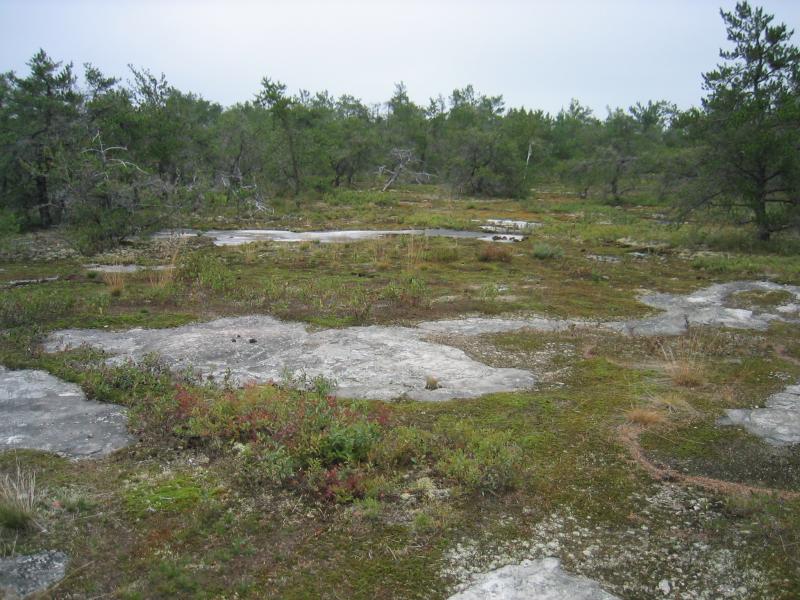
Sandstone pavement barrens at Gadway Sandstone Pavement Barrens.
Gregory J. Edinger
- System
- Terrestrial
- Subsystem
- Barrens And Woodlands
- State Protection
- Not Listed
Not listed or protected by New York State.
- Federal Protection
- Not Listed
- State Conservation Status Rank
- S1
Critically Imperiled in New York - Especially vulnerable to disappearing from New York due to extreme rarity or other factors; typically 5 or fewer populations or locations in New York, very few individuals, very restricted range, very few remaining acres (or miles of stream), and/or very steep declines.
- Global Conservation Status Rank
- G2
Imperiled globally - At high risk of extinction due to rarity or other factors; typically 20 or fewer populations or locations in the world, very few individuals, very restricted range, few remaining acres (or miles of stream), and/or steep declines.
Summary
Did you know?
It is believed that the Potsdam Sandstone bedrock of these barrens was exposed with catastrophic flooding from the abrupt drainage of Glacial Lake Iroquois during deglaciation, roughly 11,000 years ago. This flooding stripped away much of the soil and unconsolidated material that had previously covered the underlying bedrock (Franzi and Adams 1999). "Potsdam Sandstone" was named by geologist Ebenezer Emmons in 1838 for Potsdam in St. Lawrence County, NY (Emmons 1838).
State Ranking Justification
There are probably less than two dozen occurrences statewide. A few documented occurrences have good viability and a few are protected on public land or private conservation land. This community is limited to the regions of the state underlain with Potsdam Sandstone, and there are only a few high quality examples. The current trend of this community is probably stable for occurrences on private conservation land and public land, or declining slightly elsewhere due to moderate threats that include wildfire suppression, invasive plants, quarrying, excessive ATV use, excessive logging, and trash dumping.
Short-term Trends
The number and acreage of sandstone pavement barrens in New York have probably declined slightly in recent decades due to fire suppression, disturbance by off-road vehicles, trash dumping, and development.
Long-term Trends
The number and acreage of sandstone pavement barrens in New York have probably had moderate declines from historical numbers due to fire suppression, fragmentation, disturbance by off-road vehicles, trash dumping, and development.
Conservation and Management
Threats
Loss of Jack pine dominance due to wildfire suppression and the invasion and spread of exotic plants are the primary threats to sandstone pavement barrens. Quarrying, excessive ATV use, excessive logging, and trash dumping are secondary threats. Protected occurrences should be monitored for the invasion of Southern Pine Beetle.
Conservation Strategies and Management Practices
Increase and/or maintain the size of existing sandstone pavement barrens by increasing patch size where appropriate, by "softening" the abrupt forest edges by maintaining a native shrub transition zone. Improve the condition of existing sandstone pavement barrens by reducing and/or eliminating invasive species (including invasive native woody species), minimizing trail network and clearly marking existing trails, and developing and implementing a prescribed burn plan at appropriate sites. Improve the landscape context by encouraging surrounding landowners to establish natural buffers and restore natural corridors to other larger natural landscape blocks.
Development and Mitigation Considerations
Soils are very thin or lacking in and around this community and the effect of clearing and construction on soil retention and erosion must be considered during any development activities. Similarly, these soils are acidic and nutrient-poor and any soil enrichment contamination (e.g., from septic leach fields and fertilized lawns) may alter community structure and function. The open structure of this community is maintained by fire and presents a fire hazard to existing and proposed development. Unprotected structures located within or near this community are more susceptible to damage from fire.
Inventory Needs
Periodic inventory of the sandstone pavement barrens is needed in order to keep occurrence data current. Need more thorough inventory of the best sites, especially including identification of mosses, lichens, and fauna.
Research Needs
Determine the optimal fire regime for this community. The effect of prescribed burning needs to be evaluated. Evaluate the success of mechanical removal of woody plants in areas where fire is prohibited.
Rare Species
- Abagrotis orbis (Well-marked Cutworm) (guide)
- Agrotis obliqua (Oblique Dart) (guide)
- Cerma cora (Bird Dropping Moth) (guide)
- Chytonix sensilis (Sensitive Chytonix) (guide)
- Macaria signaria (Jack Pine Looper) (guide)
- Oligia bridghamii (Bridgham's Brocade) (guide)
- Symphyotrichum ciliolatum (Lindley's Aster) (guide)
- Sympistis dentata (Toothed Apharetra) (guide)
- Xylena thoracica (Acadian Swordgrass Moth) (guide)
- Zale largera (A Zale Moth) (guide)
- Zanclognatha martha (Pine Barrens Zanclognatha) (guide)
Range
New York State Distribution
This community is a narrow regional endemic that is possibly restricted to the northernmost counties of New York, north of the Adirondack Mountains in the northeastern portion of the Great Lakes Ecoregion, where the bedrock is sandstone. It is concentrated in the Champlain Valley of Clinton and Essex Counties where it reaches large patch size. Several small patch occurrences are reported from the Eastern Ontario and St. Lawrence Lowlands including islands in the Thousand Islands Region. Additional occurrences are suspected from within Lake George.
Global Distribution
This community is possibly restricted to the northeastern portion of the Great Lakes basin and parts of Maine. It may extend into northern and central Canada. The narrowly defined jack pine (Pinus banksiana) dominated barrens are known from northeastern New York, southern Quebec and Maine. Similar communities may also occur in Ontario, Minnesota, and Iowa.
Best Places to See
- Adirondack Park
- South Hammond State Forest (St. Lawrence County)
- Flat Rock State Forest
- Lewis Preserve Wildlife Management Area
- Altona Flat Rock
- Gadway Sandstone Pavement Barrens Preserve
Identification Comments
General Description
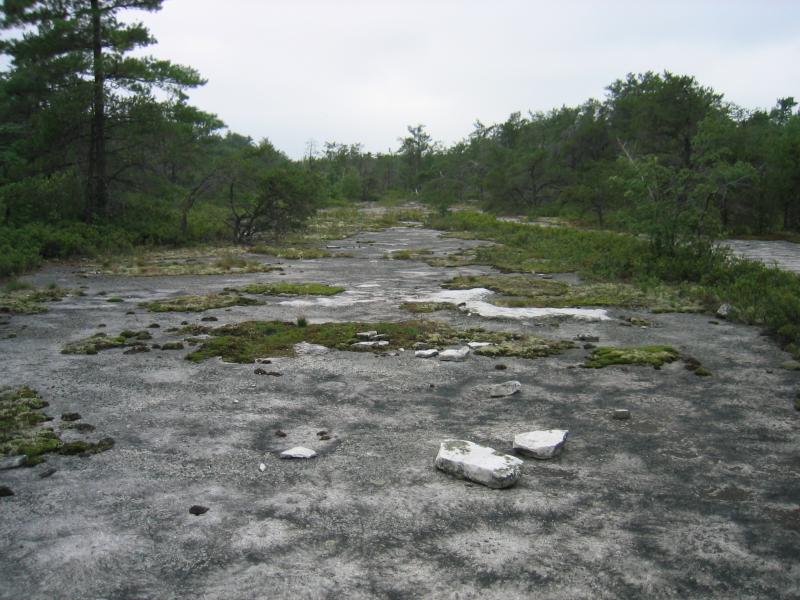
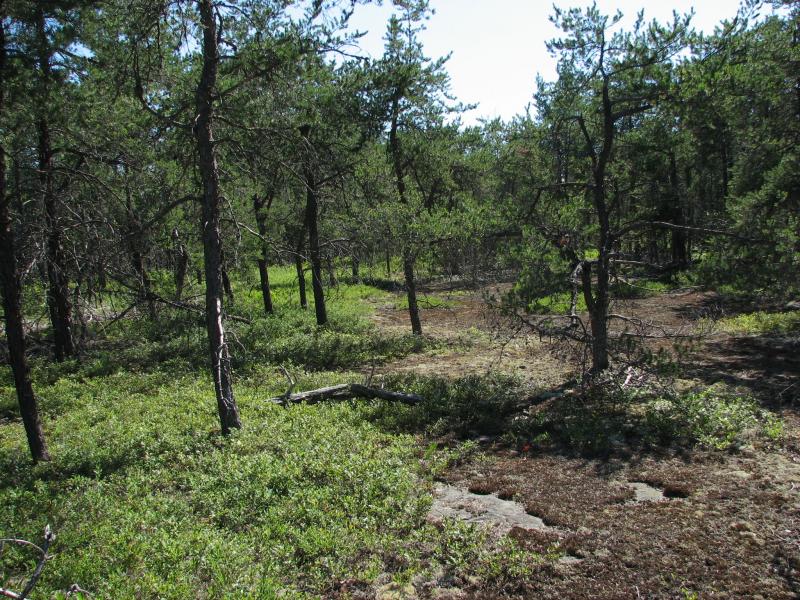
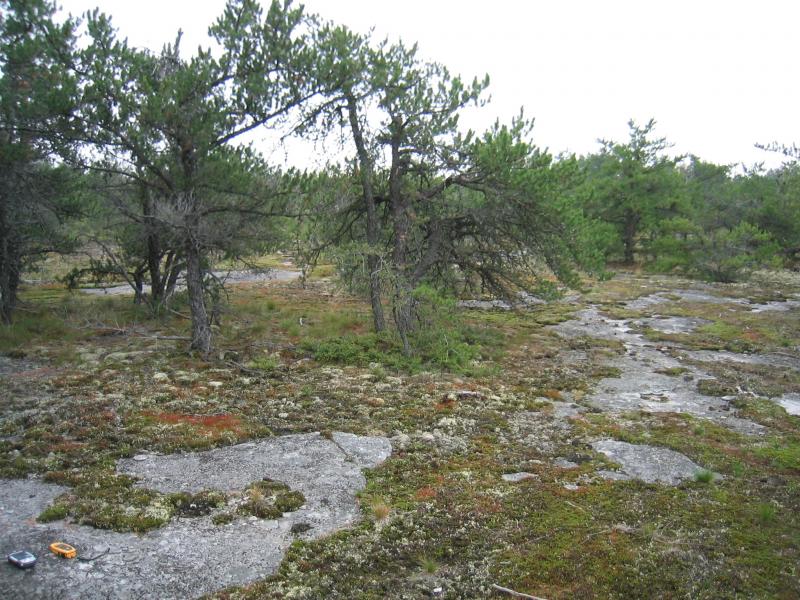
A terrestrial open canopied (averaging 25 -60% cover) woodland that occurs on very shallow soils (dysic lithic borofolist) over sandstone bedrock; this community is best developed where the bedrock is nearly level, thus forming a pavement. Fire is the most important ecological process for the maintenance of healthy sandstone pavement barren communities (Stergas and Adams 1989, Hawver 1993). Other disturbances that have influenced these barrens include blow downs, ice storms, and subsequent restoration cutting. Physiognomic variants such as exposed bedrock, open heath shrubs, sparse woodland, and closed canopy forest reflect the disturbance history of a given site.
Characters Most Useful for Identification
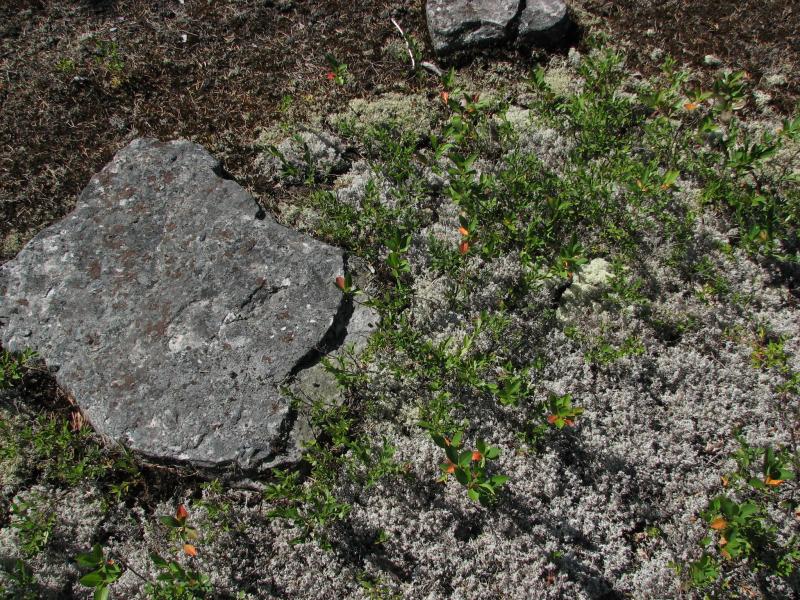
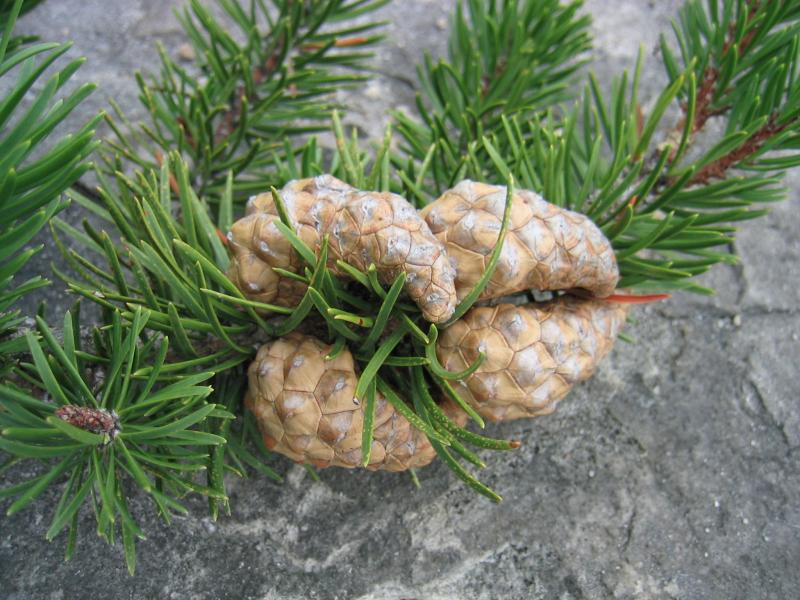
In New York the dominant tree is typically jack pine (Pinus banksiana) but pitch pine (Pinus rigida) may be more common at some sites. Other associated pines include white pine (P. strobus), and red pine (P. resinosa). Other characteristic trees include red maple (Acer rubrum), paper birch (Betula papyrifera), and red oak (Quercus rubra). The shrublayer is dominated by black huckleberry (Gaylussacia baccata) and blueberry (Vaccinium angustifolium). Other important shrubs are black chokeberry (Photinia melanocarpa), sheep laurel (Kalmia angustifolia), and sweet-fern (Comptonia peregrina). The groundcover includes many lichens and mosses, which may form a continuous cover in some areas. Characteristic lichens include Cladina rangiferina, C. mitis, C. stellaris, and Cladonia uncialis. Characteristic mosses include Polytrichum juniperinum and Pleurozium schreberi. Herbs grow throughout this groundcover and include bracken fern (Pteridium aquilinum), wintergreen (Gaultheria procumbens), cow-wheat (Melampyrum lineare), poverty-grass (Danthonia spicata), and common hairgrass (Deschampsia flexuosa).
Elevation Range
Known examples of this community have been found at elevations between 27 feet and 1,005 feet.
Best Time to See
In late summer and early fall the shrublayer and hardwood trees turn warm shades of yellow, red, and scarlet which provides a lovely contrast to the greens of the pines.
Sandstone Pavement Barrens Images
Gregory J. Edinger
Elizabeth Spencer
Gregory J. Edinger
Elizabeth Spencer
Gregory J. Edinger
Gregory J. Edinger
Classification
International Vegetation Classification Associations
This New York natural community encompasses all or part of the concept of the following International Vegetation Classification (IVC) natural community associations. These are often described at finer resolution than New York's natural communities. The IVC is developed and maintained by NatureServe.
- Jack Pine / Black Chokeberry / Boulder Lichen species Woodland (CEGL005045)
NatureServe Ecological Systems
This New York natural community falls into the following ecological system(s). Ecological systems are often described at a coarser resolution than New York's natural communities and tend to represent clusters of associations found in similar environments. The ecological systems project is developed and maintained by NatureServe.
- Northern Appalachian-Acadian Rocky Heath Outcrop (CES201.571)
Characteristic Species
-
Trees > 5m
- Acer rubrum var. rubrum (common red maple)
- Pinus banksiana (jack pine)
- Pinus rigida (pitch pine)
- Pinus strobus (white pine)
-
Shrubs 2 - 5m
- Pinus banksiana (jack pine)
-
Shrubs < 2m
- Aronia melanocarpa (black chokeberry)
- Comptonia peregrina (sweet-fern)
- Gaylussacia baccata (black huckleberry)
- Ilex mucronata (mountain holly)
- Kalmia angustifolia var. angustifolia (sheep laurel, sheep-kill)
- Pinus banksiana (jack pine)
- Vaccinium angustifolium (common lowbush blueberry)
-
Herbs
- Avenella flexuosa (common hair grass)
- Danthonia spicata (poverty grass)
- Gaultheria procumbens (wintergreen, teaberry)
- Maianthemum canadense (Canada mayflower)
- Pteridium aquilinum ssp. latiusculum (eastern bracken fern)
-
Nonvascular plants
- Cladina mitis
- Cladina rangiferina
- Cladina stellaris
- Cladona uncialis
- Dicranum spp.
- Pleurozium schreberi
- Polytrichum juniperinum
- Sterocaulon saxatile
- Xanthoparmelia plittii
Similar Ecological Communities
- Alvar pavement grassland
(guide)
This upland barrens occurs on flat to gently sloping pure calcareous bedrock with a pH greater than 5.5 and dominated by calcareous indicator species such as eastern red cedar (Juniperus virginiana) and northern white cedar (Thuja occidentalis), in contrast to sandstone pavement barrens where acidic indicators such as jack pine (Pinus banksiana), blueberries (Vaccinium spp.), and black huckleberry (Gaylussacia baccata) predominate.
Vegetation
Percent cover
This figure helps visualize the structure and "look" or "feel" of a typical Sandstone Pavement Barrens. Each bar represents the amount of "coverage" for all the species growing at that height. Because layers overlap (shrubs may grow under trees, for example), the shaded regions can add up to more than 100%.
Additional Resources
References
Adams, K.B. and D.A. Franzi. 1994. The pine barrens of Clinton County (New York). Wildflower 10(2):30-33.
Edinger, G. J., D. J. Evans, S. Gebauer, T. G. Howard, D. M. Hunt, and A. M. Olivero (editors). 2014. Ecological Communities of New York State. Second Edition. A revised and expanded edition of Carol Reschke’s Ecological Communities of New York State. New York Natural Heritage Program, New York State Department of Environmental Conservation, Albany, NY. https://www.nynhp.org/ecological-communities/
Edinger, Gregory J., D.J. Evans, Shane Gebauer, Timothy G. Howard, David M. Hunt, and Adele M. Olivero (editors). 2002. Ecological Communities of New York State. Second Edition. A revised and expanded edition of Carol Reschke's Ecological Communities of New York State. (Draft for review). New York Natural Heritage Program, New York State Department of Environmental Conservation. Albany, NY. 136 pp.
Emmons, E. 1838. Geology of New York. New York State Geological Survey, 2nd report. p. 214-217.
Franzi, D.A., and Adams, K.B. 1999. The origin and fate of the sandstone pavement pine barrens in northeastern New York; in Wright, S.F. ed., New England Intercollegiate Geologic Conference Guidebook Number 91, p 201-212.
Gifford, N. 1994. Habitat selection by birds in two adjacent forested ecosystems. M.A. Thesis. State University of New York at Plattsburgh, Plattsburgh, NY.
Grossman, D. H., K. Lemon Goodin, and C. L. Reuss, editors. 1994. Rare plant communities of the conterminous United States: An initial survey. The Nature Conservancy. Arlington, VA. 620 pp.
NatureServe. 2015. NatureServe Explorer: An online encyclopedia of life [web application]. Version 7.1. NatureServe, Arlington, Virginia. Available http://www.natureserve.org/explorer.
New York Natural Heritage Program. 2024. New York Natural Heritage Program Databases. Albany, NY.
Reschke, Carol. 1990. Ecological communities of New York State. New York Natural Heritage Program, New York State Department of Environmental Conservation. Latham, NY. 96 pp. plus xi.
Stergas, R. L., and K. B. Adams. 1989. Jack pine barrens in northeastern New York: Postfire macronutrient concentrations, heat content, and understory biomass. Canadian Journal Forest Research 19:904-910.
Yorks, T.E. and K.B. Adams. 2003. Restoration cutting as a management tool for regenerating Pinus banksiana after ice storm damage. Forest Ecology and Management 177:85-94.
Links
About This Guide
This guide was authored by: Gregory J. Edinger
Information for this guide was last updated on: November 13, 2023
Please cite this page as:
New York Natural Heritage Program. 2024.
Online Conservation Guide for
Sandstone pavement barrens.
Available from: https://guides.nynhp.org/sandstone-pavement-barrens/.
Accessed April 25, 2024.