Calcareous Talus Slope Woodland
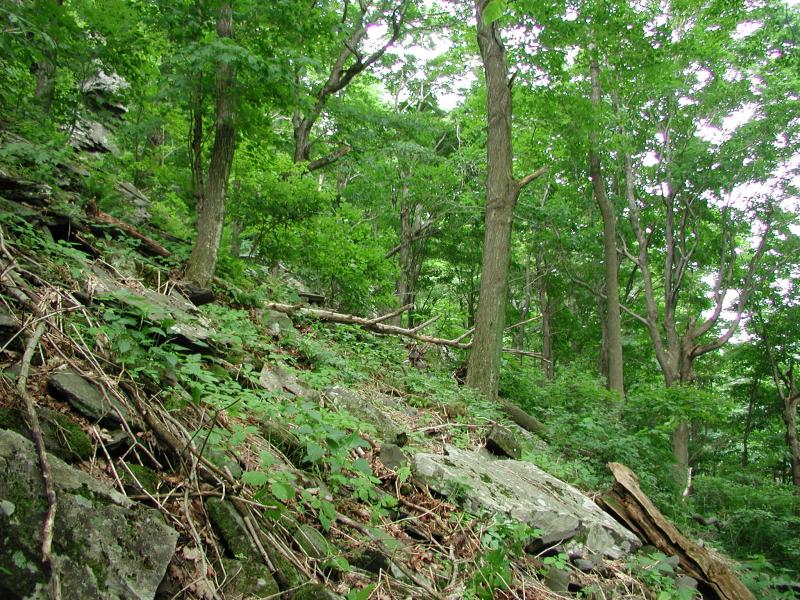
Calcareous Talus Slope Woodland
Timothy G. Howard
- System
- Terrestrial
- Subsystem
- Barrens And Woodlands
- State Protection
- Not Listed
Not listed or protected by New York State.
- Federal Protection
- Not Listed
- State Conservation Status Rank
- S3
Vulnerable in New York - Vulnerable to disappearing from New York due to rarity or other factors (but not currently imperiled); typically 21 to 80 populations or locations in New York, few individuals, restricted range, few remaining acres (or miles of stream), and/or recent and widespread declines.
- Global Conservation Status Rank
- G3G4
Vulnerable globally, or Apparently Secure - At moderate risk of extinction, with relatively few populations or locations in the world, few individuals, and/or restricted range; or uncommon but not rare globally; may be rare in some parts of its range; possibly some cause for long-term concern due to declines or other factors. More information is needed to assign either G3 or G4.
Summary
Did you know?
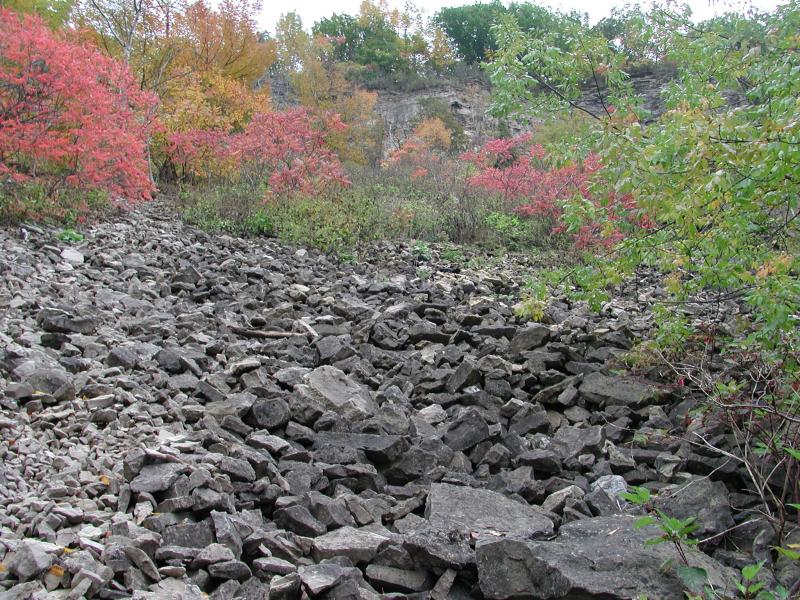
What is talus? Talus, or scree, is a steep slope usually found at the base of a mountain. The block size of the talus is strongly influenced by the type of rock forming the cliff face and rate of erosion. Shale talus or rapidly eroding sandstone forms unstable, small, loose talus, eroded from the mountain's face. The unstable nature of shale results in uneven slopes and many rock crevices. Other talus, such as hard dolostone caprock, produces stable, very large talus that provides habitat for much larger organisms.
State Ranking Justification
There are several hundred occurrences statewide. Some documented occurrences have good viability and many are protected on public land or private conservation land. This community is limited to areas with calcareous talus across the state, and includes several high quality examples. The current trend of this community is probably stable for occurrences on public land, or declining slightly elsewhere due to moderate threats related to development pressure.
Short-term Trends
The number and acreage of calcareous talus slope woodlands in New York have probably declined slightly in recent decades as a result of logging, conversion to agriculture, and other development.
Long-term Trends
The number and acreage of calcareous talus slope woodlands in New York have probably declined substantially from historical numbers as a result of logging, conversion to agriculture, and other development.
Conservation and Management
Threats
Threats to calcareous talus slope woodlands in general include changes in land use (e.g., clearing for development), forest fragmentation (e.g., roads), and invasive species (e.g., insects, diseases, and plants). Other threats may include over-browsing by deer, fire suppression, and air pollution (e.g., ozone and acidic deposition). Calcareous talus slope woodlands are threatened by development (e.g., residential, agricultural), either directly within the community or in the surrounding landscape. Other threats include habitat alteration (e.g., roads, utility ROWs, excessive logging, mining, blasting), and recreational overuse (e.g., ATVs, hiking trails, campgrounds, rock climbing, trash dumping). The primary invasive species threat is black swallow-wort (Cynanchum louiseae). Other calcareous talus slope woodlands are threatened by buckthorn (Rhamnus cathartica), bluegrass (Poa compressa), shrubby honeysuckle (Lonicera morrowii), Japanese honeysuckle (Lonicera japonica), black locust (Robinia pseudo-acacia), and multiflora rose (Rosa multiflora). A few calcareous talus slope woodlands are threatened by the illegal collection of rattlesnakes and the disturbance of nesting peregrine falcons.
Conservation Strategies and Management Practices
Minimize or avoid habitat alteration within the woodland and surrounding landscape. Prevent recreational overuse. Remove/prevent the spread of invasive exotic species into the woodland through appropriate direct management, and by minimizing potential dispersal corridors, such as trails and roads.
Development and Mitigation Considerations
A natural (usually forested) buffer around the edges of this community will help it maintain the microclimatic characteristics that help make this community unique.
Inventory Needs
Survey for occurrences statewide to advance documentation and classification of calcareous talus slope woodlands. A statewide review of calcareous talus slope woodlands is desirable, perhaps using GIS modeling to locate new occurrences. Known examples in New York range from evergreen-dominated with northern white cedar (Thuja occidentalis), to mixed evergreen-deciduous, to deciduous dominated with sugar maple (Acer saccharum). Continue searching for large sites in excellent to good condition (A- to AB-ranked).
Research Needs
Collect sufficient plot data to support the recognition of several distinct calcareous talus slope woodland types based on composition and physical characteristics. Known examples in New York range from evergreen-dominated with northern white cedar (Thuja occidentalis), to mixed evergreen-deciduous, to deciduous dominated with sugar maple (Acer saccharum). Current classification includes wide range of physiognomy (e.g., open talus, woodland, forest), and moisture gradients (e.g., dry, moist, wet). These types may correspond to ecoregional distribution, and/or specific talus type.
Rare Species
- Agastache nepetoides (Yellow Giant Hyssop) (guide)
- Aplectrum hyemale (Puttyroot) (guide)
- Asplenium scolopendrium var. americanum (Hart's-tongue Fern) (guide)
- Asplenium viride (Green Spleenwort) (guide)
- Astragalus neglectus (Cooper's Milkvetch) (guide)
- Blephilia ciliata (Downy Wood Mint) (guide)
- Borodinia missouriensis (Green Rock Cress) (guide)
- Botrychium minganense (Mingan Moonwort) (guide)
- Botrychium neolunaria (Common Moonwort) (guide)
- Bouteloua curtipendula var. curtipendula (Side Oats Grama) (guide)
- Carex capillaris (Hair-like Sedge) (guide)
- Carex careyana (Carey's Sedge) (guide)
- Carex formosa (Handsome Sedge) (guide)
- Carex molesta (Troublesome Sedge) (guide)
- Carex scirpoidea ssp. scirpoidea (Canadian Single-spike Sedge) (guide)
- Chamaelirium luteum (Fairywand) (guide)
- Cirriphyllum piliferum (Hair-pointed Moss) (guide)
- Corydalis aurea (Golden Corydalis) (guide)
- Crotalus horridus (Timber Rattlesnake) (guide)
- Cypripedium arietinum (Ram's Head Lady's Slipper) (guide)
- Didymodon ferrugineus (Rusty Beard-moss) (guide)
- Draba glabella (Smooth Whitlow Grass) (guide)
- Erigeron hyssopifolius (Hyssop-leaved Fleabane) (guide)
- Gentianopsis virgata (Lesser Fringed Gentian) (guide)
- Haliaeetus leucocephalus (Bald Eagle) (guide)
- Hedeoma hispida (Rough Pennyroyal) (guide)
- Hydrastis canadensis (Goldenseal) (guide)
- Jeffersonia diphylla (Twinleaf) (guide)
- Liatris cylindracea (Few-headed Blazing Star) (guide)
- Linum sulcatum (Grooved Yellow Flax) (guide)
- Myotis septentrionalis (Northern Long-eared Bat) (guide)
- Myotis sodalis (Indiana Bat) (guide)
- Myurella julacea (Small Mousetail Moss) (guide)
- Oxalis violacea (Violet Wood Sorrel) (guide)
- Platanthera hookeri (Hooker's Orchid) (guide)
- Platydictya jungermannioides (False Willow Moss) (guide)
- Polygonum douglasii (Douglas' Knotweed) (guide)
- Solidago rigida var. rigida (Stiff Flat-topped Goldenrod) (guide)
- Symphyotrichum oolentangiense (Sky-blue Aster) (guide)
- Ulmus thomasii (Rock Elm) (guide)
Range
New York State Distribution
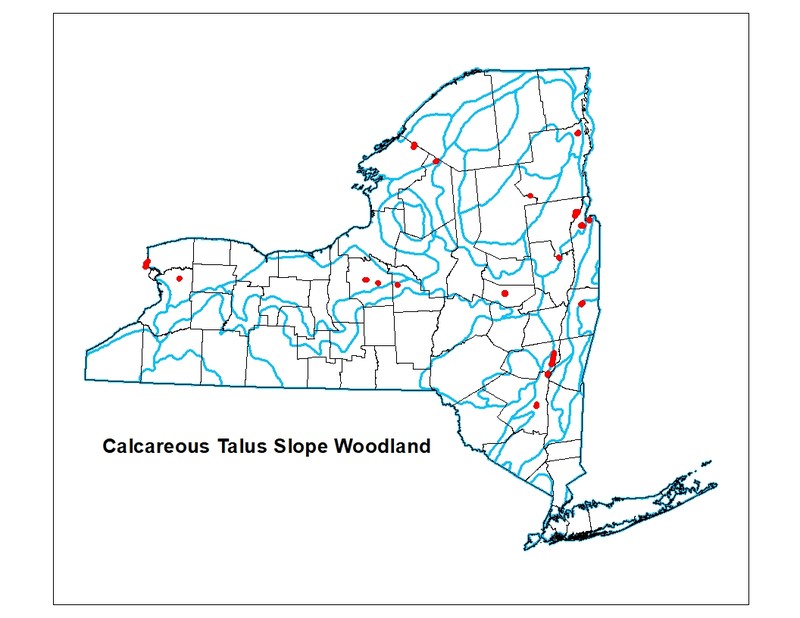
This community is currently known from Western New York within the Niagara Region, in central New York north of the Finger Lakes, and at scattered locations in the Hudson Valley. Calcareous talus slope woodlands are also known from the Adirondack Mountains within the Eastern Adirondack Low Mountains (Lake George Valley) and in the limestone region of Lewis County. Additional occurrences may be located elsewhere in the state where the bedrock is calcareous.
Global Distribution
The range of this physically broadly-defined community is probably global, but limited to mountainous areas with calcareous bedrock. Examples with the greatest biotic affinities to New York occurrences are suspected to span north to southern Canada, west to Ohio and Kentucky, southwest to Tennessee, and east to western New England.
Best Places to See
- Clark Reservation State Park (Onondaga County)
- Whirlpool State Park (Niagara County)
- Bonaparte Swamp Preserve (Lewis County)
- Lake George Wild Forest, Adirondack Park (Warren County)
- Devils Hole State Park (Niagara County)
- Great Vly Wildlife Management Area (Greene, Ulster Counties)
- Chittenango Falls State Park (Madison County)
Identification Comments
General Description
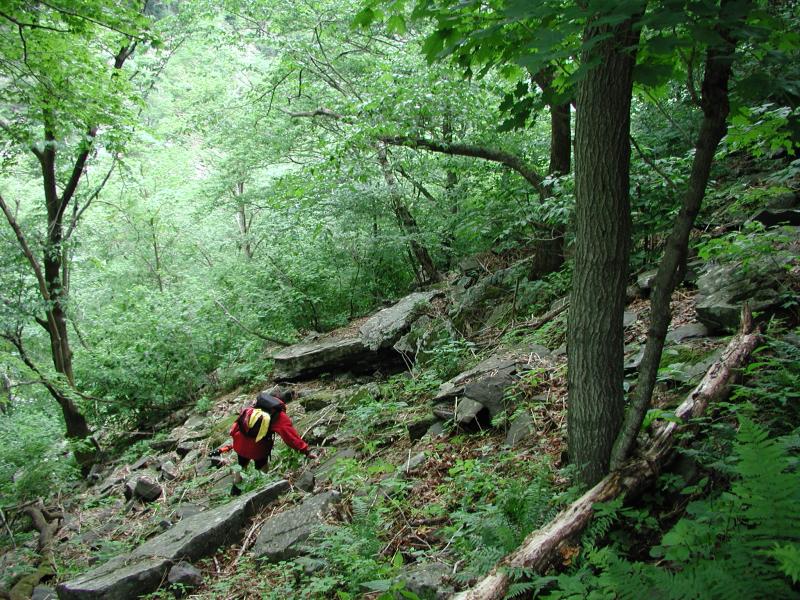
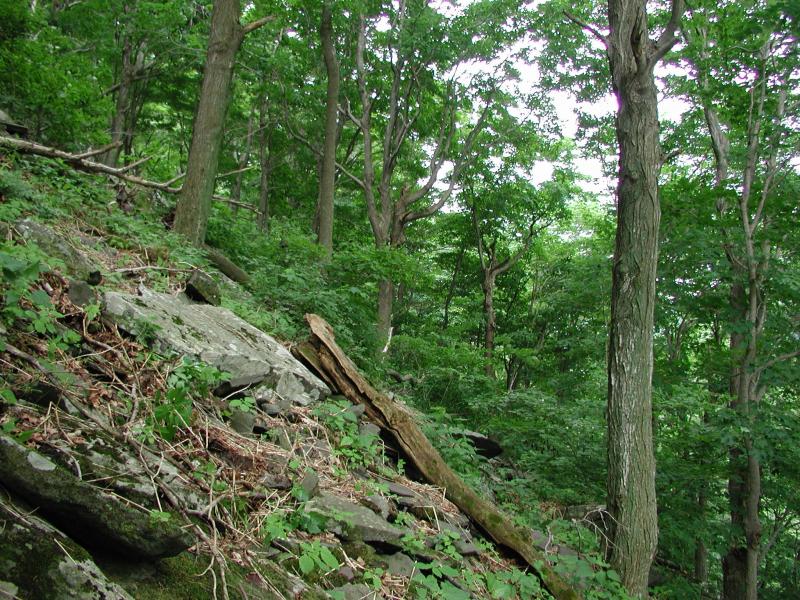
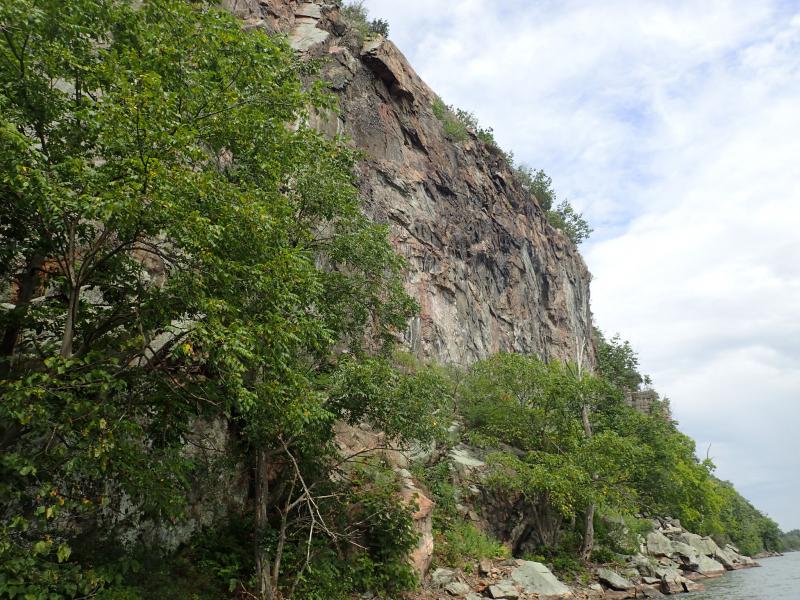
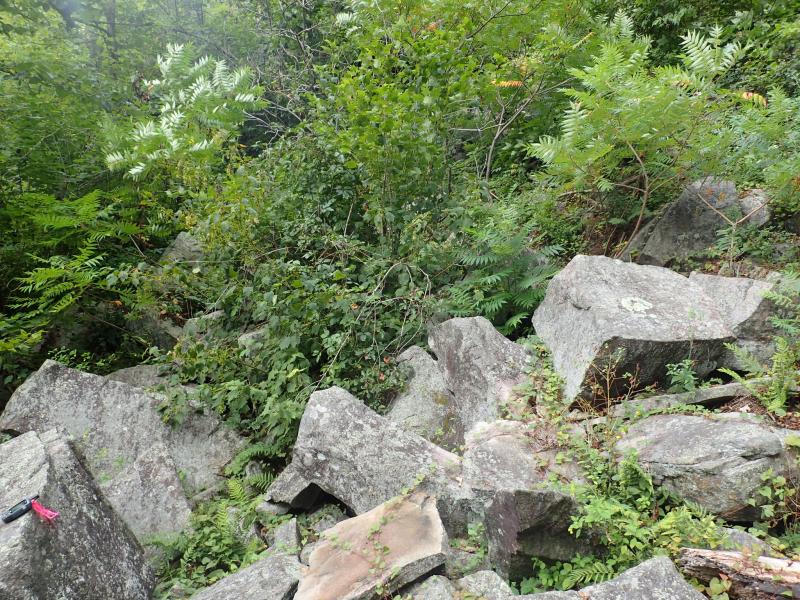
An open or closed canopy community that occurs on talus slopes composed of calcareous bedrock such as limestone or dolomite. The soils are usually moist and loamy; there may be numerous rock outcrops.
Characters Most Useful for Identification
The combination of rich vegetation indicating calcium enriched bedrock and steep rocky slopes (talus) identify this community. Talus should make up at least 50% of the substrate and is typically at least partially moss-covered. Talus should be derived from cliff rockfall or from landslides and slopes that average about 20 degrees, but can be as steep as 45 degrees. Plant communities of a calcareous talus slope woodland can range from closed canopy forests to a sparse canopy woodlands to steep, open slopes of non-vegetated bare rock. Plants that can be found on calcareous substrates include sugar maple, white ash, eastern hop hornbeam, basswood, northern white cedar, butternut, bladdernut, alternate-leaf dogwood, and mountain maple. Ferns that grow on the rocks often include bulbet fern, maidenhair spleenwort, fragile fern, and walking fern. Other characteristic plants that might grow on the rocks and calcium rich soil include herb robert, Solomon's seal, wild ginger, white baneberry, early meadow rue , blue cohosh, and blue-stem goldenrod.
Elevation Range
Known examples of this community have been found at elevations between 50 feet and 1,969 feet.
Best Time to See
These rich forests and woodlands often have nice wildflower displays during the spring and early summer that include trilliums, trout lilies, and Solomon's-seal. Thus, a good time to see them is in the spring and early June. Fern viewing peaks in late June and July.
Calcareous Talus Slope Woodland Images
Timothy G. Howard
Timothy G. Howard
Stephen M. Young
Timothy G. Howard
Gregory J. Edinger
Gregory J. Edinger
Classification
International Vegetation Classification Associations
This New York natural community encompasses all or part of the concept of the following International Vegetation Classification (IVC) natural community associations. These are often described at finer resolution than New York's natural communities. The IVC is developed and maintained by NatureServe.
- Sugar Maple - American Basswood - White Ash / Hophornbeam / Robert's Geranium Talus Woodland (CEGL005058)
- Northern White-cedar - Green Ash / Striped Maple Woodland (CEGL006508)
NatureServe Ecological Systems
This New York natural community falls into the following ecological system(s). Ecological systems are often described at a coarser resolution than New York's natural communities and tend to represent clusters of associations found in similar environments. The ecological systems project is developed and maintained by NatureServe.
- Laurentian-Acadian Calcareous Cliff and Talus (CES201.570)
Characteristic Species
-
Trees > 5m
- Acer saccharum (sugar maple)
- Fraxinus americana (white ash)
- Juniperus virginiana var. virginiana (eastern red cedar)
- Ostrya virginiana (hop hornbeam, ironwood)
- Quercus rubra (northern red oak)
- Tilia americana var. americana (American basswood)
- Tsuga canadensis (eastern hemlock)
-
Shrubs 2 - 5m
- Hamamelis virginiana (witch-hazel)
- Lonicera morrowii (Morrow's honeysuckle)
-
Shrubs < 2m
- Viburnum acerifolium (maple-leaved viburnum)
-
Vines
- Parthenocissus quinquefolia (Virginia-creeper)
- Vitis labrusca (fox grape)
-
Herbs
- Aquilegia canadensis (wild columbine, red columbine)
- Arabidopsis lyrata ssp. lyrata (lyre-leaved rock cress)
- Carex platyphylla (broad-leaved sedge)
- Cystopteris bulbifera (bulblet fern)
- Dryopteris marginalis (marginal wood fern)
- Eurybia divaricata (white wood-aster)
- Geranium robertianum (herb-Robert)
- Pellaea atropurpurea (purple cliff-brake)
- Solidago bicolor (silver-rod)
Similar Ecological Communities
- Acidic talus slope woodland
(guide)
Calcareous talus slope woodlands occur on limestone or dolomite and have sugar maple, white ash, or basswood in the tree canopy. Whereas, acidic talus slope woodlands occur on talus slopes composed of non-calcareous bedrock such as granite, quartzite, or schist and have oaks and birches in the tree canopy.
- Calcareous cliff community
(guide)
While both communities occur on calcareous rock such as limestone or dolomite, calcareous cliff communities tend to be steeper and usually sparsely vegetated, and typically have very few to no trees. Whereas, calcareous talus slope woodlands are not as steep and have at least 25% cover of trees. Calcareous talus slope woodlands often occur at the base of calcareous cliffs.
- Calcareous talus slope woodland
(guide)
Shale cliff and talus communities occur on shale, tend to be steeper and usually sparsely vegetated, and typically have few to no trees. Whereas, calcareous talus slope woodlands occur on less steep talus slopes composed of calcareous rock such as limestone or dolomite, and have at least 25% cover of trees.
- Limestone woodland
(guide)
Limestone woodlands will usually have a more sparse tree canopy layer, have shallower soils, and typcially have exposed limestone pavement and fissures.
- Shale cliff and talus community
(guide)
Shale cliff and talus communities occur on shale, tend to be steeper and usually sparsely vegetated, and typically have few to no trees. Whereas, calcareous talus slope woodlands occur on less steep talus slopes composed of calcareous rock such as limestone or dolomite, and have at least 25% cover of trees.
- Shale talus slope woodland
(guide)
While both communities have at least 25% cover trees on talus, calcareous talus slope woodlands occur on calcareous rock such as limestone or dolomite, whereas shale talus slope woodlands occur on shale rock.
Vegetation
Percent cover
This figure helps visualize the structure and "look" or "feel" of a typical Calcareous Talus Slope Woodland. Each bar represents the amount of "coverage" for all the species growing at that height. Because layers overlap (shrubs may grow under trees, for example), the shaded regions can add up to more than 100%.
Additional Resources
References
Edinger, G. J., D. J. Evans, S. Gebauer, T. G. Howard, D. M. Hunt, and A. M. Olivero (editors). 2014. Ecological Communities of New York State. Second Edition. A revised and expanded edition of Carol Reschke’s Ecological Communities of New York State. New York Natural Heritage Program, New York State Department of Environmental Conservation, Albany, NY. https://www.nynhp.org/ecological-communities/
Edinger, Gregory J., D.J. Evans, Shane Gebauer, Timothy G. Howard, David M. Hunt, and Adele M. Olivero (editors). 2002. Ecological Communities of New York State. Second Edition. A revised and expanded edition of Carol Reschke's Ecological Communities of New York State. (Draft for review). New York Natural Heritage Program, New York State Department of Environmental Conservation. Albany, NY. 136 pp.
McVaugh, R. 1958. Flora of the Columbia County area, New York. Bull. 360. New York State Museum and Science Service. University of the State of New York. Albany, NY. 400 pp.
New York Natural Heritage Program. 2024. New York Natural Heritage Program Databases. Albany, NY.
Reschke, Carol. 1990. Ecological communities of New York State. New York Natural Heritage Program, New York State Department of Environmental Conservation. Latham, NY. 96 pp. plus xi.
Zenkert, Charles A. 1934. The Flora of the Niagara Frontier Region. Bulletin of the Buffalo Society of Natural Sciences, Vol 16. Buffalo, NY. 328 Pp.
About This Guide
Information for this guide was last updated on: December 13, 2023
Please cite this page as:
New York Natural Heritage Program. 2024.
Online Conservation Guide for
Calcareous talus slope woodland.
Available from: https://guides.nynhp.org/calcareous-talus-slope-woodland/.
Accessed April 24, 2024.