Pitch Pine-Oak Forest
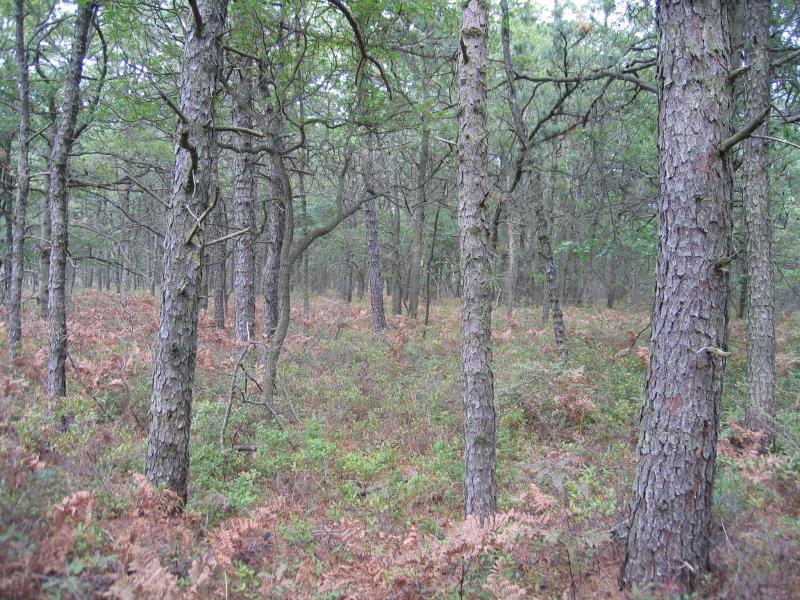
Pitch pine-oak forest in the Long Island Central Pine Barrens
Gregory J. Edinger
- System
- Terrestrial
- Subsystem
- Forested Uplands
- State Protection
- Not Listed
Not listed or protected by New York State.
- Federal Protection
- Not Listed
- State Conservation Status Rank
- S2S3
Imperiled or Vulnerable in New York - Very vulnerable, or vulnerable, to disappearing from New York, due to rarity or other factors; typically 6 to 80 populations or locations in New York, few individuals, restricted range, few remaining acres (or miles of stream), and/or recent and widespread declines. More information is needed to assign either S2 or S3.
- Global Conservation Status Rank
- G4G5
Apparently or Demonstrably Secure globally - Uncommon to common in the world, but not rare; usually widespread, but may be rare in some parts of its range; possibly some cause for long-term concern due to declines or other factors. More information is needed to assign either G4 or G5.
Summary
Did you know?
The pitch that was produced from pitch pine (Pinus rigida) sap was used to seal seams in ships and preserve wood during the American colonial period. The pitch can be obtained by scraping it off the tree in areas that have been wounded naturally, or by cutting marks along the tree's bark. Therefore, unlike other pines, few pitch pines were logged during this time period. If the cuts were made infrequently, the tree was not damaged.
State Ranking Justification
There are about a hundred occurrences statewide (number and acres may be artificially elevated by development fragmentation and broad classification). Several documented occurrences have good viability and several are protected on public land or private conservation land. This community has a restricted statewide distribution (correlated to pine barrens and sandy soils). Most examples are moderate in size and a few are high quality. Several pitch pine-oak forests are threatened by fire suppression.
Short-term Trends
The acreage of pitch pine-oak forest in New York has probably declined slightly in recent decades due to fire suppression, disturbance by off-road vehicles, trash dumping, and development. The number of pitch pine-oak forests may have increased slightly from historical numbers as formerly large matrix examples were fragmented by development into numerous large and small patches.
Long-term Trends
The acreage of pitch pine-oak forests in New York has probably declined substantially from historical numbers due to fire suppression, fragmentation, disturbance by off-road vehicles, trash dumping, and development. The number of pitch pine-oak forests may have increased substantially from historical numbers as formerly large matrix examples were fragmented by development into numerous large and small patches.
Conservation and Management
Threats
As a fire-dependent natural community, the primary threat to pitch pine-oak forests is the suppression of fire. Other threats to this community include fragmenting development (e.g., residential development, roads), recreational overuse (e.g., ATVs, hikers, mountain bikes, trash dumping), and habitat alteration (e.g., excessive logging, construction of utility ROWs). Several examples of pitch pine-oak forest are threatened by invasive species, such as Japanese barberry (Berberis thunbergii), black locust (Robinia pseudoacacia), multiflora rose (Rosa multiflora), buckthorn (Rhamnus cathartica), Asiatic bittersweet (Celastrus orbiculatus), Japanese honeysuckle (Lonicera japonica), and garlic mustard (Alliaria petiolaris).The oak trees in pitch pine-oak forests may be threatened by the non-native spongy moth (Lymantria dispar) which is one of North America's most destructive forest pests. The spongy moth is known to feed on the foliage of hundreds of species of plants in North America but its most common hosts are oaks (Quercus spp.) and aspen (Populus spp.). Spongy moth populations are typically eruptive in North America; in any forest stand densities may fluctuate from near 1 egg mass per ha to over 1,000 per ha. When densities reach very high levels, trees may become completely defoliated. Several successive years of defoliation, along with other biotic and abiotic stress factors, may ultimately result in tree mortality (McManus et al. 1980, Liebold 2003 ). Southern pine beetle (Dendroctonus frontalis) is a bark beetle that infests pine trees, such as pitch pine, white pine, and red pine. Southern pine beetle is native to the southeastern United States, but its range has spread up the east coast to Long Island, New York in 2014. Natural communities dominated or co-dominated by pines would likely be most impacted by southern pine beetle invasion.
Conservation Strategies and Management Practices
Develop and implement presribed burn plans at appropriate sites. Reduce or minimize fragmenting features, such as roads, abandoned clearings, unnecessary trails, etc. Restrict mountain bikes and ATVs to designated trails and least sensitive areas, and prevent dumping of trash.
Management should focus on activities that help maintain regeneration of the species associated with this community. Deer have been shown to have negative effects on forest understories (Miller et al. 1992, Augustine and French 1998, Knight 2003) and management efforts should strive to ensure that regenerating trees and shrubs are not so heavily browsed that they cannot replace overstory trees. Encourage selective logging in areas that are under active forestry.
Development and Mitigation Considerations
Strive to minimize fragmentation of large forest blocks by focusing development on forest edges, minimizing the width of roads and road corridors extending into forests, and designing cluster developments that minimize the spatial extent of the development. Development projects with the least impact on large forests and all the plants and animals living within these forests are those developments built on brownfields or other previously developed land. These projects have the added benefit of matching sustainable development practices (for example, see: The President's Council on Sustainable Development 1999 final report, US Green Building Council's Leadership in Energy and Environmental Design certification process at http://www.usgbc.org/).
Inventory Needs
Survey for occurrences statewide to advance documentation and classification of pitch pine-oak forests. A statewide review of pitch pine pine-oak forests is desirable. Continue searching for large sites in good condition (A or B-ranked).
Research Needs
Research the composition of pitch pine-oak forests statewide in order to characterize variations (e.g., coastal plain, inland, and northern types). Collect sufficient plot data to support the recognition of several distinct pitch pine-oak forest types based on composition and by ecoregion. Determine the optimal fire regime for this community.
Rare Species
- Acronicta albarufa (Barrens Dagger Moth) (guide)
- Aletris farinosa (White Colicroot) (guide)
- Ambystoma tigrinum (Tiger Salamander) (guide)
- Atrytonopsis hianna (Dusted Skipper) (guide)
- Callicera erratica (Golden Pine Fly) (guide)
- Callophrys irus (Frosted Elfin) (guide)
- Calycopis cecrops (Red-banded Hairstreak) (guide)
- Carex barrattii (Barratt's Sedge) (guide)
- Carex polymorpha (Variable Sedge) (guide)
- Carex reznicekii (Reznicek's Sedge) (guide)
- Catocala herodias gerhardi (Herodias or Pine Barrens Underwing) (guide)
- Cerma cora (Bird Dropping Moth) (guide)
- Chaetaglaea cerata (Waxed Sallow) (guide)
- Chytonix sensilis (Sensitive Chytonix) (guide)
- Cisthene packardii (Packard's Lichen Moth) (guide)
- Citheronia sepulcralis (Pine Devil) (guide)
- Crocanthemum dumosum (Bushy Rock Rose) (guide)
- Desmodium ciliare (Hairy Small-leaved Tick Trefoil) (guide)
- Digitaria filiformis (Slender Crab Grass) (guide)
- Erastria coloraria (Broad-lined Catopyrrha) (guide)
- Erynnis martialis (Mottled Duskywing) (guide)
- Eupatorium pubescens (Hairy Thoroughwort) (guide)
- Eupatorium subvenosum (Veined Thoroughwort) (guide)
- Hemileuca maia maia (Inland Barrens Buckmoth) (guide)
- Hypericum stragulum (Low St. John's Wort) (guide)
- Juncus biflorus (Large Grass-leaved Rush) (guide)
- Lasiurus borealis (Eastern Red Bat) (guide)
- Lemna perpusilla (Minute Duckweed) (guide)
- Lespedeza stuevei (Stuve's Bush Clover) (guide)
- Macaria signaria (Jack Pine Looper) (guide)
- Macrochilo bivittata (Two-striped Cord Grass Moth) (guide)
- Melanerpes erythrocephalus (Red-headed Woodpecker) (guide)
- Metalectra richardsi (Richard's Fungus Moth) (guide)
- Myotis lucifugus (Little Brown Bat) (guide)
- Myotis septentrionalis (Northern Long-eared Bat) (guide)
- Oenothera oakesiana (Oakes' Evening Primrose) (guide)
- Plebejus melissa samuelis (Karner Blue) (guide)
- Polygala lutea (Orange Milkwort) (guide)
- Pyrrhia aurantiago (Aureolaria Seed Borer) (guide)
- Pyxidanthera barbulata (Pyxies) (guide)
- Satyrium edwardsii (Edwards' Hairstreak) (guide)
- Satyrium favonius ontario (Northern Oak Hairstreak) (guide)
- Scleria pauciflora var. caroliniana (Few-flowered Nutrush) (guide)
- Scleria triglomerata (Whip Nut Sedge) (guide)
- Sericocarpus linifolius (Narrow-leaved White-topped Aster) (guide)
- Silene caroliniana ssp. pensylvanica (Wild Pink) (guide)
- Smilax pseudochina (Coastal Carrion Flower) (guide)
- Solidago latissimifolia (Coastal Goldenrod) (guide)
- Speranza exonerata (Barrens Itame) (guide)
- Sphenopholis pensylvanica (Swamp Oats) (guide)
- Sphinx gordius (Gordian Sphinx) (guide)
- Uvularia puberula (Pine Barren Bellwort) (guide)
- Zanclognatha martha (Pine Barrens Zanclognatha) (guide)
Range
New York State Distribution
Pitch pine-oak forests are primarily known from the Suffolk County portion of the Atlantic Coastal Plain where it historically occurred as a matrix forest associated with the Central Long Island Pine Barrens where large examples persist. Smaller examples of this community are also known from Hudson Valley Glacial Lake Plain and the outwash plains along Lake Champlain in Clinton County and probably Essex County. Within the Hudson Valley Glacial Lake Plain, pitch pine-oak forests are known from Albany County (Albany Pine Bush), Saratoga County (Saratoga Sandplains), and Warren County (Glen Falls Sandplain). Small patches may occur in the Mohawk River Valley and the hills of the Mid-Hudson River Valley in Rensselaer County. As more data are collected, the inland sites may be recognized as distinct communities separate from the coastal plain type.
Global Distribution
This broadly-defined community probably occupies only sandy outwash areas on the Atlantic and Saint Lawrence drainages of the northeastern United States. This range is estimated to extend northeast to southern Maine, northwest to northern Lake Champlain, New York, southeast to Cape Cod and the offshore islands of Massachusetts, and south through New Jersey and Pennsylvania, possibly to Delaware. Small examples are possible farther west around Lake Ontario (e.g., near Plessis Flat Rock, New York or near the Lake Ontario dunes of Ontario), or farther south in the central Appalachians.
Best Places to See
- Albany Pine Bush Preserve
- Edgewood Oak Brush Plains Preserve (Suffolk County)
- David A. Sarnoff Pine Barrens Preserve (Suffolk County)
- Heckscher State Park (Suffolk County)
- Macomb Reservation State Park
- Brookhaven State Park (Suffolk County)
- Bethpage State Park (Nassau County)
- Rocky Point Natural Resources Management Area (Suffolk County)
Identification Comments
General Description
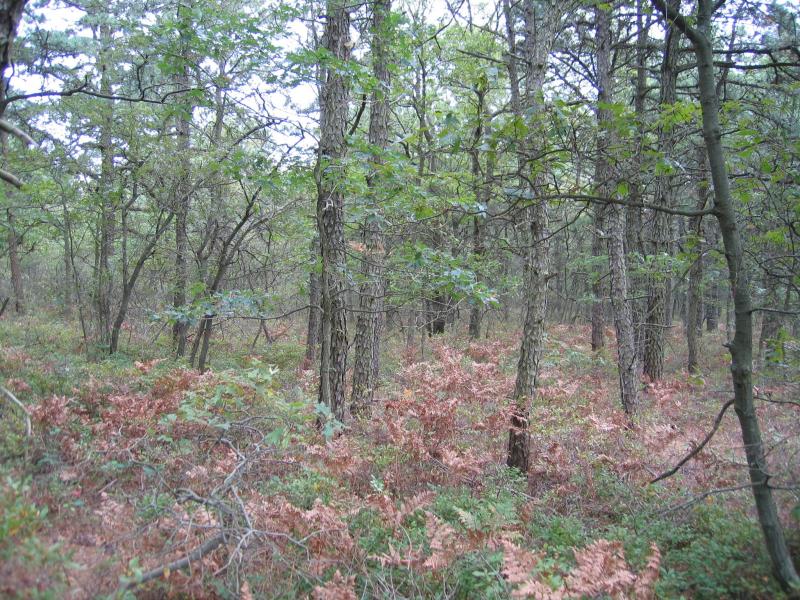
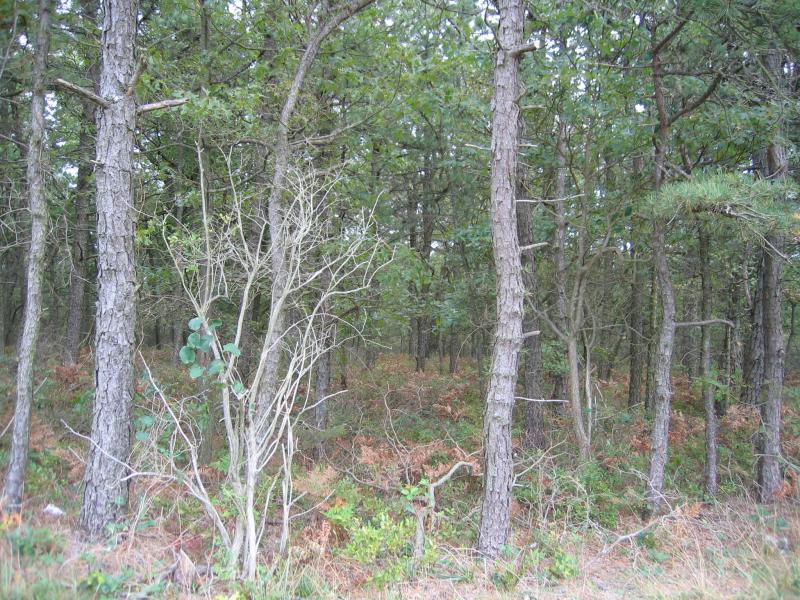
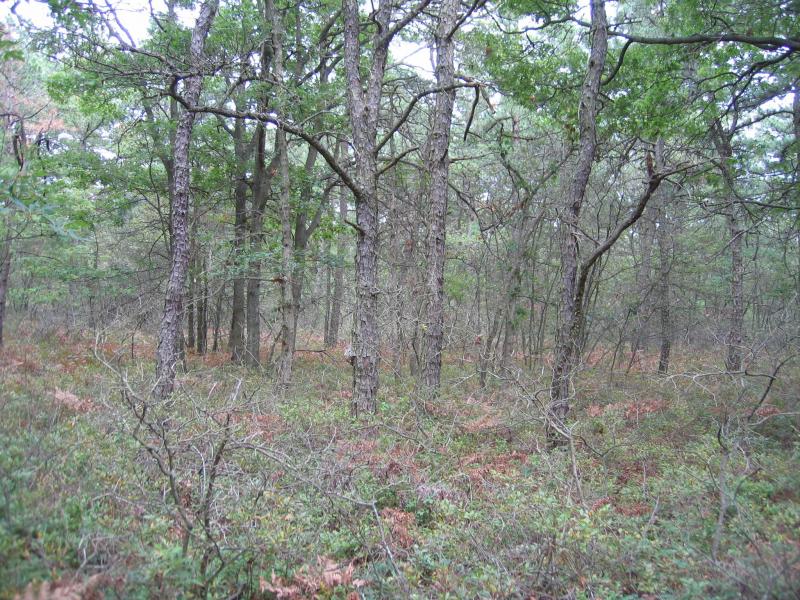
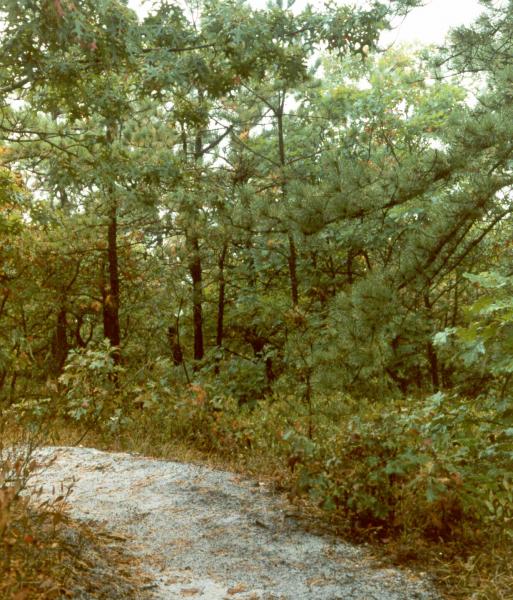
A mixed forest that occurs on well-drained sandy soils of glacial outwash plains or moraines. The dominant canopy species are pitch pine (Pinus rigida) with one or more of the following oaks: black oak (Quercus velutina), red oak (Q. rubra), scarlet oak (Q. coccinea), and white oak (Q. alba). The relative abundance and distribution of the pitch pine and oak species varies greatly. The shrub layer is well developed, with scattered patches of scrub oak (Q. ilicifolia), and an extensive cover of blueberries (Vaccinium angustifolium, V. pallidum) and huckleberries (Gaylussacia baccata). The herbaceous layer is sparse and may include bracken fern (Pteridium aquilinum), pennsylvania sedge (Carex pensylvanica), and wintergreen (Gaultheria procumbens) (Edinger et al. 2002).
Characters Most Useful for Identification
Pitch pine-oak forests are mature, closed canopy forests with a variable relative abundance of pitch pine and oak species, an extensive layer of heath low shrubs, and scattered patches of scrub oak. This community is present in areas of outwash plains and moraines.
Elevation Range
Known examples of this community have been found at elevations between 10 feet and 724 feet.
Best Time to See
During midsummer, two species of lowbush blueberry come into fruit, producing a tasty snack.
Pitch Pine-Oak Forest Images
Gregory J. Edinger
Gregory J. Edinger
Gregory J. Edinger
Gregory J. Edinger
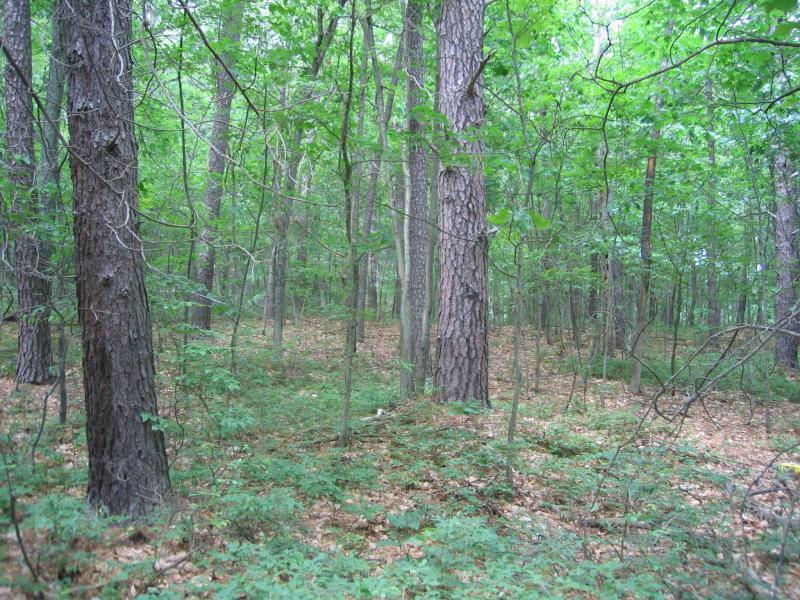
Gregory J. Edinger
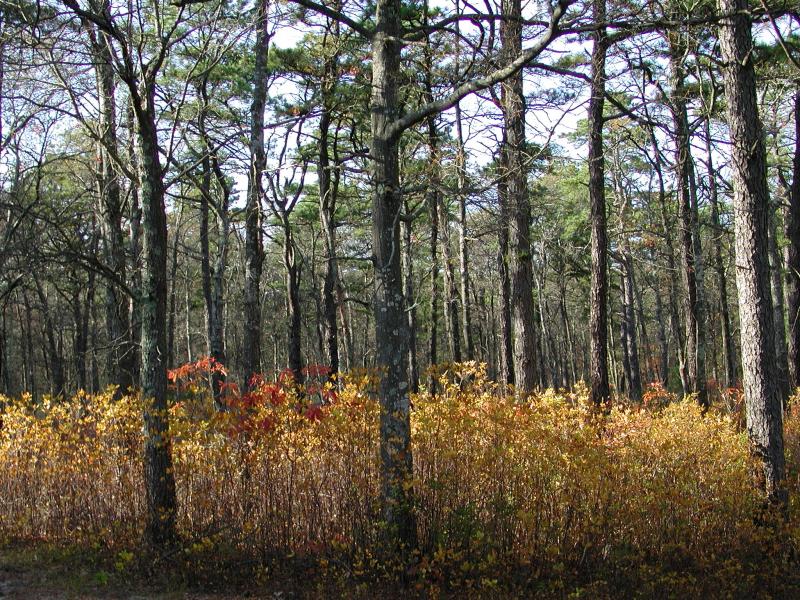
Stephen M. Young
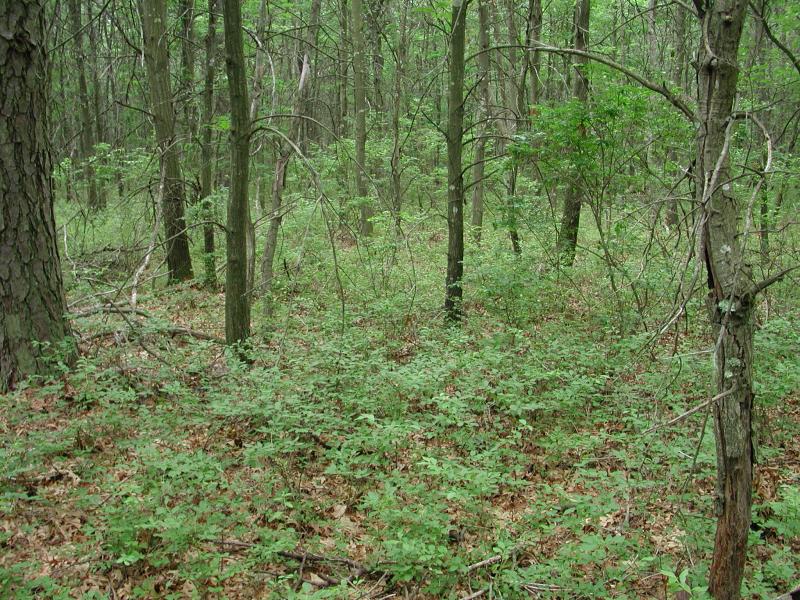
Stephen M. Young
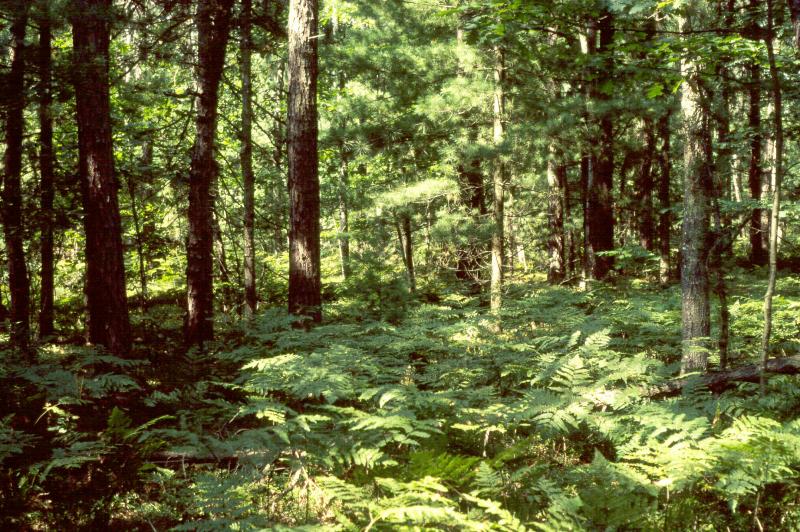
David M. Hunt
C. Reschke
Classification
International Vegetation Classification Associations
This New York natural community encompasses all or part of the concept of the following International Vegetation Classification (IVC) natural community associations. These are often described at finer resolution than New York's natural communities. The IVC is developed and maintained by NatureServe.
- Pitch Pine - Scarlet Oak / Blue Ridge Blueberry - (Northern Bayberry) Woodland (CEGL006381)
- Pitch Pine - (Black Oak, Chestnut Oak) Forest (CEGL006290)
- Eastern White Pine - Red Pine - Pitch Pine Forest (CEGL006259)
NatureServe Ecological Systems
This New York natural community falls into the following ecological system(s). Ecological systems are often described at a coarser resolution than New York's natural communities and tend to represent clusters of associations found in similar environments. The ecological systems project is developed and maintained by NatureServe.
- Central Appalachian Dry Oak-Pine Forest (CES202.591)
- Northeastern Interior Pine Barrens (CES202.590)
- Northern Atlantic Coastal Plain Pitch Pine Barrens (CES203.269)
Characteristic Species
-
Trees > 5m
- Acer rubrum var. rubrum (common red maple)
- Pinus rigida (pitch pine)
- Pinus strobus (white pine)
- Quercus alba (white oak)
- Quercus coccinea (scarlet oak)
- Quercus rubra (northern red oak)
- Quercus velutina (black oak)
-
Shrubs 2 - 5m
- Quercus ilicifolia (scrub oak, bear oak)
- Vaccinium corymbosum (highbush blueberry)
-
Shrubs < 2m
- Gaylussacia baccata (black huckleberry)
- Vaccinium angustifolium (common lowbush blueberry)
- Vaccinium pallidum (hillside blueberry)
-
Herbs
- Carex pensylvanica (Pennsylvania sedge)
- Gaultheria procumbens (wintergreen, teaberry)
- Maianthemum canadense (Canada mayflower)
- Pteridium aquilinum ssp. latiusculum (eastern bracken fern)
Similar Ecological Communities
- Appalachian oak-pine forest
(guide)
Appalachian oak-pine forest communities are made up of any of the oaks present in pitch pine-oak forests, and usually white pine (Pinus strobus), which has a canopy percent cover of at least 25%. When pitch pine is present and abundant in this community, it is typically located on thin rocky soils.
- Coastal oak-heath forest
(guide)
Coastal oak-heath forest communities feature the same oak species as pitch pine-oak forests, but they have a very low percent cover of pitch pine (<1%) in the canopy. The two communities have similar understory species compositions.
- Pitch pine-heath barrens
(guide)
Pitch pine-heath barrens is a shrub-savanna community that has a very open canopy (with 30-60% cover), and an extensive shrub layer dominated by heath species and sweet fern (Comptonia peregrina). In contrast, pitch pine-oak forests are closed-canopy mature communities.
- Pitch pine-oak-heath woodland
(guide)
Pitch pine-oak-heath woodland communities are pine barrens communities of the coastal plain region that have a vegetation structure between a shrub-savanna and a woodland. The canopy of this community is more sparse than that of pitch pine-oak forests, and the understory has species characteristic of coastal plain barrens, such as bearberry (Arctostaphylos uva-ursi) and heathers (Hudsonia spp.).
- Pitch pine-scrub oak barrens
(guide)
Pitch pine-scrub oak barrens is a shrub-savanna community that has a very open canopy (with 20-60% cover), and an extensive shrub layer dominated by scrub oak and scrub chestnut oak (Quercus prinioides). In contrast, pitch pine-oak forests are closed-canopy mature communities.
Vegetation
Percent cover
This figure helps visualize the structure and "look" or "feel" of a typical Pitch Pine-Oak Forest. Each bar represents the amount of "coverage" for all the species growing at that height. Because layers overlap (shrubs may grow under trees, for example), the shaded regions can add up to more than 100%.
Additional Resources
References
Bernard, J.M. and F.K. Seischab. 1995. Pitch pine (Pinus rigida Mill.) communities in northeastern New York State. American Midland Naturalist 134:294-306.
Edinger, G. J., D. J. Evans, S. Gebauer, T. G. Howard, D. M. Hunt, and A. M. Olivero (editors). 2014. Ecological Communities of New York State. Second Edition. A revised and expanded edition of Carol Reschke’s Ecological Communities of New York State. New York Natural Heritage Program, New York State Department of Environmental Conservation, Albany, NY. https://www.nynhp.org/ecological-communities/
Edinger, Gregory J., D.J. Evans, Shane Gebauer, Timothy G. Howard, David M. Hunt, and Adele M. Olivero (editors). 2002. Ecological Communities of New York State. Second Edition. A revised and expanded edition of Carol Reschke's Ecological Communities of New York State. (Draft for review). New York Natural Heritage Program, New York State Department of Environmental Conservation. Albany, NY. 136 pp.
Greller, Andrew M. 1977. A classification of mature forests on Long Island, New York. Bull. Torrey Bot. Club 140 (4):376-382.
Kerlinger, P., and C. Doremus. 1981. Habitat disturbance and the decline of dominant avian species in pine barrens of the northeastern United States. American Birds 35:16-20.
Liebold, S. 2003. Gypsy Moth in North America. U.S. Department of Agriculture, Forest Service, Northeastern Research Station, Morgantown, WV.
McManus, M, N. Schneebergerm R. Reardon, and G. Mason. 1980. Gypsy Moth. Forest Insect and Disease Leaflet 162. U.S. Department of Agriculture, Forest Service, Washington, D.C.
New York Natural Heritage Program. 2024. New York Natural Heritage Program Databases. Albany, NY.
Olsvig, L.S. 1979. Pattern and diversity analysis of the irradiated oak-pine forest, Brookhaven, New York. Vegetatio 40(2):65-78.
Olsvig, L.S. 1980. A comparative study of northeastern Pine Barrens vegetation. Ph.D. dissertation, Cornell University, Ithaca, NY. 479 pp.
Olsvig, L.S., J.F. Cryan and R.H. Whittaker. 1979. Vegetational gradients of the pine plains and barrens of Long Island, New York. In: Forman, R.T.T. ed. 1979. Pine Barrens: Ecosystems and Landscape.
Reiners, W.A. 1967. Relationships between vegetational strata in the pine barrens of central Long Island, New York. Bulletin Torrey Botanical Club 94(2): 87-99.
Reschke, Carol. 1990. Ecological communities of New York State. New York Natural Heritage Program, New York State Department of Environmental Conservation. Latham, NY. 96 pp. plus xi.
Seischab, F. K., and J. M. Bernard. 1991. Pitch pine (Pinus rigida Mill.) communities in central and western New York. Bulletin of the Torrey Botanical Club 118:412-423.
Seischab, F.K, and J.M. Bernard. 1996. Pitch pine (Pinus rigida Mill.) communities in Hudson Valley region of New York. American Midland Naturalist 136:42-56.
Seischab, F.K. and J.M. Bernard. 1994. Pitch pine (Pinus rigida Mill.) communities on Long Island, New York. Unpublished article. Department of Biology, Rochester Institute of Technology, Rochester, NY and Department of Biology, Ithaca College, Ithaca, NY.
Links
- Albany Pine Bush Preserve Commission
- Albany Pine Bush Preserve (NYS DEC)
- Long Island: Central Pine Barrens (TNC)
- Long Island Pine Barrens Society
- Rocky Point Pine Barrens State Forest (NYS DEC)
- Southern Pine Beetle Fact Sheet (NYS DEC)
- Southern Pine Beetle, Forest Insect & Disease Leaflet 49 (USDA Forest Service)
About This Guide
This guide was authored by: Jennifer Garrett
Information for this guide was last updated on: November 8, 2023
Please cite this page as:
New York Natural Heritage Program. 2024.
Online Conservation Guide for
Pitch pine-oak forest.
Available from: https://guides.nynhp.org/pitch-pine-oak-forest/.
Accessed April 26, 2024.