Coastal Oak-Hickory Forest
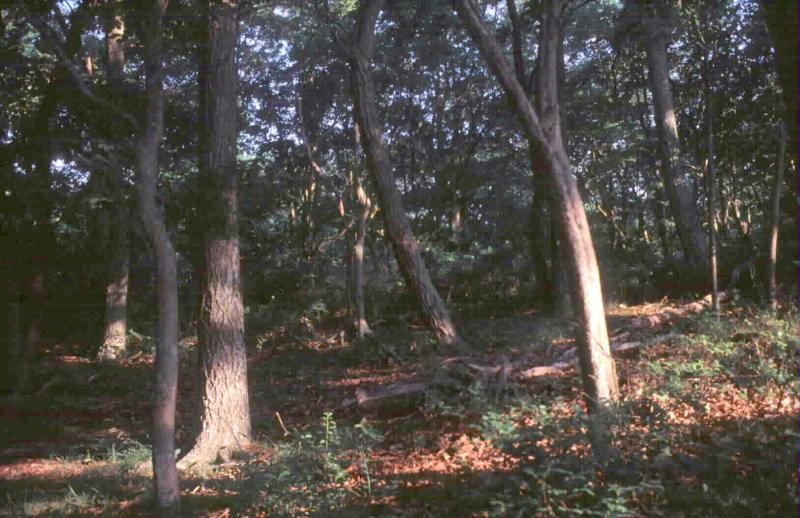
Coastal oak-hickory forest
David Hunt
- System
- Terrestrial
- Subsystem
- Forested Uplands
- State Protection
- Not Listed
Not listed or protected by New York State.
- Federal Protection
- Not Listed
- State Conservation Status Rank
- S3
Vulnerable in New York - Vulnerable to disappearing from New York due to rarity or other factors (but not currently imperiled); typically 21 to 80 populations or locations in New York, few individuals, restricted range, few remaining acres (or miles of stream), and/or recent and widespread declines.
- Global Conservation Status Rank
- G4
Apparently Secure globally - Uncommon in the world but not rare; usually widespread, but may be rare in some parts of its range; possibly some cause for long-term concern due to declines or other factors.
Summary
Did you know?
Pignut hickory (Carya glabra), and sweet pignut hickory (Carya ovalis) are two species of hickory that occur within coastal oak-hickory forests. These two species of hickory are actually very difficult to distinguish from each other most of the year. The main difference between the two species is the husk of the fruit. "The fruit of pignut hickory is pearshaped and the husks splits only about halfway down. This last feature is the only trustworthy one, since the other characteristics intergrade" (Harlow 1957).
State Ranking Justification
There are less than 10 documented occurrences statewide. These occurrences have good viability and are protected on private or public conservation land. The community is restricted to interior portions of coastal lowlands in Suffolk and possibly Nassau Counties and is concentrated on knolls and mid to upper slopes of moraines. The acreage, extent, and condition of coastal oak-hickory forests in New York is suspected to be declining.
Short-term Trends
The acreage, extent, and condition of coastal oak-hickory forests in New York is suspected to be declining due to fragmentation and extirpation from residential and commercial development, heavy deer browse, and invasive species.
Long-term Trends
The number, extent, and viability of coastal oak-hickory forests in New York are suspected to have declined substantially over the long-term. These declines are likely correlated with the settlement of Long Island and the subsequent residential, agricultural and commercial development.
Conservation and Management
Threats
The threats to the coastal oak-hickory forest are many and varied: displacement of the community by commercial and residential development; invasive species; roads and trails causing forest fragmentation and erosion; and deer browse. Some of the invasive species that have been observed in the forest include Japanese barberry (Berberis thunbergii), Black locust (Robinia pseudo-acacia), bittersweet (Celastrus orbiculatus), garlic mustard (Alliaria petiolata) and multiflora rose (Rosa multiflora). Deer browse on seedlings and saplings are causing a loss of forest canopy regeneration.
Conservation Strategies and Management Practices
To promote a dynamic forest mosaic, allow natural processes, including gap formation from blowdowns and tree mortality, as well as, in-place decomposition of fallen coarse woody debris and standing snags, to operate, particularly in mature and old growth examples (Spies and Turner 1999). Management efforts should focus on the control or local eradication of invasive exotic plants and the reduction of white-tailed deer densities. Consider deer exclosures or population management, particularly if studies confirm that canopy species recruitment is being affected by heavy browse. Generally, management should focus on activities that help maintain regeneration of the species associated with this community. Deer have been shown to have negative effects on forest understories (Miller et al. 1992, Augustine and French 1998, Knight 2003) and management efforts should strive to ensure that tree and shrub seedlings are not so heavily browsed that they cannot replace overstory trees. If active forestry must occur, use silvicultural techniques and extended rotation intervals that promote regeneration of a diversity of canopy, subcanopy and shrub species over time (Busby et al. 2009) while avoiding or minimizing both short-term and persistent residual disturbances such as soil compaction, loss of canopy cover due to logging road construction, and the unintended introduction of invasive plants.
Development and Mitigation Considerations
Fragmentation of coastal forests should be avoided. It is also important to maintain connectivity with adjacent natural communities, not only to allow nutrient flow and seed dispersal, but to allow animals to move between them seasonally. Strive to minimize fragmentation of large forest blocks by focusing development on forest edges, minimizing the width of roads and road corridors extending into forests, and designing cluster developments that minimize the spatial extent of the development. Development projects with the least impact on large forests and all the plants and animals living within these forests are those built on brownfields or other previously developed land. These projects have the added benefit of matching sustainable development practices (for example, see: The President's Council on Sustainable Development 1999 final report, US Green Building Council's Leadership in Energy and Environmental Design certification process at http://www.usgbc.org/). A cross-section of coastal oak-hickory forest occurrences should be protected, including the largest ones, the most mature ones, and the ones in the best landscape block.
Inventory Needs
Survey for additional large examples in central to western Suffolk County. Some leads to follow up on include Caleb Smith State Park, Wildwood State Park, and Butler-Huntington Preserve among others.
Research Needs
A critical assessment of the long-term effects of heavy deer browse on this community, particularly addressing oak and other canopy species seedling recruitment, is needed.
Rare Species
- Ageratina aromatica var. aromatica (Small White Snakeroot) (guide)
- Asclepias variegata (White Milkweed) (guide)
- Calycopis cecrops (Red-banded Hairstreak) (guide)
- Carex nigromarginata (Black-edged Sedge) (guide)
- Citheronia regalis (Regal Moth) (guide)
- Crataegus uniflora (Dwarf Hawthorn) (guide)
- Crocanthemum dumosum (Bushy Rock Rose) (guide)
- Cyperus echinatus (Globe Flat Sedge) (guide)
- Diospyros virginiana (Persimmon) (guide)
- Hypericum stragulum (Low St. John's Wort) (guide)
- Lasiurus borealis (Eastern Red Bat) (guide)
- Lechea tenuifolia (Narrow-leaved Pinweed) (guide)
- Ligusticum scoticum ssp. scoticum (Scotch Lovage) (guide)
- Myotis septentrionalis (Northern Long-eared Bat) (guide)
- Parrhasius m-album (White-m Hairstreak) (guide)
- Satyrium favonius ontario (Northern Oak Hairstreak) (guide)
- Viburnum dentatum var. venosum (Southern Arrowwood) (guide)
Range
New York State Distribution
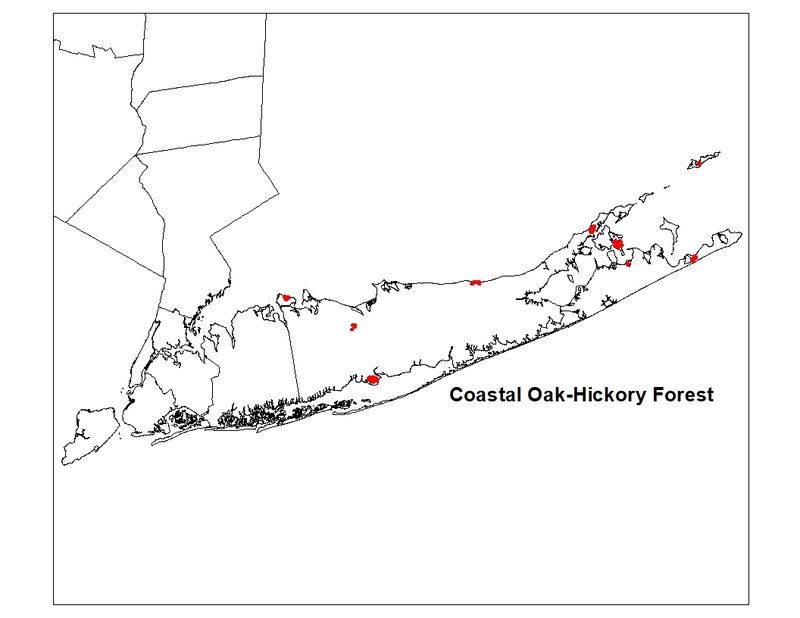
Coastal oak-hickory forests are restricted to the coastal lowlands in Suffolk and possibly Nassau Counties. They are concentrated on knolls and mid to upper slopes of glacial moraines. The range of this community possibly extends westward into northeastern Nassau County and on the end moraine of western Long Island (Greller 1977).
Global Distribution
This natural community occurs along the coast from Maine to Maryland. This community is similar to the mesic coastal plain mixed oak forest of New Jersey.
Best Places to See
- Sag Harbor State Park (Suffolk County)
- Heckscher State Park (Suffolk County)
- Caleb Smith State Park Preserve (Suffolk County)
- Wildwood State Park (Suffolk County)
- Northwest Creek SCFWH (Suffolk County)
- Hither Hills State Park (Suffolk County)
- Mashomack Preserve (Suffolk County)
- Barcelona Neck Natural Resource Management Area (Suffolk County)
- Caumsett State Park (Suffolk County)
Identification Comments
General Description
The forest is usually codominated by two or more species of oaks, usually white oak (Q. alba), black oak (Quercus velutina) and chestnut oak (Q. montana). Scarlet oak (Quercus coccinea) is also a common associate. Mixed with the oaks, usually at moderate densities, are one or more of the following hickories: pignut (Carya glabra), mockernut (C. alba), and sweet pignut (C. ovalis). These hickories can range from nearly pure stands to as little as about 25% cover. There is typically a subcanopy stratum of small trees and tall shrubs including flowering dogwood (Cornus florida) and highbush blueberry (Vaccinium corymbosum). The shrublayer and groundlayer flora may be diverse. Common low shrubs include maple-leaf viburnum (Viburnum acerifolium), blueberries (Vaccinium angustifolium, V. pallidum) and black huckleberry (Gaylussacia baccata). Characteristic groundlayer herbs are Swan's sedge (Carex swanii), panic grass (Panicum dichotomum), poverty grass (Danthonia spicata), cow-wheat (Melampyrum lineare), spotted wintergreen (Chimaphila maculata), rattlesnake weed (Hieracium venosum), white wood aster (Aster divaricatus), false Solomon's seal (Maianthemum racemosum), Pennsylvania sedge (Carex pensylvanica), and white goldenrod (Solidago bicolor).
Characters Most Useful for Identification
A hardwood forest with oaks (Quercus spp.) and hickories (Carya spp.) codominant that occurs in dry well-drained, loamy sand of knolls, upper slopes, or south-facing slopes of glacial moraines of the Atlantic coastal plain.
Elevation Range
Known examples of this community have been found at elevations between 4 feet and 150 feet.
Best Time to See
Early spring is a good time to catch many of the understory trees and shrubs in bloom. Flowering dogwood and maple-leaf viburnum provide visual sprays of color in the spring. Mid to late summer is a good time to snack on ripening blueberries and huckleberries.
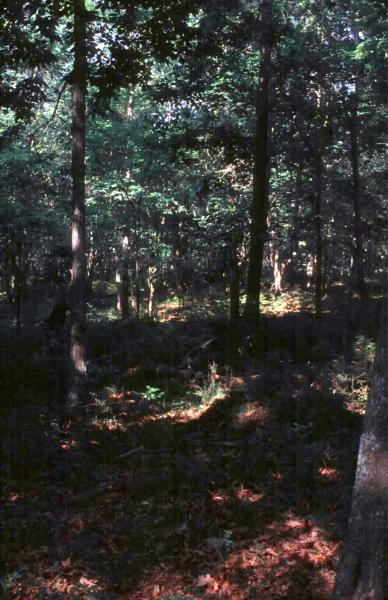
Coastal Oak-Hickory Forest Images
David Hunt
David Hunt
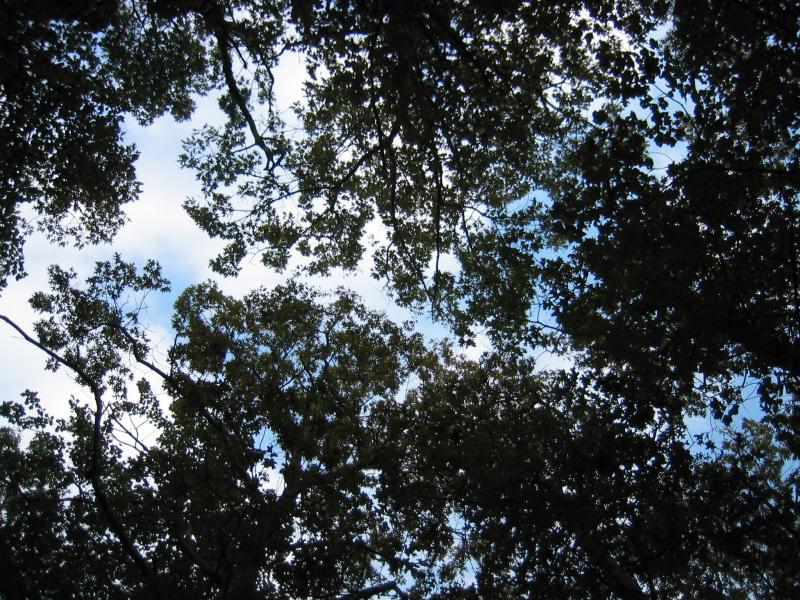
Gregory J. Edinger
Classification
International Vegetation Classification Associations
This New York natural community encompasses all or part of the concept of the following International Vegetation Classification (IVC) natural community associations. These are often described at finer resolution than New York's natural communities. The IVC is developed and maintained by NatureServe.
- (White Oak, Northern Red Oak, Black Oak) / Hickory species / Mapleleaf Viburnum Forest (CEGL006336)
NatureServe Ecological Systems
This New York natural community falls into the following ecological system(s). Ecological systems are often described at a coarser resolution than New York's natural communities and tend to represent clusters of associations found in similar environments. The ecological systems project is developed and maintained by NatureServe.
- Northern Atlantic Coastal Plain Dry Oak-Hardwood Forest (CES203.475)
Characteristic Species
-
Trees > 5m
- Acer rubrum var. rubrum (common red maple)
- Carya cordiformis (bitternut hickory)
- Carya glabra (pignut hickory)
- Carya ovata var. ovata (shagbark hickory)
- Cornus florida (flowering dogwood)
- Prunus serotina var. serotina (wild black cherry)
- Quercus alba (white oak)
- Quercus coccinea (scarlet oak)
- Quercus montana (chestnut oak)
- Quercus palustris (pin oak)
- Quercus rubra (northern red oak)
- Quercus stellata (post oak)
- Quercus velutina (black oak)
- Sassafras albidum (sassafras)
-
Shrubs 2 - 5m
- Acer rubrum var. rubrum (common red maple)
- Amelanchier canadensis var. canadensis (coastal shadbush)
- Carya glabra (pignut hickory)
- Carya ovata var. ovata (shagbark hickory)
- Carya tomentosa (mockernut hickory)
- Cornus florida (flowering dogwood)
- Hamamelis virginiana (witch-hazel)
- Lindera benzoin (spicebush)
- Quercus alba (white oak)
- Quercus coccinea (scarlet oak)
- Quercus montana (chestnut oak)
- Quercus palustris (pin oak)
- Quercus rubra (northern red oak)
- Quercus velutina (black oak)
- Sassafras albidum (sassafras)
- Vaccinium corymbosum (highbush blueberry)
- Viburnum acerifolium (maple-leaved viburnum)
-
Shrubs < 2m
- Clethra alnifolia (coastal sweet-pepperbush)
- Cornus florida (flowering dogwood)
- Gaylussacia baccata (black huckleberry)
- Quercus coccinea (scarlet oak)
- Quercus montana (chestnut oak)
- Quercus rubra (northern red oak)
- Quercus velutina (black oak)
- Vaccinium angustifolium (common lowbush blueberry)
- Vaccinium corymbosum (highbush blueberry)
- Vaccinium pallidum (hillside blueberry)
- Viburnum acerifolium (maple-leaved viburnum)
- Viburnum dentatum
-
Herbs
- Aralia nudicaulis (wild sarsaparilla)
- Carex pensylvanica (Pennsylvania sedge)
- Carex swanii (Swan's sedge)
- Chimaphila maculata (spotted-wintergreen)
- Danthonia spicata (poverty grass)
- Dichanthelium dichotomum ssp. dichotomum (forked rosette grass)
- Eurybia divaricata (white wood-aster)
- Gaultheria procumbens (wintergreen, teaberry)
- Hieracium venosum (rattlesnake hawkweed)
- Maianthemum canadense (Canada mayflower)
- Maianthemum racemosum
- Melampyrum lineare (cow-wheat)
- Polygonatum biflorum var. biflorum (small Solomon's-seal)
- Solidago bicolor (silver-rod)
- Thelypteris noveboracensis (New York fern)
Similar Ecological Communities
- Appalachian oak-hickory forest
(guide)
This is a hardwood forest that occurs on well-drained sites, usually on ridgetops, upper slopes, or south- and west-facing slopes. The soils are usually loams or sandy loams. This is a broadly defined forest community with several regional and edaphic variants. The dominant trees include one or more of the following oaks: red oak (Quercus rubra), white oak (Q. alba), and black oak (Q. velutina). Mixed with the oaks, usually at lower densities, are one or more of the following hickories: pignut (Carya glabra), shagbark (C. ovata), and sweet pignut (C. ovalis). Common associates are white ash (Fraxinus americana), red maple (Acer rubrum), and hop hornbeam (Ostrya virginiana). This forest is typically somewhat enriched with a subcanopy stratum of small trees and tall shrubs. Appalachian oak-hickory forests differ from coastal oak-hickory forests in that they only occur north of the Coastal Lowlands ecozone.
- Coastal oak-beech forest
(guide)
This is a hardwood forest with oaks (Quercus spp.) and American beech (Fagus grandifolia) codominant that occurs in dry well-drained, loamy sand of morainal coves of the Atlantic coastal plain. Some occurrences are associated with maritime beech forest. Beech can range from nearly pure stands to as little as about 25% cover. The forest is usually codominated by two or more species of oaks, usually black oak (Quercus velutina) and white oak (Q. alba). Scarlet oak (Quercus coccinea) and chestnut oak (Q. montana) are common associates. Red oak (Quercus rubra) may be present at low density and is a key indicator species along with sugar maple (Acer saccharum) and paper birch (Betula papyrifera). There are relatively few shrubs and herbs. Coastal oak-beech forests differ from coastal oak-hickory forests due to the significant amount of beech in the canopy, and by typically having poorer diversity in the herbaceous plant strata.
- Coastal oak-heath forest
(guide)
This is a large patch to matrix low diversity hardwood forest that typically occurs on dry, well-drained, sandy soils of glacial outwash plains or moraines of the Atlantic coastal plain. The forest is usually codominated by two or more species of oaks: scarlet oak (Quercus coccinea), white oak (Q. alba) and black oak (Q. velutina). Chestnut oak (Quercus montana) is also a common associate. Pitch pine (Pinus rigida) and trees of other genera, if present, typically occur at less than 1% cover each in the canopy. The shrublayer is well-developed typically with a low, nearly continuous, cover of dwarf heaths such as blueberries (Vaccinium pallidum, V. angustifolium) and black huckleberry (Gaylussacia baccata). Coastal oak-heath forests differ from coastal oak-hickory forests from the lack of hickory in the overstory, having a low continuous cover of heath species in the shrub layer, and a general overall low diversity of shrubs and herbaceous plants.
- Coastal oak-holly forest
(guide)
This is a mixed deciduous-evergreen broadleaf forest that occurs on somewhat moist and moderately well drained silt and sandy loams in low areas on morainal plateaus. The elevation afforded by the raised plateau protects these areas from overwash and salt spray. In New York State, this forest is best developed on the narrow peninsulas of eastern Long Island. The trees are usually not stunted, and are removed from the pruning effects of severe salt spray. Coastal oak-holly forests differ from coastal oak-hickory forests from the lack of significant hickory in the overstory, being generally on moister sites, and typically having less species diversity.
- Coastal oak-laurel forest
(guide)
This is a large patch low diversity hardwood forest with broadleaf canopy and evergreen subcanopy that typically occurs on dry well-drained, sandy and gravelly soils of morainal hills of the Atlantic coastal plain. This forest is similar to the chestnut oak forest of the Appalachian Mountains; it is distinguished by lower abundance of chestnut oak (Quercus montana) and absence of red oak (Quercus rubra), probably correlated with the difference between the sand and gravel of glacial moraines versus the bedrock of mountains.
Vegetation
Percent cover
This figure helps visualize the structure and "look" or "feel" of a typical Coastal Oak-Hickory Forest. Each bar represents the amount of "coverage" for all the species growing at that height. Because layers overlap (shrubs may grow under trees, for example), the shaded regions can add up to more than 100%.
Additional Resources
References
Augustine, A.J. and L.E. French. 1998. Effects of white-tailed deer on populations of an understory forb in fragmented deciduous forests. Conservation Biology 12:995-1004.
Busby, Posy E. and G. Motzkin. 2009. Dwarf beech forests in coastal New England: topographic and edaphic controls on variation in forest structure. American Midland Naturalist 162(1): 180-194.
Busby, Posy E., G. Motzkin and B. R. Hall. 2009. Distribution and dynamics of American beech in coastal southern New England. Northeastern Naturalist 16(2): 159-176.
Edinger, G. J., D. J. Evans, S. Gebauer, T. G. Howard, D. M. Hunt, and A. M. Olivero (editors). 2014. Ecological Communities of New York State. Second Edition. A revised and expanded edition of Carol Reschke’s Ecological Communities of New York State. New York Natural Heritage Program, New York State Department of Environmental Conservation, Albany, NY. https://www.nynhp.org/ecological-communities/
Edinger, Gregory J., D.J. Evans, Shane Gebauer, Timothy G. Howard, David M. Hunt, and Adele M. Olivero (editors). 2002. Ecological Communities of New York State. Second Edition. A revised and expanded edition of Carol Reschke's Ecological Communities of New York State. (Draft for review). New York Natural Heritage Program, New York State Department of Environmental Conservation. Albany, NY. 136 pp.
Greller, A. M., J. M. Mansky, and R. E. Calhoon. 1982. An oak, hickory-dogwood forest on central Long Island, New York. Bulletin of the Torrey Botanical Club 109(2): 219-225.
Greller, Andrew M. 1977. A classification of mature forests on Long Island, New York. Bull. Torrey Bot. Club 140 (4):376-382.
Harlow, William M. 1957. Trees of the eastern and central United States and Canada. Dover publications Inc. New York, NY.
Knight, T.M. 2003. Effects of herbivory and its timing across populations of Trillium grandiflorum (Liliaceae). American Journal of Botany 90:1207-1214.
Miller, S.G., S.P. Bratton, and J. Hadidian. 1992. Impacts of white-tailed deer on endangered and threatened vascular plants. Natural Areas Journal 12:67-74.
NatureServe. 2009. NatureServe Explorer: An online encyclopedia of life [web application]. Version 7.1. NatureServe, Arlington, Virginia. Available http://www.natureserve.org/explorer. (Data last updated July 17, 2009)
New York Natural Heritage Program. 2024. New York Natural Heritage Program Databases. Albany, NY.
Reschke, Carol. 1990. Ecological communities of New York State. New York Natural Heritage Program, New York State Department of Environmental Conservation. Latham, NY. 96 pp. plus xi.
Rosza, R. and K. Metzler. 1982. Plant communities of Mashomack. In: The Mashomack Preserve Study. Vol. 2: Biological Resources. S. Englebright, ed. The Nature Conservancy, East Hampton, New York.
Sneddon, L. 1998. North Atlantic Coast classification. Unpublished report. The Nature Conservancy, Eastern Conservation Science, Boston, MA. July 1998.
Sneddon, L., M. Anderson and K. Metzler. 1996. Community alliances and elements of the eastern region. Second draft. Unpublished report. The Nature Conservancy, Eastern Region Conservation Science, Boston, MA. April 11. 234 pp.
Sneddon, L., M. Anderson, and J. Lundgren. 1998. International classification of ecological communities: terrestrial vegetation of the northeastern United States. July 1998 working draft. Unpublished report. The Nature Conservancy, Eastern Conservation Science and Natural Heritage ProgramS of the northeastern United States, Boston, MA. July 1998.
Spies, T.A. and M.G. Turner. 1999. Dynamic forest mosaics. Pages 95-160 in: M. L. Hunter, Jr., editor. Maintaining biodiversity in forest ecosystems. Cambridge University Press, Cambridge.
The President's Council on Sustainable Development. 1999. Towards a Sustainable America: Advancing Prosperity, Opportunity, and a Healthy environment for the 21st Century. Washington, DC. 97 pp. plus appendices.
Links
About This Guide
Information for this guide was last updated on: December 12, 2023
Please cite this page as:
New York Natural Heritage Program. 2024.
Online Conservation Guide for
Coastal oak-hickory forest.
Available from: https://guides.nynhp.org/coastal-oak-hickory-forest/.
Accessed April 26, 2024.