Rich Mesophytic Forest
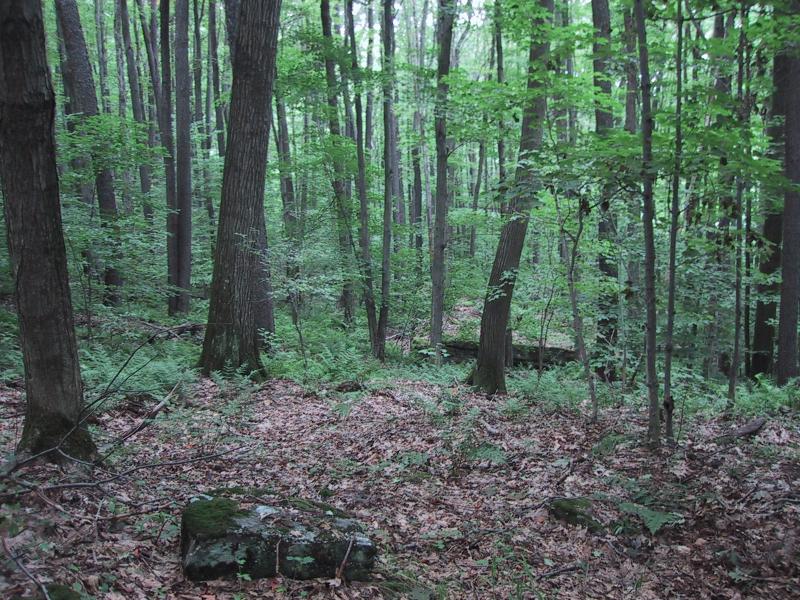
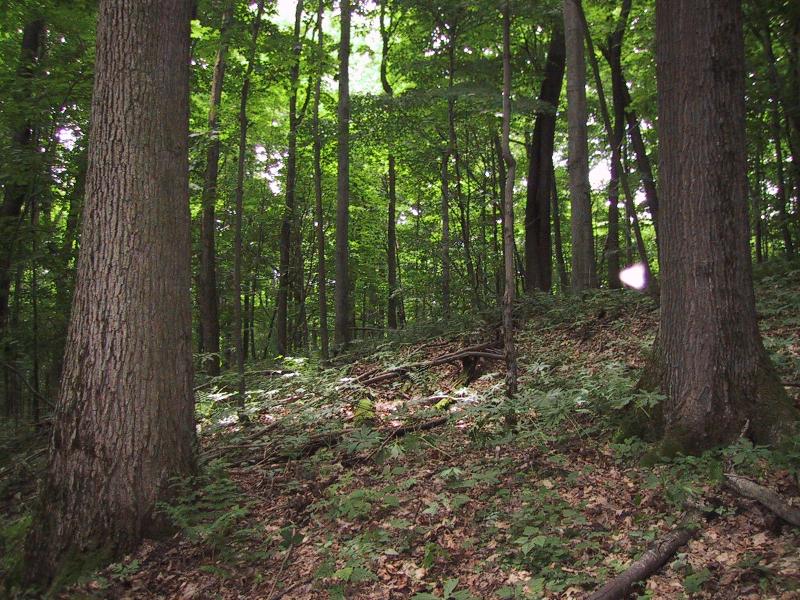
Rich mesophytic forest at Rock City State Forest.
DJ Evans
- System
- Terrestrial
- Subsystem
- Forested Uplands
- State Protection
- Not Listed
Not listed or protected by New York State.
- Federal Protection
- Not Listed
- State Conservation Status Rank
- S2S3
Imperiled or Vulnerable in New York - Very vulnerable, or vulnerable, to disappearing from New York, due to rarity or other factors; typically 6 to 80 populations or locations in New York, few individuals, restricted range, few remaining acres (or miles of stream), and/or recent and widespread declines. More information is needed to assign either S2 or S3.
- Global Conservation Status Rank
- G4
Apparently Secure globally - Uncommon in the world but not rare; usually widespread, but may be rare in some parts of its range; possibly some cause for long-term concern due to declines or other factors.
Summary
Did you know?
Black bugbane, or black cohosh (Cimicifuga racemosa), a common plant of rich mesophytic forests, has long been used as an herbal medicine to relieve inflammation, and for a variety of conditions that afflict women. Native tribes of eastern North America were known to use this plant in teas for soaking, or in a combination with other herbs as an oral medicine. Early settlers used black cohosh to treat menstrual symptoms, to relieve pain in childbirth, and as an anti-inflammatory agent against arthritis, rheumatism, and lung and nervous disorders. It is now commonly used in Europe to relieve symptoms associated with menopause, and is considered to be an effective alternative to hormone-replacement therapy.
State Ranking Justification
There are probably a few hundred occurrences statewide. A few documented occurrences have good viability and a few are protected on public land or private conservation land. This community has a limited statewide distribution and includes a few large, high quality examples. The current trend of this community is probably stable for occurrences on public land, or declining slightly elsewhere due to moderate threats related to development pressure and logging.
Short-term Trends
The number and acreage of rich mesophytic forests in New York have probably declined in recent decades as result of clearing for agriculture and development.
Long-term Trends
The number and acreage of rich mesophytic forests in New York have probably declined substantially from historical numbers likely correlated with the onset of agricultural and development.
Conservation and Management
Threats
Threats to forests in general include changes in land use (e.g., clearing for development), forest fragmentation (e.g., roads), and invasive species (e.g., insects, diseases, and plants). Other threats may include over-browsing by deer, fire suppression, and air pollution (e.g., ozone and acidic deposition). When occurring in expansive forests, the largest threat to the integrity of rich mesophytic forests are activities that fragment the forest into smaller pieces. These activities, such as road building and other development, restrict the movement of species and seeds throughout the entire forest, an effect that often results in loss of those species that require larger blocks of habitat (e.g., black bear, bobcat, certain bird species). Additionally, fragmented forests provide decreased benefits to neighboring societies from services these societies often substantially depend on (e.g., clean water, mitigation of floods and droughts, pollination in agricultural fields, and pest control) (Daily et al. 1997). Rich mesophytic forests are threatened by development (e.g., residential, agricultural, industrial), either directly within the community or in the surrounding landscape. Other threats include habitat alteration (e.g., roads, excessive logging, mining, plantations, deer over-browsing), and recreational overuse (e.g., hiking trails, ATVs, trash dumping, camping). A few rich mesophytic forests are threatened by invasive species, such as garlic mustard (Alliaria petiolata) and Japanese barberry (Berberis thunbergii). American beech (Fagus grandifolia) trees in this community are threatened by the following diseases: 1) Beech Bark Disease causes significant mortality and defect in American beech. The disease results when bark, attacked and altered by the beech scale (Cryptococcus fagisuga), is invaded and killed by fungi, primarily Nectria coccinea var. faginata and sometimes N. galligena (Houston and O'Brien 1983). This disease is common across New York State (NYS DEC); 2) Beech Leaf Disease was first discovered in 2012 from northeastern Ohio (Ewing et al. 2019). The disease was first observed in New York in 2018 in Chautauqua County and was found in Suffolk and Nassau counties in 2019 (NYS DEC). It has since spread throughout western, central, and southern NY (NYS DEC). The foliar nematode Litylenchus crenatae ssp. mcannii is responsible for beech leaf disease and is believed to be non-native in North America (Carta et al. 2020, Reed et al. 2020). Beech leaf disease can kill beech trees of all ages though younger trees appear to die more quickly (NYS DEC). The emerald ash borer (Agrilus planipennis) is an Asian beetle that infests and kills North American ash trees. All native ash trees are susceptible, including white ash, green ash, and black ash. In New York, emerald ash borer has been found mostly south of the Adirondack Mountains, but in 2017 it was recorded in Franklin and St. Lawrence Counties. Natural communities dominated or co-dominated by ash trees would likely be most impacted by emerald ash borer invasion.
Conservation Strategies and Management Practices
Management should focus on activities that help maintain regeneration of the species associated with this community. Deer have been shown to have negative effects on forest understories (Miller et al. 1992, Augustine & French 1998, Knight 2003) and management efforts should strive to ensure that regenerating trees and shrubs are not so heavily browsed that they cannot replace overstory trees. Avoid cutting old-growth examples and encourage selective logging in areas that are under active forestry.
Development and Mitigation Considerations
Strive to minimize fragmentation of large forest blocks by focusing development on forest edges, minimizing the width of roads and road corridors extending into forests, and designing cluster developments that minimize the spatial extent of the development. Development projects with the least impact on large forests and all the plants and animals living within these forests are those built on brownfields or other previously developed land. These projects have the added benefit of matching sustainable development practices (for example, see: The President's Council on Sustainable Development 1999 final report, US Green Building Council's Leadership in Energy and Environmental Design certification process at http://www.usgbc.org/).
Inventory Needs
Inventory any remaining large and/or old-growth examples. Continue searching for large sites in good condition (A- to AB-ranked).
Research Needs
Research the composition of rich mesophytic forests in glaciated and unglaciated settings in order to characterize variations.
Rare Species
- Agrimonia rostellata (Woodland Agrimony) (guide)
- Aplectrum hyemale (Puttyroot) (guide)
- Blera pictipes (Painted Wood Fly) (guide)
- Botrychium oneidense (Blunt-lobed Grape Fern) (guide)
- Cardamine douglassii (Purple Spring Cress) (guide)
- Carex careyana (Carey's Sedge) (guide)
- Carex jamesii (James' Sedge) (guide)
- Chamaelirium luteum (Fairywand) (guide)
- Cypripedium candidum (Small White Lady's Slipper) (guide)
- Cystopteris protrusa (Lowland Fragile Fern) (guide)
- Endodeca serpentaria (Virginia Snakeroot) (guide)
- Eurycea longicauda (Longtail Salamander) (guide)
- Haliaeetus leucocephalus (Bald Eagle) (guide)
- Hydrangea arborescens (Wild Hydrangea) (guide)
- Jeffersonia diphylla (Twinleaf) (guide)
- Lasiurus borealis (Eastern Red Bat) (guide)
- Lindbergia brachyptera (Papillose Fine-branch Moss) (guide)
- Monarda clinopodia (Basilbalm) (guide)
- Myotis lucifugus (Little Brown Bat) (guide)
- Myotis septentrionalis (Northern Long-eared Bat) (guide)
- Perimyotis subflavus (Tri-colored Bat) (guide)
- Pieris virginiensis (West Virginia White) (guide)
- Poa sylvestris (Forest Blue Grass) (guide)
- Protonotaria citrea (Prothonotary Warbler) (guide)
- Pseudotaxiphyllum distichaceum (Two-ranked moss) (guide)
- Setophaga cerulea (Cerulean Warbler) (guide)
- Symphyotrichum oolentangiense (Sky-blue Aster) (guide)
- Triphora trianthophora (Nodding Pogonia) (guide)
Range
New York State Distribution
In New York, rich mesophytic forests are primarily restricted to the unglaciated portion of the Appalachian Plateau in Cattaraugus and Chautauqua counties. However, examples are also known from the Great Lakes Plain within the Eastern Ontario Till Plain in Monroe County, and within the Cattaraugus Finger Lakes Moraine and Hills in Tompkins County. New York is at the northern extreme of the range that extends south along the Appalachians to approximately North Carolina and Tennessee where the richer southern type is known as a "cove hardwood forest."
Global Distribution
This forest is found in the High Alleghenies, Western Allegheny Plateau, Central Appalachians, and Cumberlands from New York and New Jersey south to West Virginia, Virginia, and eastern Kentucky.
Best Places to See
- Zoar Valley Multiple Use Area
- Allegany State Park
Identification Comments
General Description
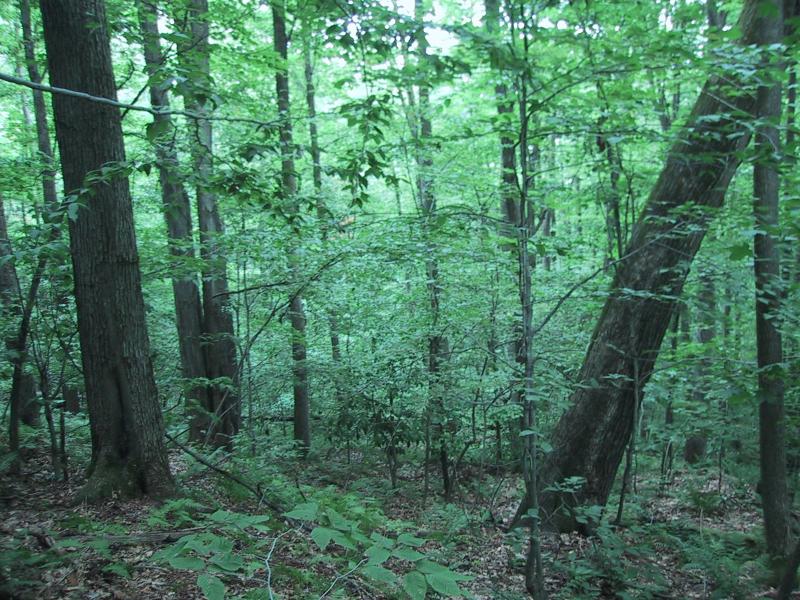
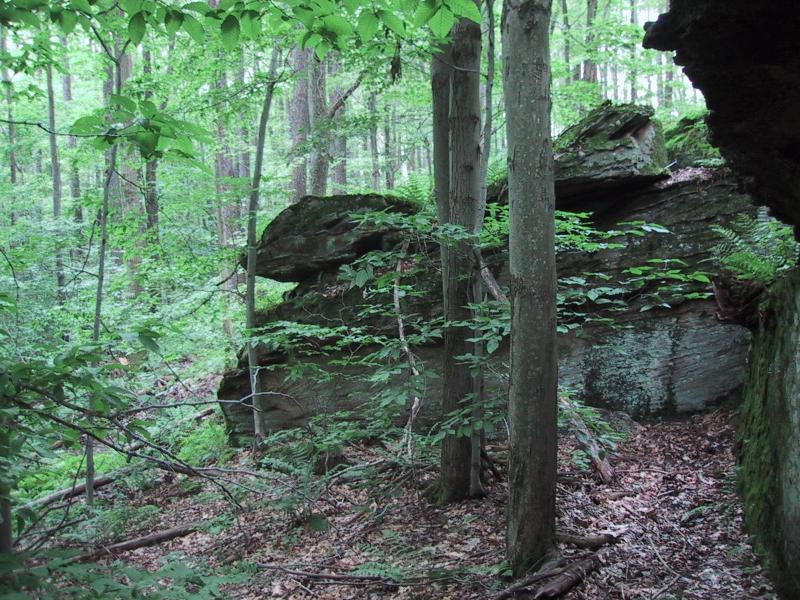
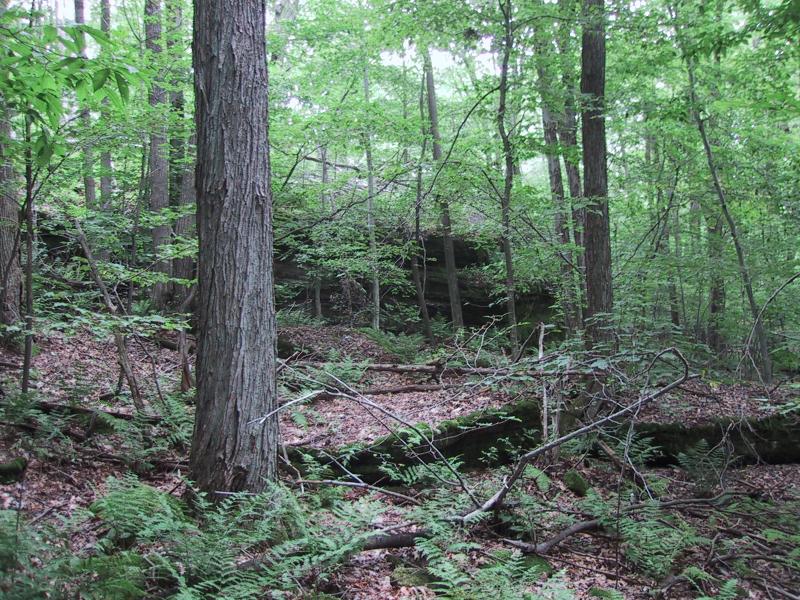
Rich mesophytic forest communities are hardwood or mixed forests that resemble the mixed mesophytic forests of the Allegheny Plateau south of New York, but are slightly less diverse. This community occurs on rich, fine-textured soils that are favorable for the dominance of a wide variety of tree species. Canopy codominants of at least five species, a well developed, diverse shrub layer, and a relatively rich herbaceous layer are characteristic of rich mesophytic forests. In New York, rich mesophytic forests are best developed in the unglaciated portions of the Allegheny Plateau. In Cattaraugus County, New York this forest typically occurs at mid to upper elevations (Edinger et al. 2002).
Characters Most Useful for Identification
A canopy with a large number of codominant species helps identify this forest. Cucumber magnolia (Magnolia acuminata) is characteristic of this community type and is sometimes codominant in the canopy. Canopy codominants include five or more of the following species: red oak (Quercus rubra) red maple (Acer rubrum), white ash (Fraxinus americana), American beech (Fagus grandifolia), sugar maple (Acer saccharum), black cherry (Prunus serotina), cucumber tree (Magnolia acuminata), and black birch (Betula lenta). The shrub layer is well developed, and the herb layer is rich and includes some southern Appalachian species such as yellow mandarin (Disporum lanuginosum), running strawberry bush (Euonymus obovatus), and black bugbane (Cimicifuga racemosa).
Elevation Range
Known examples of this community have been found at elevations between 300 feet and 2,362 feet.
Best Time to See
Because the key to distinguishing a rich mesophytic forest from related types is its vascular plant composition and diversity, it is easiest to identify the community during the growing season, from late May through summer. Striking seasonal leaf color can be enjoyed in the fall.
Rich Mesophytic Forest Images
DJ Evans
DJ Evans
DJ Evans
DJ Evans
DJ Evans
Classification
International Vegetation Classification Associations
This New York natural community encompasses all or part of the concept of the following International Vegetation Classification (IVC) natural community associations. These are often described at finer resolution than New York's natural communities. The IVC is developed and maintained by NatureServe.
- Sugar Maple - White Ash - American Basswood - Tuliptree / Black Baneberry Forest (CEGL006237)
NatureServe Ecological Systems
This New York natural community falls into the following ecological system(s). Ecological systems are often described at a coarser resolution than New York's natural communities and tend to represent clusters of associations found in similar environments. The ecological systems project is developed and maintained by NatureServe.
- Southern and Central Appalachian Cove Forest (CES202.373)
Characteristic Species
-
Trees > 5m
- Acer rubrum var. rubrum (common red maple)
- Acer saccharum (sugar maple)
- Betula lenta (black birch)
- Fagus grandifolia (American beech)
- Fraxinus americana (white ash)
- Magnolia acuminata (cucumber tree, cucumber magnolia)
- Prunus serotina var. serotina (wild black cherry)
- Quercus rubra (northern red oak)
-
Shrubs 2 - 5m
- Acer pensylvanicum (striped maple)
- Acer spicatum (mountain maple)
- Carpinus caroliniana ssp. virginiana (musclewood, ironwood, American hornbeam)
- Castanea dentata (American chestnut)
- Corylus cornuta ssp. cornuta (beaked hazelnut)
- Hamamelis virginiana (witch-hazel)
- Sambucus racemosa (red elderberry)
-
Shrubs < 2m
- Euonymus obovatus (running strawberry-bush)
- Rubus allegheniensis (common blackberry)
-
Herbs
- Actaea pachypoda (white baneberry, doll's-eyes)
- Actaea racemosa (black cohosh, black snakeroot, bug-bane)
- Ageratina altissima var. altissima (common white snakeroot)
- Allium tricoccum var. tricoccum (common wild leek)
- Brachyelytrum erectum (southern shorthusk)
- Carex appalachica (Appalachian sedge)
- Carex debilis var. rudgei (Rudge's sedge)
- Carex leptonervia (northern woodland sedge)
- Carex pensylvanica (Pennsylvania sedge)
- Carex rosea (common upland star sedge)
- Caulophyllum thalictroides (blue cohosh, late blue cohosh)
- Cinna latifolia (drooping wood-reed)
- Clintonia borealis (blue bead-lily)
- Dendrolycopodium obscurum (flat-branched tree-clubmoss)
- Dennstaedtia punctilobula (hay-scented fern)
- Dryopteris intermedia (evergreen wood fern, fancy wood fern, common wood fern)
- Eurybia divaricata (white wood-aster)
- Hepatica acutiloba (sharp-lobed hepatica)
- Huperzia lucidula (shining firmoss)
- Lysimachia borealis (starflower)
- Milium effusum var. cisatlanticum (millet grass)
- Monotropa uniflora (Indian-pipe)
- Polygonatum biflorum var. biflorum (small Solomon's-seal)
- Polystichum acrostichoides (Christmas fern)
- Prosartes lanuginosa (yellow mandarin)
- Uvularia sessilifolia (wild-oats, sessile-leaved bellwort)
- Viola rotundifolia (early yellow violet)
Similar Ecological Communities
- Allegheny oak forest
(guide)
Allegheny oak forest is also restricted to western New York and best developed in the unglaciated Allegheny Plateau region of the state. Allegheny oak forest is a summit and south-facing, upper slope community type. Rich mesophytic forest can be distinguished from Allegheny oak by the lack of chestnut oak (Quercus montana) and the lack of, or very low density of, black oak (Quercus velutina). The short shrub layer of Allegheny oak forest is typically dominated by heaths such as blueberry (Vaccinium pallidum), whereas the shrub layer of rich mesophytic forest is a mix of tree seedlings, saplings, and tall shrub species.
- Beech-maple mesic forest
(guide)
Rich mesophytic forest can be distinguished from beech-maple mesic forest by the predominance of rich herbs that include some southern species (yellow mandrin, running strawberry bush, black bugbane), and by the circumneutral fine textured soils. Beech-maple mesic forest communities, in contrast, generally occur on more acidic soils.
- Maple-basswood rich mesic forest
(guide)
Rich mesophytic forest can be distinguished from maple-basswood rich mesic forest by the presence of trees such as cucumber magnolia (Magnolia acuminata) and rich herbs including some southern Appalachian species, such as yellow mandarin (Disporum lanuginosum), running strawberry bush (Euonymus obovatus), and black bugbane (Cimicifuga racemosa).
- Oak-tulip tree forest
(guide)
Oak-tulip tree forests are found on moist, well drained sites in southeastern New York and have not been documented in western New York. Tulip tree (Liriodendron tulipifera) is typically codominant in oak-tulip tree forests and only rarely occurs in rich mesophytic forests in New York.
Vegetation
Percent cover
This figure helps visualize the structure and "look" or "feel" of a typical Rich Mesophytic Forest. Each bar represents the amount of "coverage" for all the species growing at that height. Because layers overlap (shrubs may grow under trees, for example), the shaded regions can add up to more than 100%.
Additional Resources
References
Braun, E. Lucy. 1950. Deciduous forests of Eastern North America. Macmillan Publ. Co. Inc., New York, N.Y.
Carta L.K, Z.A. Handoo, L. Shiguang, M. Kantor, G. Bauchan, D. McCann, C.K. Gabriel, Q. Yu, S. Reed, J. Koch, D. Martin, and D.J. Burke. 2020. Beech leaf disease symptoms caused by newly recognized nematode subspecies Litylenchus crenatae mccannii (Anguinata) described from Fagus grandifolia in North America. Forest Pathology, 50: e12580. https://doi.org/10.1111/efp.12580
Eaton, S.W. and E.F. Schrot. 1987. A flora of the vascular plants of Cattaraugus County, New York. Bull. Buffalo Society Natural Sci. 31: 1-235.
Edinger, G. J., D. J. Evans, S. Gebauer, T. G. Howard, D. M. Hunt, and A. M. Olivero (editors). 2014. Ecological Communities of New York State. Second Edition. A revised and expanded edition of Carol Reschke’s Ecological Communities of New York State. New York Natural Heritage Program, New York State Department of Environmental Conservation, Albany, NY. https://www.nynhp.org/ecological-communities/
Edinger, Gregory J., D.J. Evans, Shane Gebauer, Timothy G. Howard, David M. Hunt, and Adele M. Olivero (editors). 2002. Ecological Communities of New York State. Second Edition. A revised and expanded edition of Carol Reschke's Ecological Communities of New York State. (Draft for review). New York Natural Heritage Program, New York State Department of Environmental Conservation. Albany, NY. 136 pp.
Ewing C.J., C.E. Hausman, J. Pogacnik, J. Slot, and P. Bonello. 2019. Beech leaf disease: An emerging forest epidemic. Forest Pathology 49: e12488. https://doi.org/10.1111/efp.12488
Gordon, R.B. 1937. The primeval forest types of southwestern New York. New York State Museum Bull. No. 321, Albany, NY.
New York Natural Heritage Program. 2024. New York Natural Heritage Program Databases. Albany, NY.
Reed, S.E., S. Greifenhagen, Q. Yu, A. Hoke, D.J. Burke, L.K. Carta, Z.A. Handoo, M.R. Kantor, and J. Koch. 2020. Foliar nematode, Litylenchus crenatae ssp. mccannii, population dynamics in leaves and buds of beech leaf disease-affected trees in Canada and the US. Forest Pathology, 50: e12599. https://doi.org/10.1111/efp.12599
Reschke, Carol. 1990. Ecological communities of New York State. New York Natural Heritage Program, New York State Department of Environmental Conservation. Latham, NY. 96 pp. plus xi.
Shanks, R.E. 1966. An ecological survey of the vegetation of Monroe County, New York. Proc. Rochester Academy Sci. 11:108-252.
Links
About This Guide
This guide was authored by: D.J. Evans
Information for this guide was last updated on: December 1, 2023
Please cite this page as:
New York Natural Heritage Program. 2024.
Online Conservation Guide for
Rich mesophytic forest.
Available from: https://guides.nynhp.org/rich-mesophytic-forest/.
Accessed April 20, 2024.